By Boris Branisa, Correo del Sur:
Why does comparing Bolivia’s GDP per capita with that of our neighbors matter?
 GDP per capita
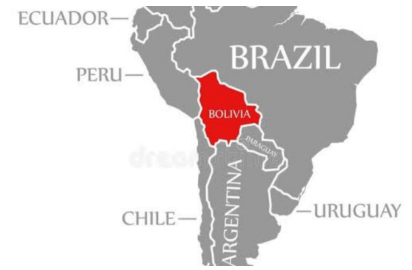
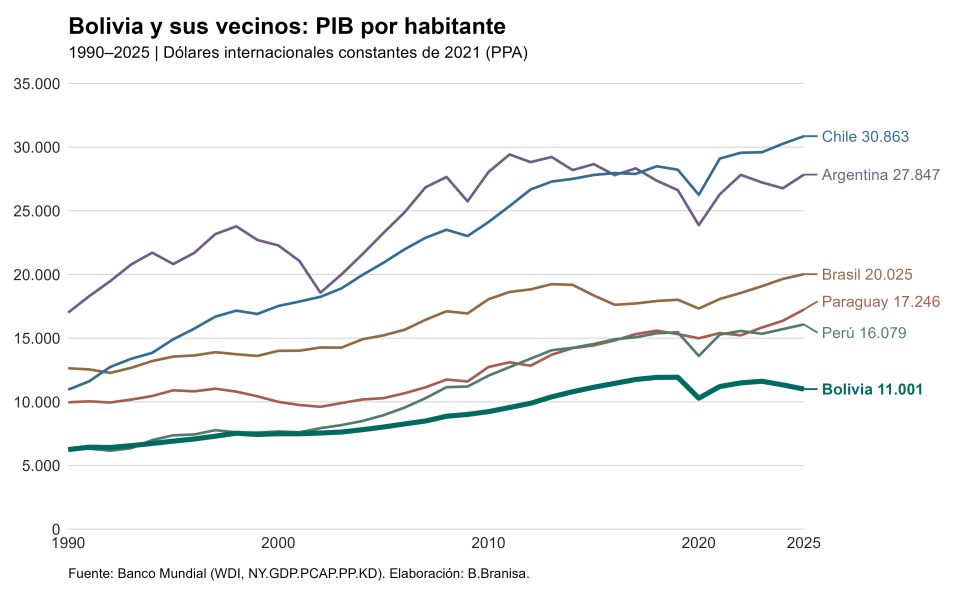
Thirty-five years passed between 1990 and 2025. Bolivia changed, and some aspects of its population’s living conditions improved. However, the economic picture compared with our five neighboring countries (Argentina, Brazil, Chile, Paraguay, and Peru) is unsatisfactory. We still have the lowest Gross Domestic Product (GDP) per capita among the six. In 1990, Bolivia and Peru started from similar levels; today, Peru is considerably ahead of us. After three and a half decades, I find it difficult to conclude that we have made sufficient progress.
Amid the current crisis, economic debate is understandably focused on stabilization. Foreign currency shortages, fiscal imbalances, and inflation affect families and businesses. Restoring the conditions needed to invest and produce is urgent. But we could overcome the crisis only to discover, a few years later, that our position relative to our neighbors has barely improved.
I propose looking another 35 years ahead, to 2060. Will we be able to narrow these gaps? A child starting school in 2027 will be around forty years old by then. Their opportunities will depend on decisions about education, investment, and production that we must make today.
I have never believed that development can be measured by income alone. During my doctoral studies at the University of Göttingen, under the supervision of Stephan Klasen, I explored in greater depth an approach that considers the different dimensions of well-being. Klasen had earned his doctorate at Harvard, where Amartya Sen, later awarded the Nobel Prize in Economics, was his doctoral advisor. Sen understands development as an expansion of people’s real freedoms and opportunities. From this perspective, we must recognize Bolivia’s progress in life expectancy, education, and access to basic services.
Why, then, focus this article on GDP per capita? Because a more productive economy can pay workers higher wages, expand employment opportunities, and finance better public services. GDP does not measure all aspects of well-being, but it helps us compare our economic trajectory with that of our neighbors.
In 1990, Bolivia and Peru had similar GDP per capita figures, close to 6,300 international dollars. By 2025, Peru had reached approximately 16,100 dollars, while Bolivia stood at 11,000. We also lost ground relative to Chile: our GDP per capita fell from 57% of Chile’s to 36%. The gaps with Argentina, Brazil, and Paraguay narrowed somewhat, without changing our position as the country with the lowest income per capita among the six. The gap with Peru, the country closest to Bolivia in GDP per capita in 1990, widened particularly during the first decade of this century.
We know many of the problems: insufficient investment, educational shortcomings, high levels of informality, institutions that make entrepreneurship difficult, and an economy that is overly dependent on natural resources. The natural gas boom helped finance public spending, but we failed to develop enough alternative export activities to sustain growth when gas production declined. Restoring macroeconomic stability is essential, but it will not be enough.
Over the coming decades, we will have to adapt to three major transformations: population aging, climate change and the energy transition, and artificial intelligence (AI).
Bolivia remains a relatively young country, but its population is aging faster than we tend to recognize. According to census data, the median age rose from 20 in 2001 to 27 in 2024. The proportion of people of working age has also increased. This is known as the “demographic dividend,” a temporary opportunity that we can only take advantage of by creating productive jobs.
As the population ages, the need for pensions, healthcare, and caregiving will increase. Germany and Japan faced this transition with much higher levels of productivity. Bolivia will have far fewer resources to do so. Living longer is an achievement of development; the problem is reaching old age without having created the conditions needed to live with dignity.
Climate change is already affecting production. Droughts, wildfires, and water shortages are becoming increasingly costly. The 2024 fires demonstrated the scale of the problem. Not everything can be explained by climate: land use, burning practices, and the lack of prevention also matter. Adapting will require investment and better decision-making.
The energy transition, driven in part by the effects of climate change, is also transforming fuel and mineral markets. For decades, we depended on natural gas exports. The decline in gas production should serve as a warning when evaluating new opportunities, such as lithium and other minerals. Having a mineral resource does not guarantee that extracting or processing it domestically will be profitable. Costs, technology, and markets all matter.
There is one opportunity that deserves attention: reliable and competitive electricity for domestic production, making use of renewable energy sources. Electrification could change comparative advantages. We should assess both its potential for export and its use in boosting our productivity.
AI introduces another uncertainty. It can reduce costs, facilitate access to knowledge, and create opportunities to export services. However, it could also widen the gap between countries if more advanced economies adopt these technologies more rapidly through better-trained workers, infrastructure, and businesses.
In Bolivia, where much of the workforce is employed informally and has low productivity, adoption will not be easy. AI could help small businesses improve their management and find customers, but many lack the connectivity and knowledge needed to take advantage of it. No tool will solve, on its own, problems that have accumulated over decades.
Education will be decisive. We have spent a long time discussing coverage and access; we must pay much more attention to quality, particularly in reading, mathematics, science, and problem-solving. We will also need to keep learning throughout our working lives. What a young person studies today will hardly be enough to prepare them for working in 2050.
We do not know what Bolivia’s main exports will be in 2060. Some could be related to minerals, food, tourism, or services that are only beginning to develop today. It would be unwise to base our entire strategy on a single natural resource or decide now which industries must exist 35 years from today.
We can create the conditions for new activities to emerge and thrive: economic and social stability, quality education, better infrastructure, trade openness, reliable institutions, and rules that encourage investment and competition. This requires agreements that survive changes in government, as well as the ability to evaluate policies and correct mistakes. Our experience shows how difficult it is to maintain that continuity.
In 2060, we will once again compare Bolivia’s GDP per capita with that of our five neighbors. I would like to see much smaller gaps and better living conditions for our population.
Overcoming the current economic crisis will be an important achievement, and it will take time. But if, another 35 years from now, Bolivia is still considerably poorer than its neighbors, we will have done far too little with the great opportunities we still have.
The author is an economist and a member of the Geneva Club.
Por Boris Branisa Caballero, Correo del Sur:
¿Por qué importa comparar el PIB por habitante de Bolivia con el de nuestros vecinos?
PIB por habitante
Entre 1990 y 2025 transcurrieron 35 años. Bolivia cambió y mejoraron algunos aspectos de las condiciones de vida de su población. Pero el balance económico frente a nuestros cinco vecinos (Argentina, Brasil, Chile, Paraguay y Perú) es insatisfactorio. Seguimos teniendo el menor Producto Interno Bruto (PIB) por habitante de los seis. En 1990, Bolivia y Perú partían de niveles similares; hoy Perú nos aventaja considerablemente. Después de tres décadas y media, me cuesta concluir que hayamos avanzado lo suficiente.
En medio de la crisis actual, la discusión económica se concentra, con razón, en la estabilización. La escasez de divisas, los desequilibrios fiscales y la inflación afectan a familias y empresas. Recuperar condiciones para invertir y producir es urgente. Pero podemos superar la crisis y descubrir, algunos años después, que nuestra posición respecto de los vecinos apenas ha mejorado.
Propongo mirar otros 35 años hacia adelante, hasta 2060. ¿Podremos reducir esas diferencias? Un niño que comience la escuela en 2027 tendrá alrededor de cuarenta años entonces. Sus oportunidades dependerán de decisiones sobre educación, inversión y producción que debemos tomar en el presente.
Nunca he considerado que el desarrollo pueda medirse únicamente por el ingreso. Durante mi doctorado en la Universidad de Göttingen, bajo la dirección de Stephan Klasen, profundicé en una perspectiva que presta atención a las distintas dimensiones del bienestar. Klasen se había doctorado en Harvard, donde Amartya Sen, posteriormente Premio Nobel de Economía, fue su director de tesis. Sen entiende el desarrollo como una ampliación de las libertades y oportunidades reales de las personas. Desde esa perspectiva, debemos reconocer los avances de Bolivia en esperanza de vida, educación y acceso a servicios básicos.
¿Por qué concentrar, entonces, este artículo en el PIB por habitante? Porque una economía más productiva puede pagar mejores remuneraciones a los trabajadores, ampliar las oportunidades laborales y financiar mejores servicios públicos. El PIB no mide todo el bienestar, pero ayuda a comparar nuestra trayectoria económica con la de nuestros vecinos.
En 1990, Bolivia y Perú tenían un PIB por habitante cercano a 6.300 dólares internacionales. En 2025, Perú alcanzó aproximadamente 16.100 dólares y Bolivia 11.000. Frente a Chile también perdimos terreno: nuestro PIB por habitante pasó de representar el 57% del chileno al 36%. Con Argentina, Brasil y Paraguay las diferencias se redujeron algo, sin alterar nuestra posición como el país de menor ingreso por habitante entre los seis. La separación respecto de Perú, el país más cercano en cuanto a PIB por habitante en 1990, se acentuó especialmente durante la primera década de este siglo.
Conocemos buena parte de nuestros problemas: inversión insuficiente, deficiencias educativas, elevada informalidad, instituciones que dificultan el emprendimiento y una economía demasiado dependiente de los recursos naturales. La bonanza del gas permitió financiar gasto público, pero no desarrollamos suficientes actividades exportadoras alternativas para sostener el crecimiento cuando cayó su producción. Recuperar la estabilidad macroeconómica es indispensable, pero no será suficiente.
En las próximas décadas tendremos que adaptarnos a tres grandes transformaciones: el envejecimiento de la población, el cambio climático y la transición energética, y la inteligencia artificial (IA).
Bolivia sigue siendo un país relativamente joven, pero envejece más rápido de lo que solemos reconocer. Según los censos, la edad mediana de la población pasó de 20 años en 2001 a 27 en 2024. También aumentó la proporción de personas en edad de trabajar. Es el llamado ‘bono demográfico’, una oportunidad temporal que solo podremos aprovechar con empleos productivos.
Con el envejecimiento aumentarán las necesidades de pensiones, atención médica y cuidados. Alemania y Japón afrontaron esa transición con una productividad mucho mayor. Bolivia tendrá muchos menos recursos para hacerlo. Vivir más años es un logro del desarrollo; el problema es llegar a edades avanzadas sin haber generado condiciones para vivir dignamente.
El cambio climático ya afecta la producción. Las sequías, los incendios y la falta de agua tienen costos crecientes. Los incendios de 2024 mostraron la magnitud del problema. No todo se explica por el clima: el uso del suelo, las quemas y la falta de prevención también importan. Adaptarnos exigirá inversiones y mejores decisiones.
La transición energética, asociada a los efectos del cambio climático, por su parte, está modificando los mercados de combustibles y minerales. Durante décadas dependimos de las exportaciones de gas natural. La caída de su producción debería advertirnos al evaluar nuevas oportunidades, como el litio y otros minerales. Contar con un mineral no garantiza que sea rentable explotarlo ni procesarlo dentro del país. Importan los costos, la tecnología y los mercados.
Hay una oportunidad que merece atención: electricidad confiable y competitiva para producir dentro del país, aprovechando fuentes renovables. La electrificación puede cambiar las ventajas comparativas. Debemos evaluar tanto su posible exportación como su uso para aumentar nuestra productividad.
La IA introduce otra incertidumbre. Puede reducir costos, facilitar el acceso al conocimiento y abrir oportunidades para exportar servicios. Pero también puede ampliar las diferencias entre países si las economías más avanzadas en cuanto a trabajadores, infraestructura y empresas incorporan estas tecnologías más rápidamente.
En Bolivia, donde buena parte del empleo es informal y de baja productividad, su adopción no será sencilla. La IA puede ayudar a negocios pequeños a mejorar su gestión y encontrar clientes, pero muchos carecen de conectividad y conocimientos para aprovecharla. Ninguna herramienta resolverá por sí sola problemas que arrastramos desde hace décadas.
La educación será decisiva. Hemos discutido durante mucho tiempo la cobertura y el acceso; debemos prestar más atención a la calidad, especialmente en lectura, matemáticas, ciencias y resolución de problemas. Y tendremos que seguir aprendiendo durante la vida laboral. Lo que hoy estudia un joven difícilmente le alcanzará para trabajar en 2050.
No sabemos cuáles serán las principales exportaciones bolivianas en 2060. Algunas podrían estar relacionadas con minerales, alimentos, turismo o servicios que hoy apenas comienzan a desarrollarse. Sería poco sensato apostar toda nuestra estrategia a un recurso natural o decidir desde ahora qué industrias deberán existir dentro de 35 años.
Podemos crear condiciones para que surjan y prosperen nuevas actividades: estabilidad económica y social, educación de calidad, mejor infraestructura, apertura comercial, instituciones confiables y reglas que favorezcan la inversión y la competencia. Esto exige acuerdos que sobrevivan a los cambios de gobierno, además de capacidad para evaluar políticas y corregir errores. Nuestra experiencia muestra cuánto cuesta mantener esa continuidad.
En 2060 volveremos a comparar el PIB por habitante de Bolivia con el de nuestros cinco vecinos. Me gustaría encontrar entonces diferencias mucho menores y mejores condiciones de vida para nuestra población.
Superar la crisis económica actual será un logro importante y nos tomará algún tiempo. Pero si dentro de otros 35 años Bolivia continúa siendo considerablemente más pobre que sus vecinos, habremos hecho demasiado poco con las grandes oportunidades que todavía tenemos.
* Es economista y miembro del Club de Ginebra.
https://correodelsur.com/economia/20261108/pensar-en-la-bolivia-que-queremos-dentro-de-35-anos.html


Leave a Reply