By Andrés Gómez, Facebook:
The War Begins with a Job Offer
Economic desperation is turning young Bolivians into targets of alleged recruitment networks for the conflict between Russia and Ukraine.
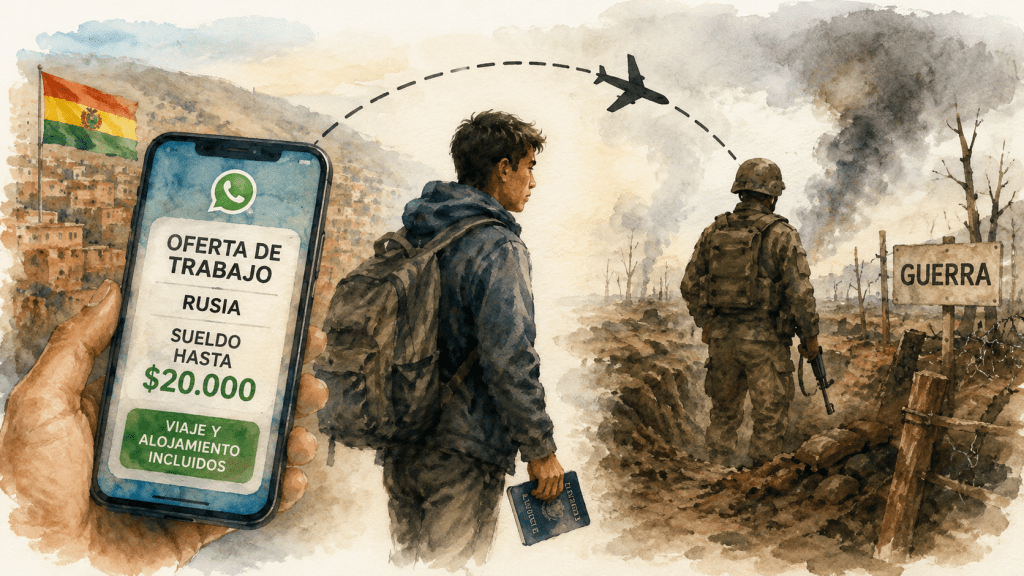
They did not begin by looking for a war; they began by looking for a job. Some answered a WhatsApp message. Others heard the offer from an acquaintance.
They were promised work as construction laborers, drivers, cooks, or logistics personnel in Russia. They were told about salaries unimaginable by Bolivian standards: up to $20,000 through contracts and monthly wages approaching $3,000.
In a country where thousands of young people survive amid unemployment, informality, and migration, that promise seemed like a way out.
But according to investigations opened in Bolivia and international complaints, for some the destination was not a construction site—it was a trench. The worker’s uniform ended up becoming a military uniform.
The Price of Hope
The story is repeated in the testimonies of families. One young Bolivian reportedly accepted an offer to perform “logistics work” during the war. According to his relatives, he was never told that he would end up fighting.
Others received similar offers to work as builders, plumbers, or cooks.
The promise was simple: free travel, accommodation, and the opportunity to earn in a few months what would take years of work in Bolivia.
For families hit hard by the economic crisis, the proposal seemed too good to refuse. Those same families are now desperately searching for news of their sons.
“They Paid for Everything”
The complaints reveal a troubling pattern. A relative of one of the Bolivians taken to Russia claims that once they arrived in the country, their passports were confiscated.
Anyone who tries to return must repay the money invested in airline tickets, medical examinations, immigration procedures, and documentation.
“They paid for everything. We did not even have the resources to obtain a passport,” she said.
The debt then becomes a form of control, and the work trip increasingly resembles a road with no return.
“The Bodies Stayed There”
War often hides death behind statistics, but an audio recording published by El Deber breaks that distance.
A wife received a call between June 27 and June 28.
On the other end was a man who identified himself as her husband’s second commander. There were no diplomatic words—only a brutal statement:
“The bodies stayed over there… they die and nobody rescues them… there are too many dead.”
In modern wars, even recovering the dead can become an impossible privilege.
The Prosecutor’s Office Begins Following the Trail
The complaints have already reached the Public Prosecutor’s Office.
Attorney General Roger Mariaca confirmed the opening of investigations into the alleged recruitment of Bolivians through deception.
In Santa Cruz, prosecutors opened two cases involving alleged human trafficking and migrant smuggling for the purpose of recruitment into armed conflicts.
Alejandra Rocha, senior prosecutor for Crimes Against Life, told Radio Fides that there are initially six alleged victims whose families have already provided testimony.
Evidence includes screenshots of WhatsApp conversations, photographs showing military clothing, and documents supplied by relatives.
Investigators are also attempting to reconstruct migration routes, review financial movements through the Financial System Supervisory Authority (ASFI), request international cooperation, and conduct cyber-patrol operations to identify those who contacted the victims.
The main hypothesis is human trafficking for participation in armed conflicts.
Who Recruits Them?
The answers remain incomplete.
Jorge Santistevan, Secretary of Citizen Security for the Santa Cruz Governor’s Office, told El Deber that a criminal organization may be operating through intermediaries.
According to his statements, they recruit young people through false job offers and then send them into the conflict.
He says they seek young men who are physically fit and capable of enduring the demands of combat.
His statements form part of an investigation that is still ongoing.
Russia Denies Involvement
While Bolivia investigates, Moscow rejects any responsibility.
Russia’s ambassador to Bolivia, Dmitry Verchenko, stated that his diplomatic mission is not involved in any recruitment process.
“We know nothing about this recruitment system. The embassy is absolutely not involved,” he said.
He also stated that he does not know whether Bolivians are fighting in the conflict and said that any such information should be requested from the appropriate Russian ministries.
According to the diplomat, people who participate in war for money are mercenaries, and such individuals exist “all over the world.”
Ukraine Responds Harshly
The reaction from Ukraine’s Embassy in Brazil, which is concurrently accredited to Bolivia, was immediate.
It accused the Russian diplomatic mission of spreading unsubstantiated information by claiming that numerous Bolivians had died fighting on Ukraine’s side.
According to Kyiv, there is currently no confirmed information regarding Bolivian citizens killed while serving in Ukraine’s Armed Forces.
The embassy went further, accusing the Kremlin of using deceptive methods to recruit foreign citizens through false job offers in construction, industry, or services, and then incorporating them into the Russian military.
It also alleged pressure against foreign workers and students to force them to sign military contracts.
As a preventive measure, it urged Bolivian citizens to distrust employment and study offers in Russia related to these sectors, warning of the risk of becoming victims of fraud and forced recruitment.
A Phenomenon That Has Already Affected Other Countries
What Bolivia is investigating today has already left traces elsewhere in Latin America.
In Peru, attorney Marcelo Tataje, who represents affected families, estimates that between 2,000 and 2,500 citizens may have been recruited through false job offers.
According to statements he made to ERBOL, recruits traveled from Colombia through Turkey before entering Russia, where they signed contracts.
So far, only 18 have managed to return.
Dozens of families are still waiting for news about sons, brothers, and husbands. Others are trying to recover bodies that never came home.
The New Face of Mercenarism
For centuries, a mercenary was a soldier who chose to fight for money.
Today, that definition seems insufficient.
The investigations underway in Bolivia point to a different phenomenon. These are not necessarily men seeking war, but men seeking work.
The difference is enormous, because when hunger pushes and unemployment closes every door, the freedom to choose begins to disappear.
War Also Recruits Poverty
The war between Russia and Ukraine is being fought more than 13,000 kilometers from Bolivia.
Yet its consequences seem to have found an unexpected bridge to South America: economic vulnerability.
Crisis turns a WhatsApp message into an opportunity. A salary promise into hope. A passport into a gamble. And, in the worst cases, a job search into a journey toward death.
The investigations are only beginning. There are still no convictions or definitive conclusions regarding the networks that may have operated in Bolivia.
But behind the judicial files, one human certainty is already emerging:
When a country like Bolivia stops offering opportunities to its young people, others end up offering them risks.
And some wars begin long before the first shot is fired; they begin when a young person in need of a paycheck accepts a job that never existed.
Por Andrés Gómez Vela, Facebook:
La guerra empieza con una oferta de trabajo
La desesperación económica convierte a jóvenes bolivianos en blanco de presuntas redes de reclutamiento para el conflicto entre Rusia y Ucrania.
No comenzaron buscando una guerra, comenzaron buscando un empleo. Algunos respondieron un mensaje de WhatsApp. Otros escucharon la oferta de un conocido.
Les prometieron trabajo como albañiles, conductores, cocineros o personal de logística en Rusia. Les hablaron de salarios imposibles para la realidad boliviana: hasta 20.000 dólares por contratos y sueldos mensuales cercanos a los 3.000 dólares.
En un país donde miles de jóvenes sobreviven entre el desempleo, la informalidad y la migración, aquella promesa parecía la puerta de salida.
Pero, según las investigaciones abiertas en Bolivia y las denuncias internacionales, para algunos el destino no era una obra de construcción, era una trinchera. Es decir el uniforme de trabajador terminó convirtiéndose en uniforme militar.
El precio de la esperanza
La historia se repite en los testimonios de las familias. Un joven boliviano habría aceptado una oferta para realizar “trabajos de logística” durante la guerra. Según sus familiares, nunca le dijeron que terminaría combatiendo.
Otros recibieron ofertas similares para desempeñarse como albañiles, plomeros o cocineros.
La promesa era sencilla: viajar gratis, recibir alojamiento, ganar en pocos meses lo que en Bolivia demandaría años de trabajo.
Para familias golpeadas por la crisis económica, la propuesta parecía demasiado buena como para rechazarla. Esas mismas familias buscan ahora desesperadamente noticias de sus hijos.
“Ellos pagaron todo”
Las denuncias revelan un patrón inquietante. Una familiar de uno de los bolivianos trasladados a Rusia asegura que, una vez llegados al país, les retienen los pasaportes.
Quien intenta regresar debe devolver el dinero invertido en pasajes, exámenes médicos, trámites migratorios y documentación. “Ellos pagaron todo. Nosotros no teníamos recursos ni siquiera para sacar el pasaporte”, contó.
La deuda se convierte entonces en una forma de control; y el viaje laboral termina pareciéndose cada vez más a un camino sin retorno.
“Los cuerpos se quedaron allá”
La guerra suele esconder la muerte detrás de estadísticas, pero un audio, difundido por El Deber, rompe esa distancia. Una esposa recibió una llamada entre el 27 y el 28 de junio.
Del otro lado hablaba un hombre que se identificó como el segundo comandante de su esposo. No hubo palabras diplomáticas. Solo una frase brutal: “Los cuerpos se quedaron por allá… se mueren y nadie los rescata… son demasiados muertos”.
En las guerras modernas, incluso recuperar a los muertos puede convertirse en un privilegio imposible.
La Fiscalía comienza a seguir las huellas
Las denuncias ya llegaron al Ministerio Público. El fiscal general del Estado, Roger Mariaca, confirmó la apertura de investigaciones de oficio sobre el presunto reclutamiento de bolivianos mediante engaños.
En Santa Cruz, la Fiscalía abrió dos procesos por presuntos delitos de trata y tráfico de personas con fines de reclutamiento para conflictos armados.
La fiscal superior en Delitos de Vida, Alejandra Rocha, declaró a radio Fides que inicialmente existen seis presuntas víctimas cuyas familias ya prestaron declaraciones.
Las evidencias incluyen capturas de conversaciones por WhatsApp, fotografías con ropa militar y documentación entregada por los familiares.
La investigación también intenta reconstruir las rutas migratorias, revisar movimientos financieros mediante la ASFI, solicitar cooperación internacional y realizar ciberpatrullaje para identificar a quienes contactaban a las víctimas.
La principal hipótesis es trata de personas con fines de participación en conflictos armados.
¿Quién los recluta?
Las respuestas todavía son incompletas. El secretario de Seguridad Ciudadana de la Gobernación de Santa Cruz, coronel Jorge Santistevan, dijo a El Deber que detrás existiría una asociación delictiva que operaría mediante intermediarios.
Según afirmó, captarían jóvenes mediante falsas ofertas laborales para posteriormente enviarlos al conflicto.
Asegura que buscan hombres jóvenes, físicamente aptos y con capacidad para soportar las exigencias del combate. Sus declaraciones forman parte de una investigación que todavía se encuentra en desarrollo.
Rusia niega participación
Mientras Bolivia investiga, Moscú rechaza cualquier responsabilidad. El embajador de Rusia en Bolivia, Dmitry Verchenko, afirmó que su representación diplomática no participa en ningún proceso de reclutamiento.
“No sabemos nada de este sistema de reclutación. La embajada no está involucrada absolutamente”, dijo.
También sostuvo que desconoce si existen bolivianos combatiendo en el conflicto y señaló que cualquier información corresponde ser solicitada a los ministerios competentes de Rusia.
Para el diplomático, quienes participan en la guerra por dinero son mercenarios que existen “en todo el mundo”.
Ucrania responde con dureza
La reacción de la Embajada de Ucrania en Brasil, concurrente para Bolivia, fue inmediata. Acusó a la representación rusa de difundir información sin sustento al afirmar que numerosos bolivianos habrían muerto combatiendo del lado ucraniano.
Según Kiev, hasta la fecha no existe información confirmada sobre ciudadanos bolivianos fallecidos sirviendo en las Fuerzas Armadas de Ucrania.
La representación diplomática fue más allá, acusó al Kremlin de utilizar mecanismos de engaño para captar ciudadanos extranjeros mediante falsas ofertas laborales en construcción, industrias o servicios, y posteriormente incorporarlos al ejército ruso.
También denunció presiones contra trabajadores extranjeros y estudiantes para obligarlos a firmar contratos militares.
Como medida preventiva pidió a los ciudadanos bolivianos desconfiar de ofertas de empleo y estudios en Rusia relacionadas con esos sectores, advirtiendo sobre el riesgo de convertirse en víctimas de fraude y reclutamiento forzoso.
Un fenómeno que ya golpeó a otros países
Lo que hoy investiga Bolivia ya dejó huellas en otros lugares de América Latina.
En Perú, el abogado Marcelo Tataje, representante de familias afectadas, estima que entre 2.000 y 2.500 ciudadanos habrían sido captados mediante falsas ofertas laborales.
Según explicó a ERBOL, los reclutados viajaban desde Colombia pasando por Turquía antes de ingresar a Rusia, donde firmaban contratos.
Hasta ahora apenas 18 lograron regresar. Decenas de familias siguen esperando noticias de hijos, hermanos y esposos. Otras intentan recuperar cuerpos que nunca volvieron.
La nueva cara del mercenarismo
Durante siglos, el mercenario era un soldado que elegía combatir por dinero. Hoy esa definición parece insuficiente. Las investigaciones abiertas en Bolivia apuntan a un fenómeno diferente. No son necesariamente hombres que buscan la guerra, sino hombres que buscan trabajo.
La diferencia es enorme porque cuando el hambre empuja y el desempleo cierra todas las puertas, la libertad para elegir comienza a desaparecer.
La guerra también recluta pobreza
La guerra entre Rusia y Ucrania se libra a más de 13.000 kilómetros de Bolivia. Sin embargo, sus consecuencias parecen haber encontrado un puente inesperado hacia Sudamérica: la vulnerabilidad económica.
La crisis convierte un mensaje de WhatsApp en una oportunidad. Una promesa de salario en una esperanza. Un pasaporte en una apuesta. Y, en los peores casos, una búsqueda de trabajo en un viaje hacia la muerte.
Las investigaciones apenas comienzan. Todavía no existen sentencias ni conclusiones definitivas sobre las redes que habrían operado en Bolivia.
Pero detrás de los expedientes judiciales ya aparece una certeza humana. Cuando un país, como Bolivia, deja de ofrecer oportunidades a sus jóvenes, otros terminan ofreciéndoles riesgos. Y algunas guerras empiezan mucho antes del primer disparo; empiezan cuando un joven que necesita un sueldo acepta un empleo que nunca existió.


Leave a Reply