By Brújula Digital:
Bolivia’s political age crisis: between “old” and “new” politicians, what does renewal really mean?
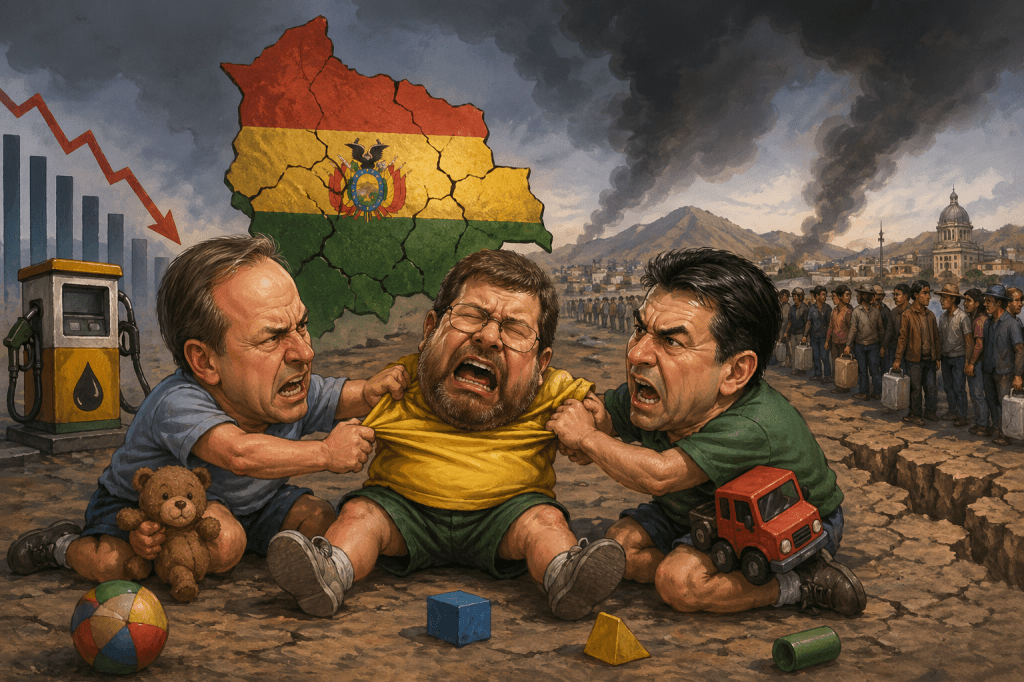
A statement by Minister Zamora sparked backlash among lawmakers and political figures, reopening the debate over old and young faces in politics — but above all, over what true political renewal actually means.

Photo composition with images of Rodrigo Paz, Jorge Quiroga and Samuel Doria Medina / Archive
Throughout nearly two decades of MAS rule, the movement presented itself as the “process of change,” based on the premise that it had replaced the neoliberal model that dominated Bolivia from the mid-1980s until 2005. Several candidates in the 2025 elections promoted themselves as agents of “renewal,” seeking to distinguish themselves from the socialist era. But who are the “old” and “new” figures among today’s authorities and the leaders of the country’s most influential political forces?
The debate began with comments from Public Works Minister Mauricio Zamora, who told Tarija media outlets last Friday: “Mr. Samuel Doria Medina, Mr. Tuto Quiroga and other politicians have already completed their cycle. What we need are new leaders, young people. People are tired of seeing the same faces.” He immediately added: “I believe Rodrigo is the new cycle because he has done what old politicians never did. Rodrigo Paz had the courage to remove fuel subsidies — something I assure you an old politician would never have done.”
The remarks triggered a wide range of reactions on social networks and in the media. Some lawmakers’ views are presented later in this article. But first, two political analysts offer a broader perspective on renewal and continuity, going beyond the issue of age in national politics.
A few facts are worth noting: Rodrigo Paz will turn 59 in a few months. His first government position came during the Banzer administration (1997–2002), when he served as Bolivia’s commercial attaché at the embassy in Spain. He later became a city councilor and mayor of Tarija, and eventually a national legislator. Jorge Quiroga is 66; in 1989 he became deputy secretary for public investment, in 1997 vice president, and between 2001 and 2002 president. Samuel Doria Medina is approaching 68; he was Planning Minister in 1991 and has remained active in politics ever since, including several presidential bids. These are only three of the most prominent leaders in today’s political landscape.
A bridge between generations and a new political wave
Political analyst Ricardo Paz clearly distinguishes between the outgoing generation and the emerging one. However, he first highlights President Rodrigo Paz’s intermediate role, describing him as “a kind of hinge, a bridge, in the generational renewal process. He does not fully belong to the generation that is leaving, but he is not part of the new generation of young leaders either.”
From there, he argues: “There is no doubt that one generation is on its way out and that we are witnessing a change of cycle.” He places in that older group those born “in the late 1950s and early 1960s, who have been active in Bolivian politics throughout this entire period.” He mentions figures such as Evo Morales, Tuto Quiroga and Samuel Doria Medina — leaders now over 65 and approaching 70.
Regarding the future, Ricardo Paz sees promising signs in the early stages of a new political wave. “Without a doubt, there is a new generation emerging, a generational uprising; especially in eastern Bolivia, with a female face: women leading departmental assemblies, municipal councils, serving as deputy governors, governors… and also in the south, where we have a governor in Tarija and a mayor in Sucre. Young people are beginning to shape Bolivia’s generational renewal.”
A debate that is far from new
Political analyst Roger Cortez takes a more conceptual approach. He considers the controversy surrounding Zamora’s comments to have “an aroma of pure vanity,” arguing that the concepts of “new” and “old” in Bolivian politics are shaped by something deeper: “the absence of a stable and solid system of political representation.”
“To speak of something new or old,” he says, “those making that claim must explain what contributions the groups they represent have actually made.” He then asks whether Bolivia is truly experiencing political change and renewal — and answers: only partially.
“In essence, no,” he argues, unless there are proposals to redesign and rethink the mechanisms of political mediation and representation.
Cortez also acknowledges some recent developments, partially agreeing with Paz: “The only truly new thing we see are some winners in the subnational elections (…) expressions seeking fresh and innovative political space, although for now we cannot say they go beyond an aspiration, as in the case of Santa Cruz mayor Manuel Saavedra.”
What do lawmakers say?
Legislators from four political groups offered their own perspectives. Most framed their responses within partisan disputes and directly addressed Zamora’s statements.
Deputy Israel Mérida (Libre)
“How many years has Rodrigo Paz been in politics? Around 25 years, considering all the positions he has held. For them to talk about political renewal is false morality (…) especially when their practices remain the same as before: political deals and placing relatives in key state positions.”
Deputy Esther Góngora (APB-Súmate)
“They have already run several times in previous elections and have failed to win. Their cycle has already ended.”
Deputy Sandra Hinojosa (Unidad)
“I do not know with what authority Minister Zamora speaks, since he comes from Doria Medina’s political movement and does not belong to Paz’s line.”
Deputy Claudia Bilbao (PDC)
“I say this to Doria Medina and Tuto Quiroga: for 20 years they have had lawmakers who never passed a single law (…). They have been unable to build consensus. They must understand that no obstacle will benefit Bolivia.”
BD/RLP/MZS
Por Brújula Digital:
Crisis de edad en la política boliviana: entre “viejos” y “nuevos” políticos, ¿qué de la renovación?
Una declaración del ministro Zamora generó roncha entre legisladores y políticos, y lleva a reflexionar sobre los rostros viejos y jóvenes en la palestra política; pero, ante todo, sobre el criterio de renovación.
Fotocomposición con imágenes de Rodrigo Paz, Jorge Quiroga y Samuel Doria Medina / archivo
Todo el ciclo de casi 20 años del MAS se presentó como el “proceso de cambio” a partir de la premisa de que se renovó el modelo neoliberal que imperó entre mediados de los 80 y 2005. Varios candidatos en las elecciones de 2025 se promovieron como la “renovación”, para, precisamente, marcar diferencia con el periodo del socialismo. ¿Quiénes son viejos, quiénes son nuevos entre las actuales autoridades y líderes de los frentes políticos con mayor peso?
El debate se abrió con una declaración del ministro de Obras Públicas Mauricio Zamora que el viernes pasado sostuvo ante medios tarijeños: “don Samuel Doria Medina, don Tuto Quiroga y otros políticos ya cumplieron su ciclo. Lo que necesitamos es nuevos liderazgos, gente joven. La gente está cansada de lo mismo”. Y de inmediato agregó: “yo pienso que Rodrigo es el nuevo ciclo, porque ha hecho lo que los viejos políticos no han hecho. Rodrigo Paz ha tenido la fortaleza de hacer un levantamiento de la subvención (de combustibles) que, yo les aseguro, un viejo político nunca hubiera hecho”.
Hubo reacciones y respuestas para todo gusto en redes sociales y medios; más adelante ofrecemos algunos criterios de asambleístas. Pero antes, dos analistas políticos dan una lectura general, sobre la renovación y continuismo, más allá de asuntos etarios, en la política nacional.
Antes, solo un par de apuntes: Rodrigo Paz cumplirá 59 años en un par de meses; su primer cargo en política fue en el gobierno de Banzer (1997-2002) cuando fue agregado comercial en la embajada de Bolivia en España; luego fue concejal y alcalde de Tarija, y finalmente, asambleísta nacional. Jorge Quiroga tiene 66 años; en 1989 fue subsecretario de inversión pública; en 1997 vicepresidente y entre 2001 y 2002, presidente. Samuel Doria Medina va rumbo a los 68 años; en 1991 fue ministro de Planeamiento y desde entonces no dejó la política, incluyendo varias candidaturas a la presidencia. Eso por solo nombrar a tres de los más destacados líderes del espectro político actual.
Político bisagra y nueva camada
El analista Ricardo Paz identifica claramente a la generación de salida y a la renovadora. Pero parte por advertir la posición intermedia del presidente Rodrigo Paz que, en su criterio, “es una especie de bisagra, de puente, de la renovación generacional. No es completamente de la generación que se va, pero tampoco es parte de esta nueva camada de dirigencia joven”.
Dicho esto, sentencia: “es indudable que una generación está de salida y estamos viendo un cambio de ciclo”. En el primer grupo ubica a quienes nacieron “a finales de los 50, principios de los 60, que han actuado en la política boliviana durante todo este tiempo (…). Evo Morales, Tuto Quiroga, Samuel Doria Medina… gente que está por encima de los 65 años, acercándose ya a los 70.
Sobre lo que viene, Ricardo Paz tiene una mirada acaso auspiciosa a partir de señales iniciales. “Sin duda alguna hay una nueva camada, una insurgencia generacional; sobre todo en el oriente, y con rostro de mujer: presidentas de asambleas departamentales, de concejos municipales, vicegobernadoras, gobernadoras… y también, en el sur; ahí tenemos una gobernadora en Tarija y una alcaldesa en Sucre; gente joven que está marcando la impronta de la renovación generacional en Bolivia”.
Un debate nada novedoso
Roger Cortez se va más a lo conceptual. Para empezar, considera que el debate en torno a las palabras de Zamora “tiene un aroma a vanidad pura” porque, en su criterio, “lo nuevo y lo viejo (en la política boliviana) están condicionados por algo mucho más sencillo y profundo: la ausencia de un sistema de representación estable y sólido”
“Para hablar de nuevo o de viejo –afirma– quienes lo hacen tienen que señalar cuáles son los aportes de los grupos a los que representan”. Y de inmediato se pregunta y responde: ¿se puede hablar de cambio y renovación en la política boliviana? Muy parcialmente. Y no en el fondo, mientras no haya propuestas de remodelación, de replanteamiento de los mecanismos de mediación y de representación política”.
Tampoco evita, el especialista, alguna mención, y en esto coincide parcialmente con Paz: “lo único nuevo que vemos, son algunos triunfadores en las elecciones subnacionales (…); expresiones que buscan un espacio fresco, novedoso, pero por el momento no podemos decir que vayan más allá de una aspiración, como es el caso del alcalde cruceño (Manuel Saavedra)”.
¿Y qué dicen en la ALP?
Legisladores de cuatro frentes políticos tienen su propio punto de vista sobre el tema. La mayoría parte de una interpretación enmarcada en la disputa partidaria, y responde directamente a las afirmaciones de Zamora.
– Diputado Israel Mérida (Libre)
“¿Cuantos años tiene Rodrigo Paz en la política? 25 años más menos, entre todos los cargos que tuvo. Que vengan a hablar de renovación política, es falsa moral (…). Mas si vemos que sus prácticas son las mismas de antes: cuoteo y poner a familiares en puestos clave del Estado”.
– Diputada Esther Góngora (APB-Súmate)
“Ya en varias oportunidades han postulado (en anteriores elecciones), y no han logrado ganar. Ya han cumplido su ciclo”.
– Diputada Sandra Hinojosa (Unidad)
“No sé con qué atribución habla el ministro (Zamora), ya que él viene del (frente de) Doria Medina, y no pertenece a la línea de Paz”.
– Diputada Claudia Bilbao (PDC)
“Se los digo a Doria Medina y a Tuto Quiroga: en 20 años han tenido parlamentarios que nunca han aprobado ni una ley (…). No han podido hacer consenso, tienen que entender que ninguna tranca va a ser buena para Bolivia”.
BD/RLP/MZS


Leave a Reply