
By Germaine Barriga Velarde, Vision 360:
In four months and seven days of the government of Rodrigo Paz, three female authorities have resigned from their positions.
Margot Ayala, former director of the National Hydrocarbons Agency (ANH), resigned amid the conflict caused by poor-quality gasoline; Andrea Barrientos, former Vice Minister of Autonomies, stepped down due to pressure from the governor of Santa Cruz, Luis Fernando Camacho, and other representatives of that department; Carla Faval resigned today, eight days after announcing the resumption of relations between Bolivia and Chile at the ambassadorial level.
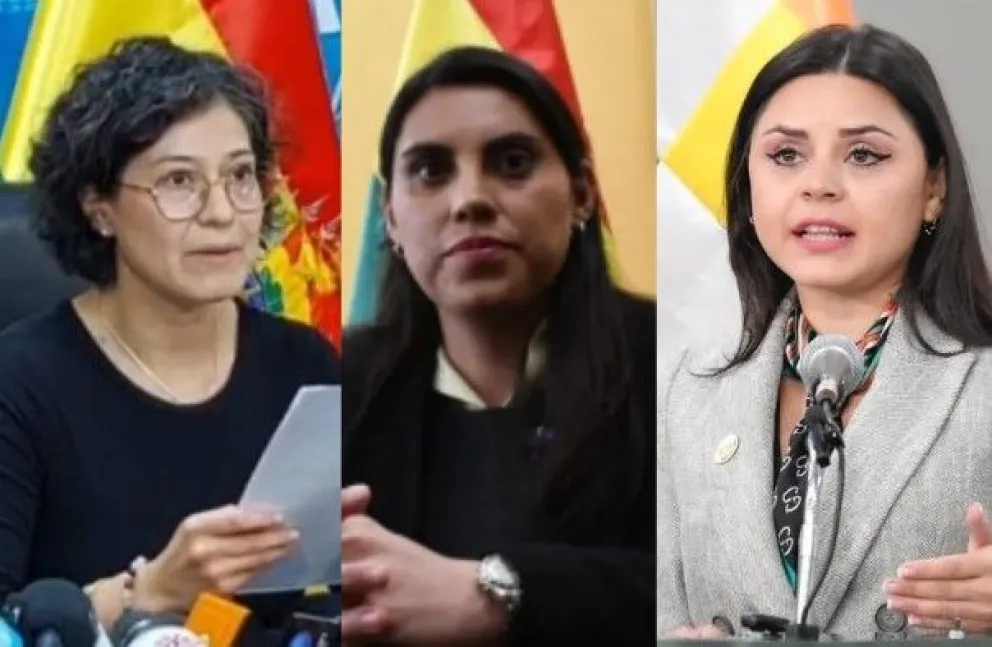
Four months and seven days into Rodrigo Paz’s administration, three female authorities have resigned from their posts. Photo: Composition
Four months and seven days into the administration of Rodrigo Paz, three female officials have resigned from their positions: the first was the director of the National Hydrocarbons Agency (ANH), Margot Ayala; the second was the Vice Minister of Autonomies, Andrea Barrientos; and the third is the presidential spokesperson, Carla Faval.
The first two resignations occurred amid conflicts: in the first case, due to problems caused by the distribution of poor-quality gasoline that allegedly damaged public transport vehicles, according to drivers’ complaints, which forced Ayala to resign in tears and amid corruption allegations during a press conference.
The second resignation was that of Barrientos, who was pressured by the governor of Santa Cruz, Luis Fernando Camacho, an ally of the government, who publicly called for her resignation due to some views she expressed regarding the autonomy process.
This position was supported by several senators, including Branko Marinkovic; the president of the Pro Santa Cruz Civic Committee, Stello Cochamanidis; and the former governor of Beni, Ernesto Suárez, who accused her of being centralist and opposing that department’s aspirations.
Barrientos submitted her resignation letter on the night of March 7, hours before International Women’s Day, which was used by the government to send greetings, without anyone addressing the vice minister’s resignation.
The national leader of the Unidad Alliance, Samuel Doria Medina, welcomed Barrientos’ decision, arguing that she had made a mistake. “Andrea made a mistake that has been magnified because we are in an electoral stage, on a very sensitive issue such as the 50/50. I don’t think she said anything new, but perhaps it was not the right time to talk about that issue,” he said.
Ayala resigned in tears amid the conflict over the distribution of poor-quality gasoline
On February 11, the director of the ANH announced her resignation amid the conflict over poor-quality gasoline that damaged vehicles. Drivers mobilized demanding solutions, and as tensions grew, they demanded Ayala’s resignation. She acknowledged having worked for 10 years at Yacimientos Petrolíferos Fiscales Bolivianos (YPFB) and said she had witnessed many irregularities that were not reported in time.
Parliamentarians joined the drivers’ demands, questioning her past ties to the Movement for Socialism (MAS) and former president Evo Morales.
Ayala alleged the existence of a corruption network, involving journalists and other spokespersons, who attacked and discredited her as a person because of her intention to “clean up” the ANH. Due to this pressure, she said she “decided to step aside to preserve her professional and personal integrity.”
“Today I have decided to resign from my position as executive director of the ANH. I do so without resentment, without a desire for confrontation, and with the peace and calm of having fulfilled my duty as far as possible. I leave grateful for the opportunity to have served the country,” she stated.
Pressure from Santa Cruz leaders led to Barrientos’ departure
Barrientos also faced problems due to statements about the autonomy process and Paz’s electoral proposal regarding the distribution of economic resources in a 50/50 scheme between departmental governments and municipalities.
The former vice minister referred to candidates in the subnational elections and cast doubt on the delivery of those resources, as had been proposed during the general election campaign. This provoked protests from Camacho and other parliamentarians from Santa Cruz and Beni, who demanded her removal from the government. However, Barrientos apologized for her statements, which helped reduce tensions.
On a second occasion, she again addressed the issue and stated that it was difficult to determine how long the autonomy process would take: “it lasts two or three days, five weeks, or 10 years,” which triggered rejection from authorities and leaders in Santa Cruz.
Finally, Barrientos resigned after her statements on the implementation of the 50/50 scheme generated criticism and discomfort among political leaders in Santa Cruz and Beni, who accused her of centralism.
In her resignation letter, she stated that she took on the role “with a deep sense of commitment and vocation to serve the country” and that her decision aims to preserve the proper functioning of the government.
Amid the silence of Paz’s government, the former vice minister published a message on International Women’s Day stating: “When a woman raises her voice, there are still those who tremble. Those who cannot add two plus two and call us incapable, unfit, inadequate.”
She added: “The blows come, the disqualifications, the attempts to silence us. But many of us have been there before. And let me say it with absolute certainty: thousands more are coming. There isn’t enough firewood for so many,” reads part of her message.
Faval steps down after announcing the resumption of diplomatic relations with Chile at the ambassadorial level
On March 17, presidential spokesperson Carla Faval submitted her resignation letter. In the document, after having announced the resumption of relations between Bolivia and Chile at the ambassadorial level, she clarified that the information was later denied and attributed to a communication error.
In a statement, Faval explained that she is leaving her position after having been part of President Rodrigo Paz’s team, whom she thanked for the trust placed in her and the opportunity to serve the country. “It has been an honor to serve the nation from this role,” she wrote.
She said her decision stems from the conviction that she can continue contributing to public service from other areas, maintaining the same commitment.
She highlighted the work carried out with the Presidential Spokesperson’s Office team, saying she feels “calm, grateful, and satisfied.” She added that in the coming days she will announce her next steps, although she did not provide further details about her immediate future.
Read also: Carla Faval leaves the Presidential Spokesperson’s Office and announces a “new stage”
Some voices emerged to support and call for explanations regarding the resignations
Former Vice Minister of Popular Participation Carlos Hugo Molina defended Barrientos and said that at this moment, debate and argumentation are needed. Those of us who understand the difficulties of a federal reform like the one being proposed warn of the risks of slogans and single-minded thinking that, under the argument of supposed consensus, prevent dissent, difference, and contradiction, and seek to nullify others. “We have suffered that abuse for twenty years and must not return to it,” he said.
He argued that disqualification and condemnation have not been democratic and that arguments were not heard. Headlines prevailed. “Those who want to defend her by pointing to political harassment for being a woman, or attack her by accusing her of centralism, do so; but we must all remember two things: Andrea is the first defeat for all of us in failing to recognize and respect plural thought. I am sure she is leaving her position, but not the exercise of the ideas she has always upheld,” he said.
Economist Gonzalo Chávez also spoke about Barrientos’ resignation, stating that an autonomous Bolivia “is not built only with laws or patriotic speeches; it is built with something much scarcer: deliberative democracy, that old republican art of discussing ideas without wanting to excommunicate those who think differently.”
Complex issues, such as the real scope of autonomies or the well-known “50-50” slogan, which each person interprets according to their own political vision, should be debated both in civil society and within the state itself.
After all, regional, cultural, and political diversity is not a problem to be corrected, but a national asset. When that diversity is leveraged, the country can move forward; when it is suppressed, it merely goes in circles.
In this context, Andrea Barrientos’ resignation as vice minister leaves a gap in public debate. Not because a single person changes the course of history—that only happens in propaganda books—but because each different voice contributes a piece to the democratic puzzle. When one of those pieces disappears, debate becomes poorer, more predictable, and, above all, more comfortable for those who were already convinced before the discussion began.
In the end, her departure reflects something well known in Bolivian politics: the autonomy of ideas loses, and the centralism of the already convinced prevails. That comfortable centralism, where ideas come pre-labeled, numbered, and aligned like disciplined soldiers, is what her message denounces.
The vice president of the Pro Santa Cruz Civic Committee, Agustín Zambrana, for his part, said that Faval’s resignation could be due to divisions or differing strategic approaches within the spokesperson’s office or the national government, but that what happened must be officially explained.
“If she gave information that was not correct, if she made a mistake or did not say the right thing, the government has to clarify whether that was the reason for her departure; otherwise, she will have to explain that her intention was to propose a communication and information project that was not taken into account, and clarify her situation,” he said.
Por Germaine Barriga Velarde, Vision 360:
En cuatro meses y siete días de gestión del Gobierno de Rodrigo Paz, tres autoridades mujeres han renunciado a sus cargos
Margot Ayala, exdirectora de la ANH, renunció en medio del conflicto provocado por la gasolina de mala calidad; Andrea Barrientos, exviceministra de Autonomías, se alejó del cargo por la presión del gobernador de Santa Cruz, Luis Fernando Camacho, y de otros representantes de ese departamento; Carla Faval renunció hoy, después de ocho días de haber anunciado la reanudación de relaciones de Bolivia y Chile a nivel de embajadores.
A cuatro meses y siete días del Gobierno de Rodrigo Paz, tres autoridades mujeres renunciaron a sus cargos. Foto: Composición
A cuatro meses y siete días de gestión del gobierno de Rodrigo Paz, se registraron tres renuncias de autoridades mujeres: la primera fue la directora de la Agencia Nacional de Hidrocarburos (ANH), Margot Ayala; la segunda fue la de la viceministra de Autonomías, Andrea Barrientos; y la tercera es la de la vocera presidencial, Carla Faval.
Las dos primeras renuncias se dieron en medio de conflictos provocados, en el primer caso, por los problemas de la gasolina de mala calidad que fue distribuida y provocó daños en vehículos del transporte público, según denuncias que hicieron los choferes, lo que obligó a Ayala a presentar su renuncia en medio de lágrimas y denuncias de corrupción, en una conferencia de prensa.
La segunda renuncia fue la de Barrientos, quien fue presionada por el gobernador de Santa Cruz, Luis Fernando Camacho, socio del Gobierno, quien pidió públicamente la renuncia de la autoridad debido a algunos puntos de vista manifestados respecto al proceso autonómico.
A esa posición se sumaron algunos senadores, entre ellos Branko Marinkovic; el presidente del Comité Cívico Pro Santa Cruz, Stello Cochamanidis; y el exgobernador de Beni, Ernesto Suárez, quienes la acusaron de ser centralista y estar en contra de las aspiraciones de ese departamento.
Barrientos presentó su carta de renuncia la noche del 7 de marzo, horas antes de celebrarse el Día Internacional de la Mujer, que fue aprovechado para enviar mensajes de salutación por el Gobierno, sin que nadie se pronuncie respecto de la renuncia de la viceministra.
El jefe nacional de la Alianza Unidad, Samuel Doria Medina, valoró la decisión de Barrientos con el argumento de que cometió un error. “Andrea ha cometido un error que ha sido magnificado porque estamos en una etapa electoral, sobre un tema muy sensible como es el 50/50. Yo no creo que haya dicho nada nuevo y demás, pero tal vez no era oportuno hablar de ese tema”, afirmó.
Ayala renunció entre lágrimas, en medio del conflicto por la distribución de gasolina de mala calidad
El 11 de febrero, la directora de la ANH anunció su renuncia al cargo en medio del conflicto por la gasolina de mala calidad, que dañó los vehículos. Los choferes se movilizaron en demanda de soluciones y, a medida que fue creciendo la tensión, exigieron la renuncia de Ayala, quien reconoció que trabajó durante 10 años en Yacimientos Petrolíferos Fiscales Bolivianos (YPFB) y que fue testigo de muchas irregularidades que no fueron denunciadas oportunamente.
A la exigencia de los choferes se sumaron parlamentarios, quienes cuestionaron su pasado cercano al Movimiento al Socialismo (MAS) y al expresidente Evo Morales.
Ayala denunció que existía una red de corrupción, articulada con periodistas y otros voceros, que se dedicaron a atacarla y denigrarla como persona debido a su intención de “limpiar” la ANH. Debido a esa presión, dijo que “decidió dar un paso al costado para preservar su integridad profesional y personal”.
“Hoy he decidido renunciar a mi cargo como directora ejecutiva de la ANH. Lo hago sin resentimientos, sin ánimo de confrontación y con la paz y la tranquilidad de haber cumplido con mi deber hasta donde me fue posible. Me voy agradecida por la oportunidad de haber servido al país”, afirmó.
La presión de los líderes cruceños logró el alejamiento de Barrientos
Barrientos también enfrentó problemas debido a declaraciones sobre el proceso autonómico y la oferta electoral de Paz, respecto a la distribución de los recursos económicos en un esquema 50/50 entre gobernaciones y municipios.
La exviceministra se refirió a los candidatos a las elecciones subnacionales y puso en duda la entrega de esos recursos, tal como se había planteado durante la campaña electoral para los comicios generales. Esto provocó la protesta de Camacho y otros parlamentarios, cruceños y benianos, quienes pidieron su alejamiento del Gobierno. Sin embargo, Barrientos pidió disculpas por sus declaraciones, lo que ayudó a reducir la tensión.
En una segunda oportunidad, volvió a referirse al tema y señaló que era difícil determinar la duración del proceso autonómico: “dura dos o tres días, cinco semanas o 10 años”, lo que desató el rechazo de autoridades y dirigentes de Santa Cruz.
Finalmente, Barrientos presentó su renuncia al cargo luego de que sus declaraciones sobre la implementación del 50/50 generaran críticas y molestia entre líderes políticos de Santa Cruz y Beni, quienes lo acusaron de centralista.
En su carta de renuncia, aseguró que asumió la función “con profundo sentido de compromiso y vocación de servicio al país” y que su decisión busca preservar el buen desarrollo de la gestión gubernamental.
En medio del silencio del Gobierno de Paz, la exviceministra publicó, en el Día Internacional de la Mujer, un mensaje en el que manifestó: “Cuando una mujer alza la voz, todavía hay quienes tiemblan. Quienes no logran sumar dos más dos y nos llaman incapaces, no aptas, inadecuadas”.
Añadió: “Llegan los golpes, las descalificaciones, los intentos de silenciarnos. Pero muchas ya hemos estado ahí antes. Y déjenme decirlo con absoluta certeza: vienen miles más. No les alcanza la hoguera para tantas”, dice parte de su mensaje.
Faval se aleja tras anunciar la reanudación de relaciones diplomáticas con Chile a nivel de embajadores
Este 17 de marzo, la vocera presidencial, Carla Faval, presentó su carta de renuncia. En la misiva, luego de haber anunciado la reanudación de relaciones entre Bolivia y Chile a nivel de embajadores, aclaró que dicha información fue posteriormente desmentida y atribuida a un error de comunicación.
En un comunicado, Faval explicó que deja el cargo tras haber formado parte del equipo del presidente Rodrigo Paz, a quien agradeció por la confianza depositada y la oportunidad de servir al país. “Ha sido un honor servir a la patria desde este espacio”, escribió.
Señaló que su decisión responde a la convicción de que puede seguir contribuyendo a la gestión pública desde otros ámbitos, manteniendo el mismo compromiso de servicio.
Destacó el trabajo realizado junto al equipo de la Vocería Presidencial, del cual dijo sentirse “tranquila, agradecida y satisfecha”. Adelantó que en los próximos días dará a conocer sus siguientes pasos, aunque no brindó mayores detalles sobre su futuro inmediato.
Algunas voces salieron a respaldar y pedir explicaciones sobre las renuncias
El exviceministro de Participación Popular, Carlos Hugo Molina, salió en defensa de Barrientos y consideró que, en este momento, se necesita debate y argumentación. Quienes conocemos las dificultades de una reforma federal como la que se está proponiendo, llamamos la atención sobre el riesgo de la consigna y del pensamiento único, que, bajo el argumento de un supuesto consenso, impida el disenso, la diferencia y la contradicción, y trate de anular al otro. “Veinte años hemos sufrido ese atropello y no debemos volver a él”, afirmó.
Sostuvo que la descalificación y la condena no han sido democráticas y que no se han escuchado los argumentos. Se impuso el titular. “Quien quiera defenderla señalando acoso político por ser mujer, o atacarla acusándola de centralista, háganlo; pero todos debemos recordar dos cosas: Andrea es la primera derrota de todos en esto de no reconocer y respetar el pensamiento plural. Estoy seguro de que ella deja el cargo, pero no el ejercicio de las ideas que ha practicado siempre”, dijo.
El economista Gonzalo Chávez también se pronunció sobre la renuncia de Barrientos y afirmó que una Bolivia autonómica “no se construye solo con leyes o discursos patrióticos; se construye con algo mucho más escaso: democracia deliberativa, ese viejo arte republicano de discutir ideas sin querer excomulgar al que piensa distinto”.
Temas complejos, como el alcance real de las autonomías o la famosa consigna del “50-50”, que cada quien interpreta según su propia visión política, deberían debatirse tanto en la sociedad civil como dentro del propio Estado.
Después de todo, la diversidad regional, cultural y política no es un problema a corregir, sino un activo nacional. Cuando se aprovecha esa diversidad, el país puede avanzar más lejos; cuando se la aplasta, apenas camina en círculos.
En ese contexto, la renuncia de Andrea Barrientos como viceministra deja un vacío en el debate público. No porque una sola persona cambie el rumbo de la historia —eso ocurre solo en los libros de propaganda—, sino porque cada voz distinta aporta una pieza al rompecabezas democrático. Cuando una de esas piezas desaparece, el debate se vuelve más pobre, más predecible y, sobre todo, más cómodo para quienes ya estaban convencidos antes de empezar la discusión.
Al final, con su salida ocurre algo bastante conocido en la política boliviana: pierde la autonomía de las ideas y gana el centralismo de los convencidos de siempre. Ese centralismo cómodo, donde las ideas ya vienen fichadas, numeradas y alineadas como soldados disciplinados, es lo que denuncia su mensaje.
El vicepresidente del Comité Cívico Pro Santa Cruz, Agustín Zambrana, dijo, por su parte, que la renuncia de Faval podría deberse a divisiones o a planteamientos distintos y estratégicos dentro de la vocería o del Gobierno Nacional, pero que se deberá explicar oficialmente lo sucedido.
“Si ella dio información que no era correcta, se equivocó o no dijo lo correcto, el Gobierno tiene que aclarar si ese fue el motivo de su salida; de lo contrario, ella tendrá que explicar que su intención era plantear un proyecto a nivel de comunicación e información, pero que no fue tomada en cuenta, y aclarar su situación”, señaló.

 Bolivian Thoughts | Pensamientos Bolivianos (Bilingual/Bilingüe)