
By Daniela Romero, EFE; Vision 360:
Bolivia Heads Toward Exiting the Dollar Withdrawal Freeze, Says Former Central Bank Chief
The return of foreign currency and the drop in the dollar’s reference quotation, among other measures, are seen by analysts as signs that the Executive is trying to ease the restrictions in force since late 2023.
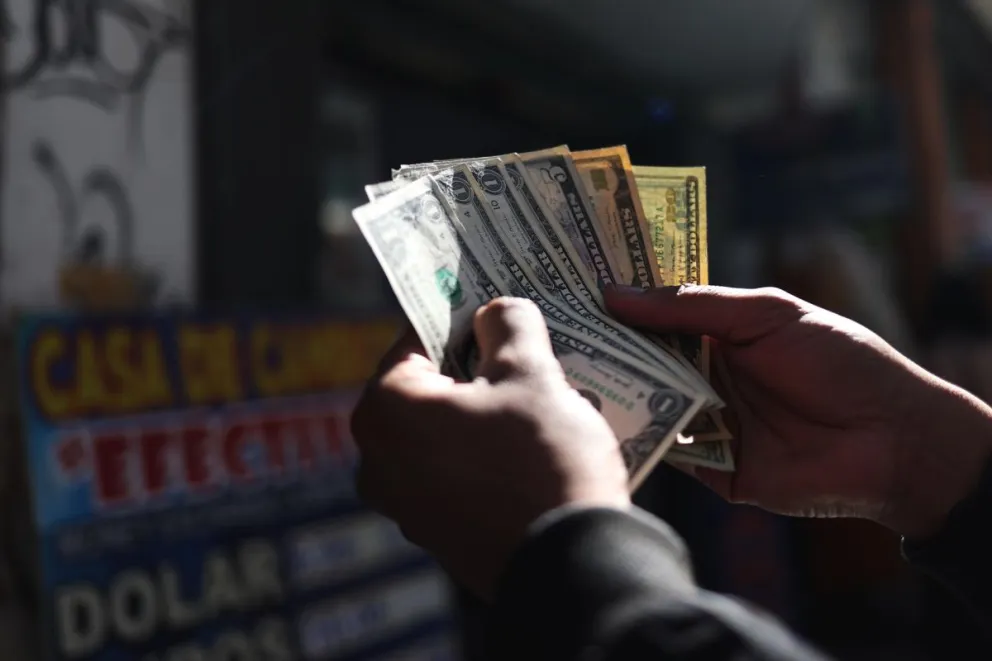
A person counting dollars on a street in La Paz. Photo: EFE
Former president of the Central Bank of Bolivia, Juan Antonio Morales, told EFE that the return of dollars to small savers launched by the government of Rodrigo Paz is “moving in the right direction” to end the withdrawal freeze, although he warned that the measure is not enough to normalize the economy’s relationship with the currency.
Morales said that the restitution of dollar savings to individuals and small businesses with deposits of up to $1,000 represents an initial step toward dismantling the so-called withdrawal freeze, as the retention of dollars in the financial system is known, but he noted that there is still “a significant amount” that has not been returned to larger savers.
The return of foreign currency and the drop in the dollar’s reference quotation, among other measures, are viewed by analysts as signs that the Executive is trying to ease the restrictions in force since late 2023, when limits began on withdrawals and transactions in foreign currency inside and outside the country, in a context of dollar shortages.
The problem worsened in early 2023, when net international reserves (NIR) fell to $3.148 billion, one of the lowest levels since 2014, the year they reached a historic high of $15.122 billion. Since then, difficulty in accessing foreign currency through official channels has fueled the expansion of the parallel market, where in May 2025 the dollar came to trade at 20 bolivianos, compared with the fixed official exchange rate of 6.96 in force since 2011.
In addition to returning dollar savings, Paz’s government adopted other economic measures such as eliminating fuel subsidies, which raised diesel and gasoline prices, and reducing tariffs on technology. In November, the elimination of four taxes that, according to authorities, discouraged private investment was also announced, although that initiative is still pending consideration in Parliament.
For his part, the manager of the private Bolivian Institute of Foreign Trade (IBCE), Gary Rodríguez, told EFE that these decisions send “strong signals” to economic agents. Rodríguez said that the drop in the dollar’s quotation relative to the parallel market, the result of greater transparency in financial transactions and the start of lifting the withdrawal freeze on dollar deposits, has been well received by the population, even though the adjustment has been severe.
Likewise, Morales, an economist who was president of the BCB from 1995 to 2006, stressed that in order to maintain a more stable relationship with the dollar, the main reference point should be the parallel market quotation, which he considered a “reasonable” level.
In that sense, he said it is not advisable to think about maintaining the official exchange rate of 6.96 bolivianos, since that would reduce the competitiveness of the Bolivian economy internationally.
For Morales, the reference quotation that should be maintained this year would stand between 9.50 and 9.60 bolivianos per dollar.
Since December, the BCB has published a daily reference value of the dollar against the boliviano, while the Executive has clarified that the official exchange rate remains in place and that it will move toward a “flexible” scheme, after first strengthening net international reserves.
The return of foreign currency was announced last week by President Paz and the Minister of Economy, and carried out through the financial system with the delivery of cash dollars by the BCB. The head of the issuing authority, David Espinoza, reported that the measure will benefit 770,000 small savers and 20,000 small businesses, with an approximate amount of $48 million, and that the government will continue working to address the remaining 20%.
Por Daniela Romero, EFE; Vision 360:
Bolivia se encamina a salir del “corralito” de dólares, dice extitular del Banco Central
La devolución de divisas y la baja de la cotización referencial del dólar, entre otras medidas, son vistas por analistas como señales de que el Ejecutivo intenta aliviar las restricciones vigentes desde finales de 2023.
Una persona contando dólares en una calle en La Paz. Foto: EFE
El expresidente del Banco Central de Bolivia Juan Antonio Morales afirmó a EFE que la devolución de dólares a pequeños ahorradores iniciada por el Gobierno de Rodrigo Paz va “en buena dirección” para terminar el “corralito”, aunque advirtió que la medida no es suficiente para normalizar la relación de la economía con la divisa.
Morales consideró que la restitución de ahorros en dólares a personas y pequeñas empresas con depósitos de hasta 1.000 dólares representa un paso inicial para desmontar el denominado “corralito”, como se le llama a la retención de dólares, que se instauró en el sistema financiero, pero señaló que todavía existe “un monto importante” que no ha sido devuelto a los ahorradores de mayor tamaño.
La devolución de divisas y la baja de la cotización referencial del dólar, entre otras medidas, son vistas por analistas como señales de que el Ejecutivo intenta aliviar las restricciones vigentes desde finales de 2023, cuando comenzaron los límites a los retiros y transacciones en moneda extranjera dentro y fuera del país, en un contexto de escasez de dólares.
El problema se agudizó a inicios de 2023, cuando las reservas internacionales netas (RIN) descendieron a 3.148 millones de dólares, uno de los niveles más bajos desde 2014, año en que alcanzaron un máximo histórico de 15.122 millones. Desde entonces, la dificultad para acceder a divisas por canales oficiales impulsó la expansión del mercado paralelo, donde en mayo de 2025 el dólar llegó a cotizarse en 20 bolivianos, frente al tipo de cambio oficial fijo de 6,96 vigente desde 2011.
Además de la devolución de ahorros en dólares, el Gobierno de Paz adoptó otras medidas económicas como la eliminación de la subvención a los combustibles, que elevó los precios del diésel y la gasolina, y la reducción de aranceles para tecnología. En noviembre también se anunció la eliminación de cuatro impuestos que, según las autoridades, desincentivaban la inversión privada, aunque esa iniciativa aún está pendiente de tratamiento en el Parlamento.
Por su parte el gerente del privado Instituto Boliviano de Comercio Exterior (IBCE), Gary Rodríguez, dijo a EFE que estas decisiones envían “señales fuertes” a los agentes económicos. Rodríguez sostuvo que la baja de la cotización del dólar frente al mercado paralelo, producto de una mayor transparencia en las transacciones financieras y del inicio del levantamiento del “corralito” para los depósitos en dólares, ha sido bien recibida por la población, pese a que el ajuste ha sido severo.
Asimismo, Morales, economista que fue presidente del BCB de 1995 a 2006, subrayó que, para mantener una relación más estable con el dólar, el principal punto de referencia debe ser la cotización del mercado paralelo, que consideró un nivel “razonable”.
En ese sentido, señaló que no es aconsejable pensar en mantener el tipo de cambio oficial de 6,96 bolivianos, ya que ello restaría competitividad a la economía boliviana en el ámbito internacional.
Para Morales, la cotización referencial que debería mantenerse este año se ubicaría entre 9,50 y 9,60 bolivianos por dólar.
Desde diciembre, el BCB publica a diario un valor referencial del dólar frente al boliviano, mientras el Ejecutivo ha aclarado que el tipo de cambio oficial se mantiene y que se avanzará hacia un esquema “flexible”, previo fortalecimiento de las RIN.
La devolución de divisas fue anunciada la semana pasada por el presidente Paz y el ministro de Economía, y ejecutada a través del sistema financiero con la entrega de dólares en efectivo por parte del BCB. El presidente del ente emisor, David Espinoza, informó que la medida beneficiará a 770.000 pequeños ahorradores y 20.000 pequeñas empresas, con un monto aproximado de 48 millones de dólares, y que el Gobierno continuará trabajando para atender al 20 % restante.

 Bolivian Thoughts | Pensamientos Bolivianos (Bilingual/Bilingüe)