
By Visión 360:
2025 Elections
In the third week of July, disinformation focused on televised electoral debates, which media outlets had opened as part of their coverage. Misleading accounts took advantage of these spaces to spread false and deceptive content about candidates.
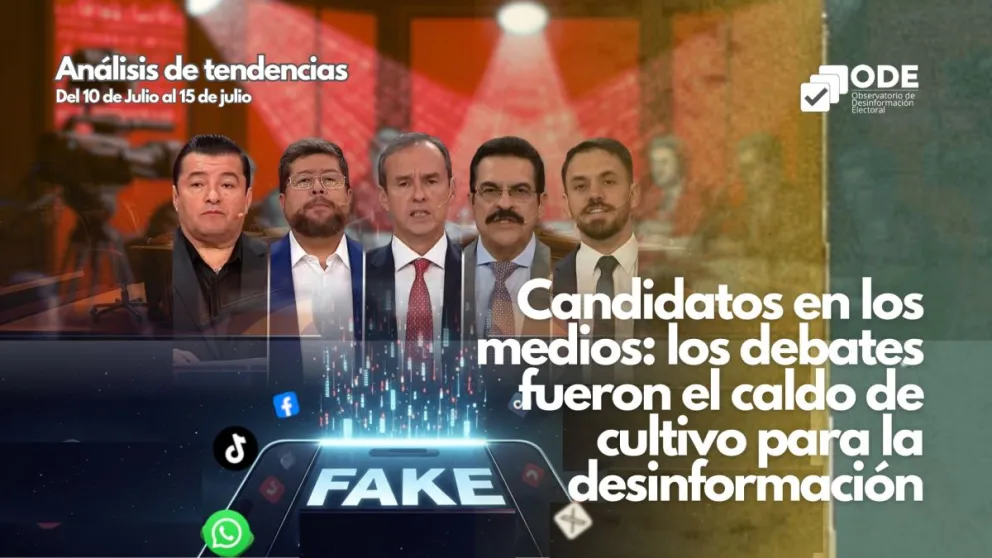
The media opened more space for electoral coverage through debates that questioned the candidates about their proposals and positions on various issues. This dynamic was exploited by disinformative accounts that attacked some candidates by manipulating the content broadcast during these programs.
The Electoral Disinformation Observatory (ODE), after a rigorous verification process, identified Samuel Doria Medina as the figure who received the largest number of falsehoods during the third week of July. Another ongoing trend in disinformation was fake polls.
Of the 12 pieces verified last week, the classification was: 8 false, 3 misleading, and 1 true.
Doria Medina in the disinformers’ sights
Two TV networks dominated the agenda with candidates appearing in various slots and formats. After the first electoral debate organized by Red Uno, a manipulated video circulated claiming that the network cut the microphone of Manfred Reyes Villa, candidate for Autonomía Para Bolivia-Súmate (APB), for mentioning “fake polls.” However, the correct information is that Reyes Villa’s allotted speaking time had ended.
The audiovisual content, widely spread on TikTok, directly accused the network with the caption: “Red Uno silences candidate Manfred for speaking about fake polls.” [See here]
Red Uno did not cut Manfred Reyes Villa’s microphone for talking about polls
In the same debate, misleading content was created by manipulating a broadcast fragment to falsely claim that Samuel Doria Medina, candidate of Alianza Unidad, admitted to buying polls. The video went viral on TikTok with a voiceover and the message: “Doria Medina admitted he bought polls on Red Uno. Without realizing it, the candidate fell into the trap when asked by Manfred Reyes Villa about the call in which he revealed the poll results.”
Doria Medina never admitted to paying for poll dissemination; he used irony in a series of verbal exchanges on the topic with Reyes Villa (APB-Súmate).
In the Red Uno debate, Eduardo del Castillo, candidate from the Movimiento Al Socialismo (MAS), stated that economist José Gabriel Espinoza Yañez was president of the Central Bank of Bolivia (BCB). He used this claim to tie Doria Medina to the transitional government of Jeanine Áñez Chávez, naming others to highlight connections with the past administration.
However, this claim is inaccurate: Espinoza was a director, not president, of the BCB.
Eduardo del Castillo gives an inaccurate claim about the former BCB director
Separately, using artificial intelligence (AI) tools, disinformers created an audio clip alleging that Samuel Doria Medina paid to disqualify Jaime Dunn de Ávila, then a pre-candidate for Nueva Generación Patriótica (NGP).
The widely spread video carried the title: “What do you mean Samuel was the one who disqualified Jaime Dunn? Leaked audio reveals Samuel was the one who took Dunn out of the race.” [See here]
AI-generated audio falsely claims Doria Medina paid for Dunn’s disqualification
Doria Medina was also impacted by the resignation of Karla Robledo Guardia, a senatorial candidate in Santa Cruz for Alianza Unidad, due to her father’s links to drug trafficking.
A fake video used images attributed to Red Uno and El Deber, claiming that Doria Medina had distanced himself from the Camacho camp after the scandal. The intent of this hoax was again to harm the businessman in the race, as he remains allied with imprisoned opposition leader Luis Fernando Camacho Vaca. [See here]
The video claiming Doria Medina distanced himself from Camacho over the Robledo case is fabricated
More fake poll dissemination
As has become common in this electoral stage, various accounts continue to spread fake polls, this time benefiting more candidates with alleged voter preference. For instance, Rodrigo Paz, from the Partido Demócrata Cristiano (PDC), was falsely shown leading with 33.1% in the first national poll by Ipsos Ciesmori, supposedly shared by Unitel.
The account @cap..lara shared this altered image three times, replacing the original result in which Samuel Doria Medina was the actual leader and Rodrigo Paz was in fifth place. [See here]
Rodrigo Paz is not leading the Ipsos Ciesmori and Unitel national poll
After Unitel released its second poll, a false video appeared claiming that results had been “leaked“, showing Jorge Quiroga Ramírez of Alianza Libre as the leading candidate.
This content, deemed false, was accompanied by the message: “Bolivia, we did it! Unitel poll leaked. The populist bloc disappears and democracy triumphs. Bolivia is now right-wing. Long live freedom, dammit! Tuto or Samuel — one of them will be the president. In the latest poll, both lead. With Tuto in first place, the change in our country is sealed. That destroys the left.”
In the official poll released by Unitel on Sunday, July 13, Quiroga was actually in second place with 18.1%, below Doria Medina with 18.7%. In third place was Andrónico Rodríguez Ledezma (Alianza Popular) with 11.8%, making him the highest-polling left-wing candidate. So, there was no leak of results.
Similarly, the front page of El Deber was doctored to show the message: “Citizen alternative poll from El Búnker confirms rigged polls in Santa Cruz.” This fake image circulated via WhatsApp groups. [See here]
El Deber’s cover manipulated to discredit official polls
In Bolivia, the main polls have been shared by Unitel, Red Uno, and El Deber—all of them authorized by the Supreme Electoral Tribunal (TSE). According to the TSE’s list, 18 polling firms and 97 media outlets are authorized to carry out and distribute electoral surveys.
Andrónico Rodríguez surrounded by hoaxes
A controversial statement brought Andrónico Rodríguez, candidate for Alianza Popular (AP), into the spotlight. On July 8, during his campaign proposal presentation, he claimed that Chilean Senate President Manuel José Ossandónhad told him Chile could grant Bolivia access to the port of Tocopilla.
According to Rodríguez, the offer was conditional upon restoring full diplomatic relations with Chile. However, this statement was deemed false, and the Chilean Senate denied the candidate’s claims. [See here]
Andrónico debunked: Chilean authorities deny offering the Tocopilla port
Rodríguez was also targeted by a manipulated video, in which Unitel anchor Alejandra Fernández announced that he had withdrawn his candidacy. In fact, this misleading video was a clip from an unrelated incident involving Movimiento Tercer Sistema (MTS), which later resolved a legal dispute.
Video taken out of context: Andrónico Rodríguez has not withdrawn from the presidential race
Countdown to the vote
As the elections approach, disinformative accounts have intensified alarmist hoaxes that could impact voter behavior — such as the false claim that one can only vote with a digitalized ID card. Although completely false, this was widely shared in WhatsApp groups.
It is false that a digital ID is required to vote in the August 17 elections
Meanwhile, during the Red Uno debate, Jhonny Fernández Saucedo, mayor of Santa Cruz and candidate for Alianza Fuerza del Pueblo, stated that current lawmakers are running again for seats in the Plurinational Legislative Assembly (ALP). Bolivia Verifica confirmed that 24 senators and deputies are seeking another five-year term. [See here]
It is true that current legislators appear on candidate lists for the 2025 elections
During the third week of July, TikTok once again emerged as the platform with the highest amount of disinformative content, followed by WhatsApp, according to the Observatory.
Samuel Doria Medina, who leads in voter intention according to authorized polls, was the main target of disinformation.
And one persistent trend remains: fake polls, with manipulated content aimed at favoring particular candidates.
Por Visión 360:
Elecciones 2025
En la tercera semana de julio, la tendencia de la desinformación se concentró en los debates, espacios que abrieron los medios de comunicación como parte de su cobertura electoral. Cuentas desinformantes aprovecharon para generar contenido falso y engañoso sobre los candidatos.
Los medios de comunicación abrieron más espacios a la cobertura electoral con debates que interpelaron a los candidatos sobre sus propuestas y posturas respecto a varios temas. Esta dinámica fue aprovechada por cuentas desinformantes que atacaron a algunos candidatos manipulando los contenidos difundidos en estos programas.
El Observatorio de Desinformación Electoral (ODE), luego de un riguroso proceso de verificación, identificó a Samuel Doria Medina como el personaje que recibió la mayor cantidad de bulos durante la tercera semana de julio. Otra constante como tendencia de desinformación fueron las encuestas falsas.
De las 12 notas verificadas en la última semana se obtuvo esta categorización: falsas (8), engañosas (3) y una verdadera.
Doria Medina en el radar de los desinformantes
Dos cadenas televisivas acapararon la agenda con la presencia de los candidatos en diferentes espacios y horarios. Luego del primer debate electoral organizado por la Red Uno, circuló un video manipulado en el que se afirmaba que el medio cortó el micrófono al candidato de Autonomía Para Bolivia- Súmate (APB), Manfred Reyes Villa, por hacer referencia a ‘encuestas falsas’. Sin embargo, la información correcta es que el tiempo de intervención que correspondía a Reyes Villa se había terminado.
El material audiovisual que fue ampliamente difundido en TikTok acusó directamente al medio con el siguiente texto de apoyo: “Red Uno silencia al candidato Manfred por hablar sobre las encuestas falsas”. Ver aquí.
La Red Uno no le cortó el micrófono a Manfred Reyes Villa por hablar de las encuestas
Sobre este mismo debate se generó un contenido engañoso que manipuló un fragmento de la transmisión para añadir una afirmación falsa en perjuicio del candidato Samuel Doria Medina de Alianza Unidad. El video se hizo viral en TikTok con una voz en off y el siguiente mensaje: “Doria Medina admitió que compró encuestas en Red Uno. Sin darse cuenta, el candidato cayó en la trampa cuando fue consultado por Manfred Reyes Villa sobre la llamada en la que adelantó los resultados de la encuesta”.
Doria Medina no admitió en ningún momento que pagó por la difusión de las encuestas, sí ironizó en una serie de entredichos sobre el tema con el candidato Manfred Reyes Villa de APB Súmate.
En el debate organizado por Red Uno, el candidato del Movimiento Al Socialismo (MAS) Eduardo del Castillo indicó que el economista José Gabriel Espinoza Yañez fue presidente del Banco Central de Bolivia (BCB). Usó este dato para señalar a Doria Medina como parte del gobierno de transición de Jeanine Áñez Chávez, mencionando también otros nombres para evidenciar los vínculos con la pasada administración.
Sin embargo, este dato es impreciso, pues Espinoza fue director del BCB, pero nunca ocupó su presidencia.
Eduardo del Castillo da un dato impreciso sobre el exdirector del BCB
Por otro lado, con el uso de una herramienta de inteligencia artificial (IA), los desinformantes crearon un audio para involucrar a Samuel Doria Medina en un supuesto pago para la inhabilitación del entonces precandidato de Nueva Generación Patriótica (NGP), Jaime Dunn de Ávila.
El video que fue ampliamente difundido tenía el siguiente título: “¿Cómo que Samuel fue quien inhabilitó a Jaime Dunn? Audio filtrado revela que Samuel habría sido quien sacó a Jaime Dunn del camino”. Ver aquí.
Crean un audio con IA para indicar que Doria Medina pagó la inhabilitación de Dunn
En la coyuntura electoral también jugó en contra de Doria Medina el anuncio de renuncia de Karla Robledo Guardia, candidata a senadora por Santa Cruz con Alianza Unidad, debido a vínculos de su padre con hechos de narcotráfico.
Un video falso mostró imágenes atribuidas a Red Uno y otras al diario El Deber en el que se aseguraba que el candidato puso distancia con el ‘camachismo’ tras el escándalo. La intención de este bulo fue nuevamente perjudicar al empresario en esta contienda electoral, pues mantiene una alianza con el líder opositor encarcelado, Luis Fernando Camacho Vaca. Ver aquí.
El video que distancia a Doria Medina de Camacho por caso Robledo es un montaje
Más difusión de encuestas falsas
Como ha sido una constante en esta fase electoral, diferentes cuentas se dedican a difundir encuestas falsas y esta vez más candidatos fueron favorecidos por la supuesta preferencia de la ciudadanía en la intención de voto. Por ejemplo Rodrigo Paz del Partido Demócrata Cristiano (PDC) aparece liderando con el 33,1% la primera encuesta nacional realizada por Ipsos Ciesmori que fue difundida por Unitel.
La cuenta identificada como @cap..lara difundió tres veces este estudio alterando la imagen original en la que Samuel Doria Medina se encuentra como líder en la preferencia y Rodrigo Paz en quinto lugar. Ver aquí.
Rodrigo Paz no lidera la encuesta nacional de Ipsos Ciesmori y Unitel
Tras la difusión de la segunda encuesta de la red Unitel se detectó la difusión de un video en el que aseguraba que los resultados habían sido «filtrados» y daban como favorito al candidato de Alianza Libre, Jorge Quiroga Ramírez.
Este contenido, que fue categorizado como falso, estuvo acompañado del siguiente mensaje: “¡Bolivia, lo logramos! Se filtra encuesta de Unitel. El bloque popular desaparece y triunfa la democracia. Bolivia ahora es de derecha. ¡Viva la libertad, carajo! O Tuto o Samuel, uno de ellos será el presidente del país. En la última encuesta ambos lideran. Con Tuto en el primer lugar se consolida el cambio en nuestro país. Eso destroza la izquierda”.
En la encuesta original presentada el domingo 13 de julio por Unitel, Quiroga aparece en realidad en el segundo lugar con el 18,1%, por debajo de Doria Medina que tiene el 18, 7% de la intención de voto. En el tercer lugar figura Andrónico Rodríguez Ledezma de Alianza Popular con el 11,8%, quien viene a ser el candidato mejor posicionado de la izquierda boliviana. Es decir, que no hubo una filtración de resultados.
En esa misma línea, la imagen de portada del diario El Deber fue manipulada para emitir el siguiente mensaje: “Sondeo de la alternativa ciudadana de El Búnker confirma el amaño de encuestas en Santa Cruz”. Esta imagen circuló por grupos en WhatsApp. Ver aquí.
Manipulan portada de El Deber para desvirtuar encuestas oficiales
En Bolivia las principales encuestas fueron difundidas por Unitel, Red Uno y El Deber, los tres medios citados cuentan con autorización del Tribunal Supremo Electoral (TSE). Son 18 encuestadoras y 97 medios de comunicación habilitados para elaborar y difundir este tipo de estudios electorales, según la lista difundida por el TSE.
Andrónico Rodríguez en medio de bulos
Una declaración controversial puso en el foco de la atención al candidato por Alianza Popular (AP), Andrónico Rodríguez. Durante la presentación de su propuesta electoral, el 8 de julio, indicó que el presidente del Senado de Chile Manuel José Ossandón le dijo que tienen la posibilidad de ceder en concesión el puerto de Tocopilla, lo que le permitiría a Bolivia tener una salida al mar.
Según Rodríguez, el ofrecimiento estaba condicionado al restablecimiento de las relaciones plenas con Chile. Sin embargo, el discurso de Rodríguez fue calificado como falso. El Senado del vecino país desmintió al candidato. Ver aquí.
Desmienten a Andrónico: Autoridades chilenas niegan haber ofrecido el puerto de Tocopilla
Pero Rodríguez también fue víctima de un video manipulado en el que la presentadora de la red Unitel, Alejandra Fernández informaba que Rodríguez desistió de su candidatura. Sin embargo, este contenido fue calificado como engañoso, pues el video original corresponde al momento en que el Movimiento Tercer Sistema (MTS) enfrentaba una impugnación que luego logró resolver.
Video sacado de contexto: Andrónico Rodríguez no se bajó de la carrera presidencial
Cuenta regresiva para votar
Ante la proximidad de las elecciones, las cuentas desinformantes se activaron para difundir bulos alarmistas que podrían influir en el voto, como el mensaje de que solo se podría ejercer este derecho si se cuenta con cédula de identidad digitalizada. Aunque este contenido es falso fue compartido varias veces en grupos por WhatsApp.
Es falso que se deba presentar el carnet digitalizado para votar en las elecciones del 17 de agosto
Por otro lado, el alcalde de Santa Cruz y candidato por Alianza Fuerza del Pueblo, Jhonny Fernández Saucedo, durante el debate de la Red Uno, indicó que en las listas de candidatos para las elecciones 2025 figuran legisladores en ejercicio que aspiran nuevamente a un escaño en la Asamblea Legislativa Plurinacional (ALP). Bolivia Verifica identificó que 24 senadores y diputados buscan mantenerse en el Legislativo por otros cinco años. Ver aquí.
Es verdad que en las listas de candidatos para las elecciones 2025 hay actuales legisladores
Durante la tercera semana de julio, TikTok aparece una vez más como la plataforma con mayor contenido desinformante en esta etapa electoral, seguida de WhatsApp, de acuerdo con la verificación realizada por el Observatorio.
Samuel Doria Medina, quien lidera las intenciones de voto según las encuestas de los medios autorizados, fue en quien recayó la mayor cantidad de bulos.
Y una tendencia que se mantiene son las encuestas falsas, que muestran manipulación de contenido para favorecer a ciertos candidatos.

 Bolivian Thoughts | Pensamientos Bolivianos (Bilingual/Bilingüe)