
By AGENCIA DE NOTICIAS AMBIENTALES, Erbol:
IN BENI
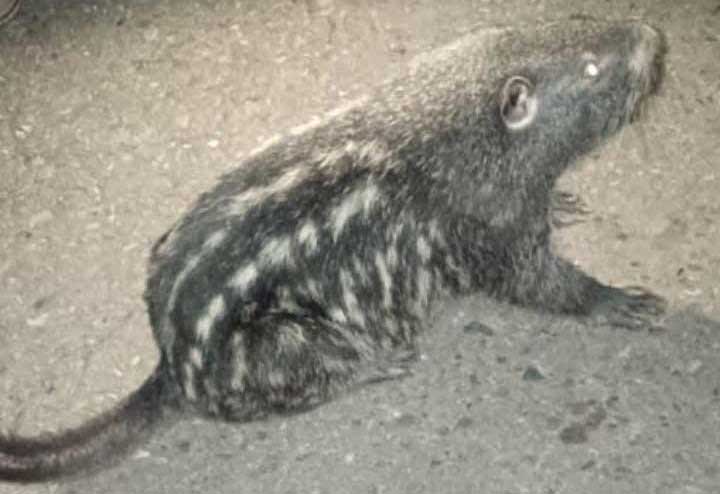
A beautiful specimen of the “jochi with a tail” survived after being run over on the road to Yucumo in the department of Beni. Its discovery marks the first live record of this large rodent in Bolivia.
Brothers Néstor and Cesar Chambi Calle, upon noticing the animal, turned back on the road to Yucumo and saved its life. Due to its size and seeing that it was injured, they were hesitant to touch it—especially since it was emitting a sound virtually identical to a human baby’s cry. For this reason, they contacted the well-known rescuer from Beni, Marcos Greminger Céspedes, who is also a research professor at the José Ballivián Autonomous University of Beni (UAB), according to testimonies collected by the Environmental News Agency (ANA).


Néstor and César Chambi Calle saved the rodent’s life Photo: Chambi/ANA
They sent a photo of the specimen to Greminger; and due to the location being 4 hours and 30 minutes away (about 280 km) by road, he gave them instructions over the phone on how to use restraint methods to transport it to a safer place. Once this was accomplished, and to prevent the animal from dying, they administered medications and applied veterinary and animal science protocols.
Néstor and Cesar later took it to the checkpoint of the National Service for Agricultural Health and Food Safety (SENASAG). The professionals from this institution kindly transported it to the city of Trinidad, arriving at 7:39 p.m. on May 15, where Greminger received the rodent along with personnel from the Forest and Environmental Protection Police (POFOMA).

Dr. Greminger with a POFOMA officer Photo: Greminger/ANA
In the morning of May 16, at the teaching hospital of the Faculty of Animal Sciences of the Autonomous University of Beni, the animal underwent a full veterinary medical examination to assess its health condition. Then they followed a protocol for feeding and pharmacological treatment to aid in its recovery, with the collaboration of Dr. Mario Justiniano Téllez,” explained the university professor.
First Live Record in Bolivia
“In Bolivia, there are only two previous records: one of a roadkill specimen in La Paz and another from a camera trap photo in Amboró Park,” Greminger explained in an interview with ANA.
“But a live animal had never been recorded in Bolivia—let alone in Beni,” the doctor emphasized, noting that this is a significant scientific contribution.
Biometrics, care, and studies
A biometric analysis determined that the “jochi with a tail,” scientifically known as Dinomys branickii, measured 54 cm in body length, had a 22 cm tail, and weighed 6 kg. It is a growing specimen, which helped it survive the accident. Fortunately, its hind legs were not fractured, although it did lose its front teeth or incisors, which are expected to grow back.
It has since been transferred to the city of Santa Cruz for further studies to safeguard the life of the specimen.

Species and distribution


In Bolivia, this species is known as the pacarana (Dinomys branickii), or “jaipa” or “jochi with a tail.” In other places, it is called “guagua con rabo” or “guagua loba.”
It is a robust-bodied rodent of the neotropical region with a short tail. Its fur is reddish-brown on the back and lighter on the belly.
In Natural History Mammalogy Notes 2024, 10(2), 431; https://doi.org/10.47603/mano.v10n2.431, it is highlighted that its “distribution ranges from Colombia and Venezuela to Brazil, Ecuador, Peru, and Bolivia, at elevations between 200 and 3,200 meters above sea level. In Bolivia, it is known in Andean and adjacent lowland forests from Amboró National Park in Santa Cruz northward. In a mammal survey using camera traps, it was recorded in the protected area of Serranía del Iñao National Park and Integrated Management Area (PN ANMI), in the department of Chuquisaca (~64°0′ W; 19°20′ S). With an effort of 3,147 trap-nights across 26 stations, two pacarana records were obtained, 55 km apart.”
“The first site is in the northeast of the park, at an altitude of 630 m in sub-Andean/inter-Andean riparian forests, and the second in the southwest at 1,353 m in upper sub-Andean subhumid forests. These findings extend the southern limit of its distribution by 170 km and add new Bolivian-Tucuman vegetation types to the knowledge of its habitat,” concludes Natural History Mammalogy.
Scientific article and gratitude
The university professor is awaiting all results in order to write a scientific article, as a contribution to science and in defense of wildlife.
“Finally, I want to highlight the collaboration of the Dean of the Faculty of Animal Sciences, Dr. Francis Ferrier Abidar, for giving us access to the teaching hospital of the Autonomous University of Beni. A special thanks also to the Rector, Ph.D. Jesús Eguez Rivero, for providing full support and logistics for the animal’s well-being,” he concluded.
Por AGENCIA DE NOTICIAS AMBIENTALES, Erbol:
EN BENI
Un hermoso ejemplar de “jochi con cola” logró sobrevivir tras ser atropellado en el camino a Yucumo en el departamento de Beni. Su hallazgo se constituye en el primer registro vivo en Bolivia de este roedor grande.
Los hermanos Chambi Calle, Néstor y Cesar al percatarse del animalito dieron vuelta en el camino a Yucumo salvándole la vida. Por su tamaño y viendo que estaba herido no querían tocarlo; porque virtualmente emitía un sonido igual al llanto de un bebé humano. Por esta razón, se comunican con el conocidísimo rescatista beniano Marcos Greminger Céspedes, quien también es docente investigador de la Universidad Autónoma del Beni José Ballivián, (UAB), según los testimonios recogidos por la Agencia de Noticias Ambientales (ANA).
Néstor y César los hermanos Chambi Calle le salvaron la vida a este roedor Foto Chambi/ANA
Le mandaron una foto del espécimen a Greminger; y por la distancia del lugar 4 horas y 30 minutos (cerca a 280 km) en carretera, por teléfono les dio instrucciones para que usen métodos de sujeción para llevarlo a un lugar más seguro. Una vez realizado este cometido, para que el animal no se muera, le brindaron medicaciones y aplicaron protocolos en medicina veterinaria y zootecnia.
Néstor y Cesar, luego lo llevaron hasta el puesto de control del Servicio Nacional de Sanidad Agropecuaria e Inocuidad Alimentaria (SENASAG). Los profesionales de esta institución gentilmente lo transportaron hasta la ciudad de Trinidad llegando a las 19.39 de la noche del 15 de mayo, donde Greminger recibió al roedor junto al personal de la Policía Forestal y Preservación del Medio Ambiente (POFOMA).
El Dr Greminger junto aun efectivo de POFOMA Fotos Greminger/ANA
Por la mañana “el 16 de mayo en los ambientes del Hospital Escuela de la Facultad de Ciencias Pecuaria de la Universidad Autónoma del Beni se le realiza toda la revisión médica veterinaria para evaluar el estado de salud del roedor, para después hacer el protocolo de alimentación y medicación farmacológica del animal para su recuperación con la colaboración del Dr. Mario Justiniano Téllez”, relata el profesor universitario.
Primer Registro Vivo en Bolivia
“En Bolivia solo existen dos registros una de un animal atropellado en La Paz y el otro es una fotografía de cámara trampa en el parque Amboró”, explica Greminger en una entrevista con ANA.
“Pero nunca se había registrado un animal vivo en Bolivia peor en Beni”, destacó el doctor, al hacer notar que es un gran aporte científico.
Biometría, atención y estudios
Se le realizó una biometría que estableció que el «jochi con cola», conocido con el nombre científico de Dinomys branickii midió de cuerpo 54 cm, cola 22 cm y peso 6 kg. Es un espécimen en crecimiento y por eso se concluyó que sobrevivió al atropello y por suerte no le fracturaron sus patas traseras, aunque perdió los dientes delanteros o incisivos, pero le crecerán de nuevo.
Al momento se lo trasladó a la ciudad de Santa Cruz, para realizarle otros estudios para precautelar la vida de espécimen.
Especie y distribución
Esta especie en Bolivia es conocida como la pacarana (Dinomys branickii) o «jaipa» o «jochi con cola». En otros lugares la llaman «guagua con rabo» o «guagua loba».
Se trata de un roedor de la región neotropical de cuerpo robusto y una cola corta. Su pelaje es de color castaño rojizo en el lomo y más claro en el vientre.
En Historia Natural Mammalogy Notes 2024, 10(2), 431; https://doi.org/10.47603/mano.v10n2.431 destaca que su “distribución abarca desde Colombia y Venezuela a Brasil, Ecuador, Perú y Bolivia, en un rango altitudinal entre 200 y 3.200 msnm. En Bolivia se la conoce en bosques andinos y de llanura adyacentes desde el PN Amboró en Santa Cruz hacia el norte, pero en un relevamiento de mamíferos por foto-trampeo fue registrada en el área protegida PN ANMI Serranía del Iñao, en el departamento de Chuquisaca (~ 64°0′ O; 19°20′ S). Con un esfuerzo de 3147 trampas-noche en 26 estaciones se obtuvieron dos registros de pacarana distantes 55 km uno del otro”.
“El primer sitio está en el NE del parque, a una altitud de 630 msnm en bosques ribereños subandinointerandinos y el segundo en el SO, a 1.353 msnm en bosques subhúmedos del subandino superior. Estos hallazgos amplían en 170 km el límite austral de su distribución y agregan nuevos tipos de vegetación boliviano-tucumana al conocimiento de su hábitat”, se concluye en Historia Natural Mammalogy.
Artículo científico y agradecimiento
El profesor universitario espera todos los resultados para escribir un artículo científico, como aporte a la ciencia y en defensa de la fauna silvestre.
“Finalmente quiero destacar la colaboración de la Decana de la Facultad de Ciencias Pecuarias a la Dra. Francis Ferrier Abidar, por abrirnos los ambientes del hospital escuela de la Universidad Autónoma del Beni. Un agradecimiento especial también al señor Rector Ph.D. Jesús Eguez Rivero de la Universidad Autónoma del Beni por brindar todo el apoyo y logística para el bienestar del animal”, finalizó.
https://erbol.com.bo/medio-ambiente/primer-registro-vivo-en-bolivia-del-‘jochi-con-cola’

 Bolivian Thoughts | Pensamientos Bolivianos (Bilingual/Bilingüe)