
By EFE, Unitel:
“I started with some little bees that were in danger, they told me: either you take them or we burn them,” said Luis Flores, the young agronomist who lives with these insects
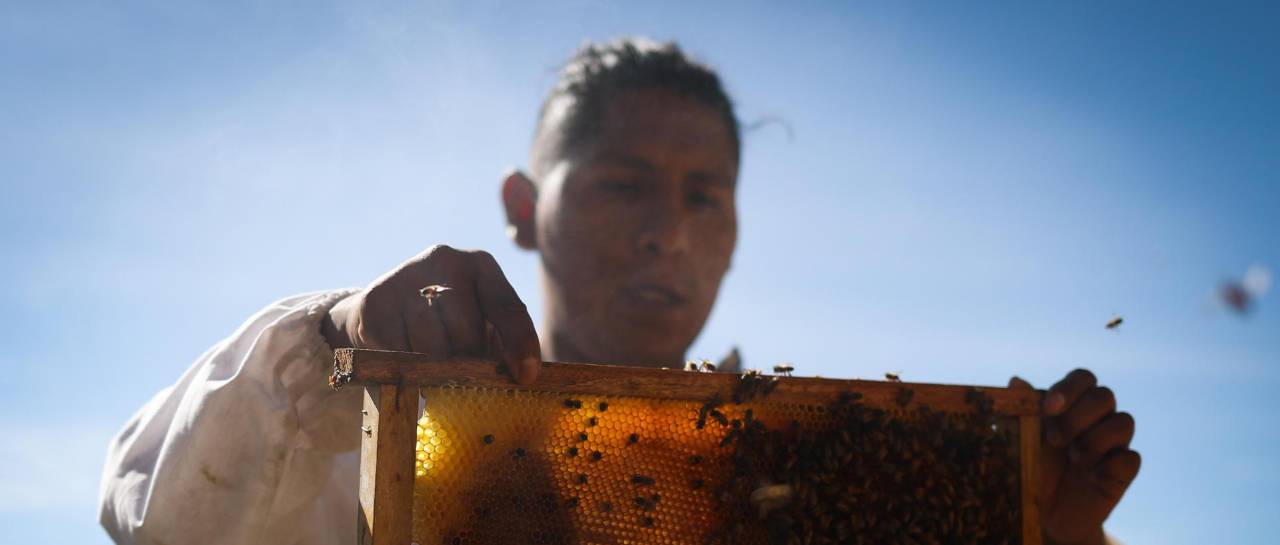
[Photo: EFE] / The swarms of bees that form on rooftops and in public spaces found refuge in the home of Luis Flores
The swarms of bees that form in the rooftops of old houses and in public areas of some cities found refuge in the home of Luis Flores, a young Bolivian agronomist who has been rescuing bees for three years and teaching how to coexist with them to help preserve the planet.
At more than 4,000 meters above sea level, in a house located on the border between the cities of La Paz and El Alto, thousands of bees buzz around six handmade hives, made from wooden and metal boxes.
Those who visit and want to get close to the bees put on a special suit, and Flores applies smoke to them, which helps calm the bees, he explained.
Flores says he has always been a bee enthusiast, but an ultimatum from some neighbors was the signal for him to start rescuing and sheltering them in his home.
“I started with some little bees that were in danger, they told me ‘either you take them or we burn them.’ It was a very tough decision, and even though I had no suits or anything, I rescued the bees,” said Flores.
After the first rescue, more followed, and before he knew it, thousands of bees had taken over his home.
“I’ve always been fascinated by them—their hierarchy, the way they work is amazing. The queen, those that feed her, the scouts—each has a specific job,” the agronomist commented.
Flores has distributed the hives among the stronger bees, the weaker ones, those that produce honey, and the newcomers, and he gives each group special care.
Inside his bedroom, where he sleeps, is the hive of the bees that already produce honey, which means trays of wax with fresh honey are spread across the floor.
“Here we try not to harvest everything. We take what we consume, up to 50% of the honey, and the rest is to feed them,” he explained.
Flores’s goal is to raise awareness among people so they learn to coexist with bees, feed them with the honey they produce without subjecting them to “exploitation,” and recognize them as “essential” for preserving the planet.
Flores carries out at least four rescues per week, especially between October and February, which is when more bees appear in various regions.
The agronomist trains young beekeepers, students, and other people so they know how to handle bees and, in a few weeks, can adopt them.
The young Bolivian has developed a new habitat for the bees. At over 4,000 meters and sometimes “with devastating cold,” he has trained them to leave their hives at specific times, depending on the season, and to “work” fewer hours during winter.
“I already have the trust to work with them; they recognize me now, and that’s a process bees have to go through,” Flores explained.
The United Nations General Assembly declared May 20 as World Bee Day to raise awareness about the importance of these insects in nature.
The agronomist has found in bees his favorite hobby and a sense of purpose, as he believes that when someone welcomes bees into their home, it is actually the bees who end up adopting the person.
Por EFE, Unitel:
“He comenzado con unas abejitas que estaban en peligro, me dijeron: o te las llevas o las quemamos”, contó Luis Flores, el joven agrónomo que vive con estos insectos
[Foto: EFE] / Los enjambres de abejas que se forman en tumbados de casas y en la vía pública encontraron refugio en la casa de Luis Flores
Los enjambres de abejas que se forman en tumbados de casas antiguas y en la vía pública de algunas ciudades encontraron su refugio en la casa de Luis Flores, un joven agrónomo boliviano que hace tres años rescata abejas y enseña a convivir con ellas para preservar el planeta.
A más de 4.000 metros de altitud, en una casa ubicada en el límite entre las ciudades de La Paz y El Alto, miles de abejas revolotean alrededor de seis panales artesanales, hechos de cajas de madera y de metal.
Quienes llegan y quieren acercarse a las abejas se colocan un traje especial y Flores les aplica humo, que ayuda a calmarlas, según explicó.
Flores dice que siempre fue un aficionado de las abejas, pero un ultimátum que le dieron unos vecinos fue la señal para que comenzara a rescatarlas y cobijarlas en su hogar.
“He comenzado con unas abejitas que estaban en peligro, me dijeron ‘o te las llevas o las quemamos’, ha sido una decisión muy fuerte y a pesar de no tener trajes ni nada, he rescatado a las abejitas”, contó Flores.
Después del primer rescate vinieron otros más y cuando se dio cuenta miles de abejas ya habían tomado posesión de su casa.
“Siempre me han traído curiosidad, su jerarquía, su forma de trabajar es impresionante, la reina, las que la alimentan, las exploradoras, hay trabajos específicos”, comentó el agrónomo.
Flores ha distribuido los panales entre las abejas más fuertes, las que están débiles, las que producen miel y las recién llegadas, y para cada grupo tiene un especial cuidado.
Dentro de su habitación, donde él duerme, está el panal de las abejas que ya producen miel, lo que hace que en el piso se distribuyan bandejas de cera con miel fresca.
“Aquí tratamos de no cosechar todo, se saca lo que se consume, hasta un 50 % de la miel, y el resto es para alimentarlas”, explicó.
El objetivo de Flores es generar conciencia en las personas para que aprendan a convivir con las abejas, alimentarlas con la miel que producen sin someterlas a “una explotación” y que puedan ser “fundamentales” para preservar el planeta.
Flores realiza al menos cuatro rescates a la semana, especialmente entre octubre y febrero que es cuando aparecen más abejas en diferentes regiones.
El agrónomo capacita a jóvenes apicultores, estudiantes y otras personas para que sepan manejar a las abejas y que en algunas semanas todos ellos puedan adoptarlas.
El joven boliviano ha desarrollado un hábitat nuevo para las abejas, pues a más de 4.000 metros y en ocasiones “con un frío devastador”, las acostumbró a salir de sus panales en horarios específicos, según la temporada del año, y a “trabajar” menos horas cuando es invierno.
“Con ellas ya tengo la confianza de trabajar, ya me reconocen y eso es un proceso por el que deben pasar las abejas”, explicó Flores.
La Asamblea General de la Naciones Unidas declaró el 20 de mayo como el Día Mundial de las Abejas con el fin de generar conciencia sobre la importancia de estos insectos en la naturaleza.
El ingeniero agrónomo ha encontrado en las abejas su pasatiempo favorito y sentido de vida, pues sostiene que cuando uno acoge en su hogar a las abejas, son en realidad ellas las que lo adoptan a uno.

 Bolivian Thoughts | Pensamientos Bolivianos (Bilingual/Bilingüe)