
By DW, Los Tiempos:
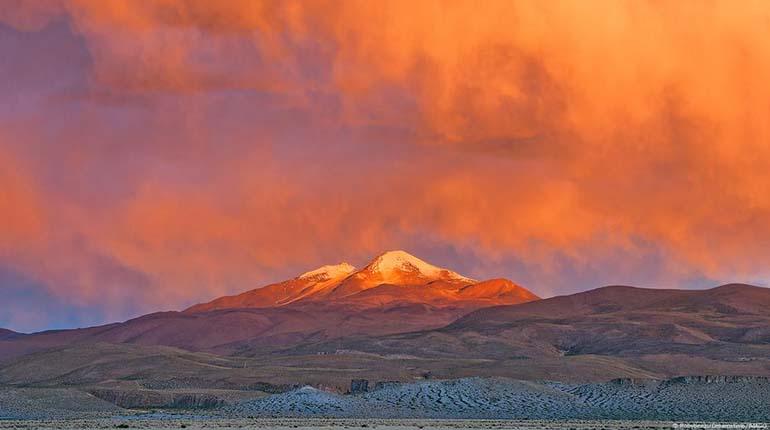 The Uturuncu volcano, located near the border with Argentina. | DW
The Uturuncu volcano is classified as a “zombie” because its last eruption occurred thousands of years ago. Now, scientists have documented an increase in its activity. What does this mean for people living in the area?
A team of researchers has studied the possible threat of a “zombie” volcano, previously declared “dead,” but which continues to show signs of activity, although not enough to erupt, according to a study published Monday in the journal Proceedings of the National Academy of Sciences.
Uturuncu is a volcano located in the Central Andes of Bolivia, informally referred to by scientists as a “zombie volcano,” since its last eruption was over 250,000 years ago.
Zombie volcanoes “are a kind of unique beasts, but they’re not entirely uncommon,” explained geophysicist Matthew Pritchard in a statement from Cornell University (USA).
Neither “dead” nor “extinct”
However, the increased seismic activity in the area and the release of gas plumes have shown that the volcano is neither “dead” nor “extinct,” although there’s no strict definition on this matter, according to the science website IFL Science.
“When people look at volcanoes, they think: ‘Oh, if it’s not going to erupt, we don’t care.’ But in reality, volcanoes that seem dead on the surface aren’t dead underneath,” Pritchard adds.
Activity at Uturuncu
In light of the increase in volcanic activity and the growing concern of local residents, scientists decided to find out how “alive” Uturuncu is and whether it could erupt anytime soon.
After analyzing data from more than 1,700 earthquakes in the area, the researchers mapped the plumbing system beneath the volcano and also noticed that the ground around the volcano is sinking.
Water and steam rising to the surface
The results reveal a shallow hydrothermal system, with hot water slowly rising outward. Additionally, beneath the crater there is a reservoir where gas accumulates, pushing the surface upward at a rate of 1 centimeter per year.
“The methods in this study could be applied to more than 1,400 potentially active volcanoes and dozens of volcanoes like Uturuncu that are not considered active but show signs of life,” Pritchard said in another statement from the University of Oxford (UK).
According to IFL Science, there are many other “zombie” volcanoes on Earth. Many of them “sleep” for thousands of years and suddenly “wake up” violently. Some examples include Mount St. Helens in the United States, which was dormant between 11,000 and 4,000 years ago, or Yellowstone, whose last lava flow was about 70,000 years ago.
An economic opportunity
For now, scientists rule out the possibility of an Uturuncu eruption, “although some neighboring volcanoes might erupt,” Pritchard warns.
Additionally, scientists seem interested in the potential formation of minerals resulting from volcanic activity, such as copper, which could bring economic benefits.
“There are still processes underway. And the processes at Uturuncu are particularly interesting because they tell us about the fluids and gases moving around there, which could become, or maybe already are, a reservoir of minerals that could be useful for technology,” the expert adds.
“Even though we’re not really concerned about this particular volcano erupting in the next few years, we can observe the processes in real time that could lead to that. Clearly, there is underground activity that could even, at some point, be economically useful,” Pritchard emphasizes.
Edited by Jose Urrejola, with information from Science Alert, University of Oxford, Cornell University, IFLScience, and PNAS.
Por DW, Los Tiempos:
El volcán Uturuncu, situado cerca de la frontera con Argentina. | DW
El volcán Uturuncu es clasificado como “zombi” porque su última erupción ocurrió hace miles de años. Ahora, científicos documentaron un aumento en su actividad. ¿Qué significa esto para los habitantes de la zona?
Un equipo de investigadores ha estudiado la posible amenaza de un volcán “zombi”, que había sido declarado “muerto”, pero que continúa mostrando signos de actividad, aunque no para erupcionar, según detalla un estudio publicado por la revista Proceedings of the National Academy of Sciences el lunes.
El Uturuncu es un volcán ubicado en los Andes Centrales de Bolivia, que ha sido calificado informalmente por los científicos como un “volcán zombi”, ya que su última erupción ocurrió hace más de 250.000 años.
Los volcanes zombi “son una especie de bestias únicas, pero no son del todo infrecuentes”, explica el geofísico Matthew Pritchard, en un comunicado de la Universidad de Cornell (Estados Unidos).
Ni “muerto”, ni “extinto”
Sin embargo, el aumento de la actividad sísmica en la zona y la expulsión de columnas de gas ha evidenciado que el volcán no está ni “muerto”, ni “extinto”, aunque tampoco hay una definición estricta sobre este tema, según informa el sitio especializado IFL Science.
“Cuando la gente mira los volcanes, piensa: ‘Oh, si no va a entrar en erupción, no nos interesa’. Pero, en realidad, los volcanes que parecen muertos en la superficie no lo están en el fondo”, añade Pritchard.
Actividad del Uturuncu
Ante el aumento de la actividad volcánica y la creciente preocupación de los habitantes de la zona, los científicos decidieron averiguar qué tan vivo está el Uturuncu y si podría erupcionar dentro de poco.
Tras analizar los datos de más de 1.700 terremotos ocurridos en los alrededores, los investigadores cartografiaron el sistema de tuberías debajo del volcán, percatándose también de que la zona alrededor del volcán se está hundiendo.
Agua y humo saliendo hacia la superficie
Los resultados muestran un sistema hidrotermal poco profundo, con agua caliente que aumenta lentamente hacia el exterior. Asimismo, debajo del cráter hay un depósito donde se acumula un gas que empuja la superficie hacia arriba a un ritmo de 1 centímetro por año.
“Los métodos de este trabajo podrían aplicarse a los más de 1.400 volcanes potencialmente activos y a las decenas de volcanes como el Uturuncu que no se consideran activos, pero que dan señales de vida”, afirma Pritchard, en otro comunicado de la Universidad de Oxford (Inglaterra).
Según IFL Science, existen muchos otros volcanes “zombis” en la Tierra. Muchos de ellos “duermen” durante miles de años y de repente se “despiertan” con violencia. Algunos ejemplos de esto son el Monte Santa Helena, en Estados Unidos, que estuvo inactivo hace entre 11.000 y 4.000 años, o Yellowstone, que tuvo su último flujo de lava hace unos 70.000 años.
Es una oportunidad económica
Los científicos descartan, por ahora, que el Uturuncu pueda erupcionar, “aunque algunos volcanes vecinos puede que lo hagan”, alerta Pritchard.
Asimismo, los científicos parecen estar interesados en la posible formación de minerales derivadas de la actividad volcánica, como el cobre, algo que podría dejar una ganancia económica.
“Todavía hay procesos en marcha. Y los procesos en el Uturuncu son particularmente interesantes porque nos hablan de los líquidos y los gases que se mueven por allí y que podrían convertirse, o quizá incluso lo sean hoy, en una reserva de minerales que podrían ser útiles para la tecnología”, agrega el experto.
“Aunque no nos preocupe realmente que este volcán en concreto entre en erupción en los próximos años, podemos ver en tiempo real los procesos para que esto ocurra. Claramente, hay actividad subterránea que puede ser incluso, en algún momento, económicamente útil”, subraya Pritchard.
Editado por Jose Urrejola, con información de Science Alert, Universidad de Oxford, Universidad de Cornell, IFLScience y PNAS.

 Bolivian Thoughts | Pensamientos Bolivianos (Bilingual/Bilingüe)