
By Marco Antonio Belmonte, Vision 360:
Quality and Competitive Prices
Coffins, Hair, Egg Yolks, and Chili Peppers Among Bolivia’s Unique Exports
The country sells zippers, rabbit or hare hair, beef offal such as livers and tongues, oregano, lemon juice, and there is potential for essential oils, llama jerky, api, fruit nectar, and more.
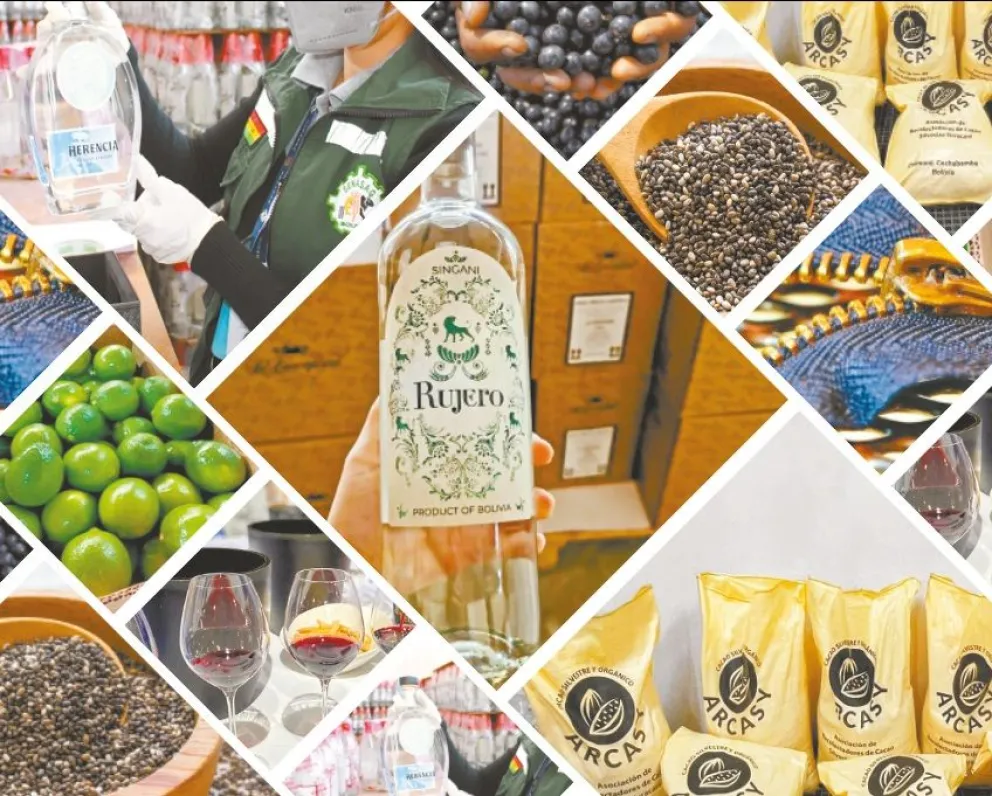
Products in Bolivia’s export portfolio: singanis, zippers, wines, cocoa, lemons, chia seeds, and others. Photo: Composition
Did you know that Bolivia exports improbable products, not just traditional ones? Yes, for example, it sends coffins, hair for wigs, dried egg yolks, and rabbit or hare hair to international markets. There are 48 strategic products that are part of this unique export portfolio for 2024 and 2025.
Last year, Bolivia’s sales to global markets reached 8.9229 billion dollars, representing a 17% decrease compared to 2023.
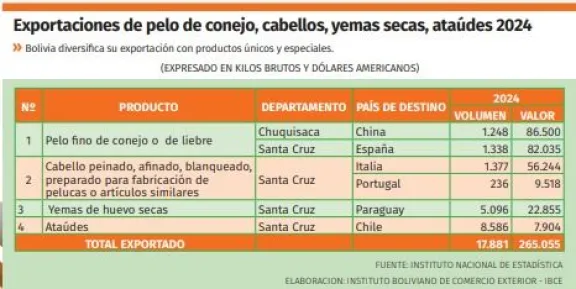
For instance, Bolivia produces combed, refined, bleached hair prepared for the manufacture of wigs or similar items, which are shipped from Santa Cruz to European markets. Last year, Italy bought 1,377 kilos valued at 56,244 dollars and Portugal bought 236 kilos for 9,518 dollars, according to data from the National Institute of Statistics (INE) processed by the Bolivian Institute of Foreign Trade (Ibce).
A total of 1,248 kilos of fine rabbit or hare hair produced in Chuquisaca were exported to China, worth 86,500 dollars, and 1,338 kilos were sent from Santa Cruz to Spain for 82,045 dollars.
Bolivia’s special export offerings also include dried egg yolks shipped from Santa Cruz to Paraguay for 22,855 dollars with a volume of 5,096 kilos, and coffins manufactured in Santa Cruz and exported to Chile for 7,904 dollars with a volume of 17,881 kilos.
Ibce also reports that Bolivia has exported more than one thousand tons of zipper closures over the past five years, positioning itself as a reliable supplier of this textile input internationally.
La Paz stands out as the country’s main exporter of zippers, with exports exceeding 650,000 dollars from 2020 to 2024, according to INE data. However, in 2024, Santa Cruz joined this production chain, showing that more regions are betting on non-traditional exports.
The main destination for zipper closures is Peru, a country that has recognized the Bolivian industry as a quality and reliable supplier since 2000, according to the institute.
“There are iconic products that show that exports are open to the entrepreneur’s imagination—you can sell even the sky,” said Gary Rodríguez.
Strategic Products
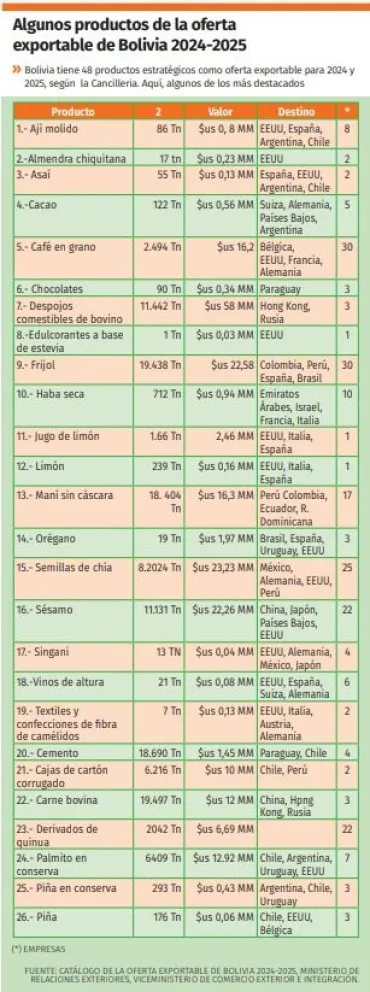
The Vice Ministry of Foreign Trade and Integration presented last year the catalog of Bolivia’s exportable offer for 2024–2025, made up of 48 strategic products whose priority insertion is through value-added generation. Here are some examples:
- Ají [Chili Pepper]
For example, the list includes ground chili, marketed by eight exporting companies with a volume of 86 tons to markets in the United States (USA), Spain, Argentina, and Chile.
In Bolivia, production volume reaches 2,871 tons with an average yield of 1.15 tons per hectare.
Among the national varieties are red chili (chicotillo, punta de lanza, huacareteño, asta de toro), yellow chili (asta de toro amarillo, asta de toro anaranjado, and huacareteño amarillo).
“Chili is one of the most relevant and economically important products in southern Bolivia. It is one of the most appreciated and valued condiments in national and international gastronomy due to its organoleptic properties, flavor, and versatility. Ground chili is made from crushed dried chilies, giving it a unique and characteristic flavor and spiciness of the region,” states Bolivia’s Foreign Ministry.
- Açaí
Another product in the offer is açaí, with sales of 0.13 million dollars for 55 tons to markets in Spain, the USA, Argentina, and Chile.
“Açaí is an excellent energizer, rich in vitamins, saturated fats, fiber, and proteins, and stands out for its high anthocyanin content, an antioxidant that reduces the aging process. Lyophilized açaí is the dehydrated pulp of the fruit; after extraction, it undergoes a freeze-drying process that consists of drying the product cold. It retains all the nutritional and sensory characteristics of the food,” the Foreign Ministry’s bulletin states.
The harvest of this product, still wild in some regions, reaches 670,712 tons in La Paz, Pando, and Beni, with a cultivated area of 1,193,333 hectares.
- Oregano
Through three companies, Bolivia also exports oregano to Brazil, Spain, the USA, and Uruguay for 1.97 million dollars for 19 tons sold. The condiment is in demand because it is ideal for preparing pasta, pizzas, soups, and digestive liqueurs. Around 800 tons are produced in Cochabamba, Tarija, and Chuquisaca.
- Cocoa Beans
Another product with interesting demand is cocoa beans. Bolivia exports 122 tons to markets in Switzerland, Germany, the Netherlands, and Argentina. There are five exporting companies, and production in La Paz, Pando, Cochabamba, and Beni reaches 5,792 tons.
According to the Foreign Ministry, cocoa is one of Bolivia’s most important commercial crops. It is characterized as mainly organic, since the groves grow naturally without any human intervention. Moreover, the climatic conditions and careful harvest and post-harvest handling ensure fine aromatic cocoa. In Bolivia, there is both foreign and wild cocoa growing naturally throughout the Bolivian Amazon.
- Coffee Beans
In Bolivia, 30 companies export coffee beans worth 16.2 million dollars, marketing 2,494 tons. The destinations are Belgium, the USA, France, and Germany.
Production reaches 23,452 tons in La Paz, Cochabamba, Santa Cruz, and Pando.
- Beef Offal
Bolivia exports frozen tongues, frozen livers, and other edible beef offal such as feet, hearts, udders, and kidneys frozen upon customer request, highly valued in the gastronomy of various countries.
According to Foreign Ministry data, Bolivia sold a total of 11,442 tons of these products to Russia and Hong Kong through three exporting companies, generating an economic movement of about 58 million dollars.
- Stevia Sweeteners
Bolivia produces 80 tons of stevia in its criolla and native varieties in Cochabamba, Santa Cruz, Beni, Chuquisaca, and Tarija and exports stevia-based sweeteners with a volume of one ton to the US market through two companies.
Stevia sweeteners are known worldwide as a natural additive. Stevia contains chemical substances that are 200 to 300 times sweeter than sucrose but are more beneficial and healthier than processed sugar.
- Lemon Juice
Se exportan 1.606 toneladas de jugo de limón, por 2,46 millones de dólares a los mercados de EEUU, Italia y España.
- Singani
Bolivia produces five million liters of singani in La Paz, Tarija, Chuquisaca, and Potosí, and through four companies, exports 13 tons to the USA, Germany, Mexico, and Japan.
Special Offers
Other strategic exportable products include the Chiquitano almond shipped to the USA; bananas to Argentina, Chile, and Uruguay; beef to China, Hong Kong, and Russia; chocolates to Paraguay, Japan, Germany, and the USA; quinoa derivatives to Canada, the USA, Australia, and Spain; beans to Colombia, Peru, Spain, and Brazil; dry broad beans to the United Arab Emirates, Israel, France, and Italy; powdered and fluid milk to Colombia, Peru, and Venezuela; shelled peanuts to Peru, Colombia, Ecuador, and the Dominican Republic.
Also included are hearts of palm, pineapples, canned pineapples, quinoa, chia seeds, sesame, cement, textiles and garments made from camelid fiber, corrugated cardboard boxes, among others.
In its report, the Foreign Ministry highlights products with potential for export such as natural essential oils from citrus, lavender, eucalyptus, lemon, mint; api made from purple corn, yellow corn, and amaranth; cotton; amaranth and derivatives like grain, amaranth pop, and chocolate-covered energy bars; and freeze-dried bananas resulting from the dehydration of fresh bananas through industrial processes.
Other products sold include llama jerky, dried fruits, fruit juice and nectar, herbal infusions and coca tea, maca, honey, avocados, instant soups, coffee, and tarwi.
Outlook
For Ibce manager Gary Rodríguez, nothing is set in stone in international trade, and Bolivia can sell anything if the products have quality, affordable prices, and market opportunity—key elements of competitiveness.
“How much can Bolivia sell? The sky’s the limit. Some countries sell improbable products—not just coffins, hair, or dried egg yolks, which Bolivia already exports. There are iconic products that show exports are open to entrepreneurial imagination; whoever has the ability can sell even the sky,” he illustrated.
$56,244 is the value of hair exports for wig making to Italy. A total of 1,377 kilos were shipped to that country, and Portugal imported another 236 kilos in 2024.
Rodríguez stated that Bolivia has potential to produce a vast array of products from nature, biodiversity, or products requiring transformation and manufacturing, such as rare earths extracted from the subsoil.
“The world demands products that stand out for their novelty, health benefits, or environmental sustainability. Several years ago, I was in France, and on the street, a small can was being sold for 10 dollars with an attractive design that said ‘air from France.’ Everything can be exported if there is ability, imagination, affordable prices, and quality,” he emphasized.
Por Marco Antonio Belmonte, Vision 360:
Calidad y precio competitivos
Ataúdes, cabello, yemas y ajíes, entre las singulares exportaciones de Bolivia
El país vende cierres, pelo de conejo o liebre, despojos de carne de res como hígados, lengua, orégano, jugo de limón y hay potencial con aceites esenciales, charque de llama, api, néctar de frutas y más.
Productos de la oferta exportable de Bolivia: singanis, cierres, vinos, cacao, limón, chía y otros. Foto: Composición
¿Conocía que Bolivia exporta productos inverosímiles y no solo productos tradicionales? Sí, por ejemplo, envía a mercados del exterior ataúdes, cabello para pelucas, yemas de huevo secas, pelo de conejo o liebre. Hay 48 productos estratégicos que forman parte de esta oferta singular, exportable entre 2024 y 2025.
El año pasado, las ventas bolivianas a los mercados del mundo alcanzaron a 8.922,9 millones de dólares, lo que representó una disminución del 17% en comparación con 2023.
Por ejemplo, Bolivia produce cabello peinado, afinado, blanqueado, preparados para fabricación de pelucas o artículos similares, que se envían desde Santa Cruz a mercados de Europa. El año pasado Italia compró 1.377 kilos por valor de 56.244 dólares y Portugal, 236 kilos por 9.518 dólares, según datos del Instituto Nacional de Estadística (INE) y procesados por el Instituto Boliviano de Comercio Exterior (Ibce).
Se exportaron 1.248 kilos de pelo fino de conejo o de liebre, producido en Chuquisaca, hacia China, por un valor de 86.500 dólares y, de Santa Cruz a España, 1.338 kilos por 82.045 dólares.
La oferta especial de productos bolivianos también incluye yemas de huevo secas, de Santa Cruz a Paraguay, por 22.855 dólares y un volumen de 5.096 kilos, o ataúdes que se fabrican en Santa Cruz y se llevan a Chile, por 7.904 dólares y un volumen de 17.881 kilos.
El Ibce también informa que Bolivia exportó más de mil toneladas de cierres de cremallera en los últimos cinco años, posicionándose como un proveedor confiable de este insumo textil en el ámbito internacional.
La Paz se destaca como el principal exportador de cierres del país, con exportaciones que superan los 650 mil dólares, desde la gestión 2020 a 2024, de acuerdo con datos proporcionados por el INE. Sin embargo, en 2024, Santa Cruz se sumó a esta cadena productiva, mostrando que más regiones están apostando por las exportaciones no tradicionales.
El principal destino de los cierres de cremallera es Perú, país que reconoce en la industria boliviana un proveedor de calidad y confiabilidad, desde el 2000, según el instituto.
“Hay productos icónicos que demuestran que la exportación está abierta a la imaginación del emprendedor, se puede vender hasta el cielo”, señaló Gary Rodríguez.
Productos estratégicos
El Viceministerio de Comercio Exterior e Integración presentó, el año pasado, el catálogo de la oferta exportable boliviana 2024 – 2025, compuesta por 48 productos estratégicos, cuya inserción prioritaria es mediante la generación de valor agregado. Estos son algunos:
- Ají
Por ejemplo, en la lista se encuentra el ají molido que fue comercializado por ocho empresas exportadores por un volumen de 86 toneladas a mercados de Estados Unidos (EEUU), España, Argentina y Chile.
En Bolivia el volumen de producción es de 2.871 toneladas con un rendimiento promedio de 1,15 toneladas por hectárea.
Entre las variedades nacionales están el ají rojo (chicotillo, punta de lanza, huacareteño, asta de toro), ají amarillo (asta de toro amarillo, asta de toro anaranjado y el huacareteño amarillo).
“El ají es uno de los productos con mayor relevancia e importancia económica en el sur de Bolivia. Es uno de los condimentos más apreciados y valorados en la gastronomía nacional e internacional por sus propiedades organolépticas, sabor y versatilidad. El ají molido se elabora a partir de ajíes secos triturados, lo que le confiere un sabor y picor únicos y característicos de la región”, señala la Cancillería boliviana.
- Asaí
Otro producto en la oferta es el asaí con ventas por 0, 13 millones de dólares por 55 toneladas a los mercados de España, EEUU, Argentina y Chile.
“El asaí es un excelente energizante, es rico en vitaminas, grasas saturadas, fibras y proteínas, y destaca por su alto contenido de antocianina, un antioxidante que reduce el proceso de envejecimiento. El asaí liofilizado es la pulpa del fruto deshidratado; luego de la extracción pasa por el proceso de liofilización que consiste en el secado del producto en frío. Mantiene todas las características nutricionales y sensoriales del alimento”, señala el boletín de la Cancillería.
La cosecha de este producto, aún silvestre en algunas regiones, llega a 670.712 toneladas en La Paz, Pando y Beni, y hay una superficie cultivada de 1.193.333 hectáreas.
- Orégano
A través de tres empresas, Bolivia también exporta orégano a Brasil, España, EEUU y Uruguay por 1,97 millones de dólares que pagan las 19 toneladas vendidas. El condimento tiene demanda porque es ideal en la elaboración de pastas, pizzas, sopas y licores digestivos. Se producen 800 toneladas en Cochabamba, Tarija y Chuquisaca.
- Cacao en grano
Otro producto con una demanda interesante es el cacao en grano y Bolivia exporta 122 toneladas a mercados de Suiza, Alemania, Países Bajos y Argentina. Hay cinco empresas exportadoras y la producción en La Paz, Pando, Cochabamba y Beni llega a 5.792 toneladas.
Según la Cancillería, el cacao es uno de los cultivos comerciales más importantes en Bolivia. Se caracteriza por ser principalmente orgánico, pues los rodales crecen naturalmente sin intervención alguna del ser humano. Además, las condiciones climáticas y el cuidado en la cosecha y post cosecha aseguran un cacao fino en aroma. En Bolivia existe el cacao foráneo y el cacao silvestre que crece naturalmente en toda la Amazonia boliviana.
- Café en grano
En Bolivia hay 30 empresas que exportan café en grano por 16,2 millones de dólares por la comercialización de 2.494 toneladas. Los destinos son Bélgica, EEUU, Francia y Alemania.
En La Paz, Cochabamba, Santa Cruz y Pando se producen 23.452 toneladas.
- Despojos de carne bovina
Bolivia exporta lengua congelada, hígados congelados y otros despojos comestibles de carne bovina como patas, corazón, ubres, riñones congelados a solicitud del cliente, que son muy apreciados en la gastronomía de varios países.
De acuerdo con datos de la Cancillería, Bolivia vendió a través de tres empresas exportadoras un total de 11.442 toneladas de estos productos a los mercados de Rusia y Hong Kong, lo que reportó un movimiento económico de unos 58 millones de dólares.
- Edulcorantes de estevia
Bolivia produce 80 toneladas de estevia en sus variedades criolla y nativa en Cochabamba, Santa Cruz, Beni, Chuquisaca, Tarija y exporta edulcorantes a base de estevia con un volumen de una tonelada al mercado de EEUU a cargo de dos empresas.
El edulcorante de estevia es conocido mundialmente como un aditivo natural. La estevia contiene sustancias químicas que son 200 o 300 veces más dulces que la sacarosa, pero son más benéficas y saludables que el azúcar procesada.
- Jugo de limón
Se exportan 1.606 toneladas de jugo de limón, por 2,46 millones de dólares a los mercados de EEUU, Italia y España.
- Singani
Bolivia produce cinco millones de litros de singani en La Paz, Tarija, Chuquisaca, Potosí y exporta, a través de cuatro empresas, 13 toneladas a los mercados de EEUU, Alemania, México y Japón.
Ofertas especiales
Entre otros productos estratégicos exportables están la almendra chiquitana, que se envía a EEUU; banano a la Argentina, Chile y Uruguay; carne de bovino a China, Hong Kong, Rusia; chocolates a Paraguay, Japón, Alemania, EEUU; y derivados de quinua a Canadá, EEUU, Australia, España; frijol a Colombia, Perú, España, Brasil; haba seca que se dirige a Emiratos Árabes, Israel, Francia, Italia; leche en polvo y leche fluida a Colombia, Perú, Venezuela; maní sin cáscara a Perú, Colombia, Ecuador y República Dominicana.
También figuran palmitos, piña, piña en conserva, quinua, semillas de chía, sésamo, cemento, textiles y confecciones de fibra de camélidos, cajas de cartón corrugado, entre otros.
En su informe, la Cancillería destaca como productos con una oferta potencial de exportación a los aceites esenciales naturales de cítricos, lavanda, eucalipto, limón, menta; api de maíz morado, amarillo y de amaranto; algodón; amaranto y derivados como grano, pop de amaranto y barras energéticas con cobertura de chocolate; banano liofilizado que es el resultado de la deshidratación de banano fresco con procesos industriales.
También se venden charque de llama, frutas deshidratadas, jugo y néctar de frutas, infusiones y mate de coca, maca, miel de abejas, palta, sopas instantáneas, café y tarwi.
Perspectiva
Para el gerente del Ibce, Gary Rodríguez, en el comercio internacional nada está escrito y Bolivia puede vender todo si los productos tienen calidad, precio asequible y oportunidad de mercado, requisitos que hacen a la competitividad.
“¿Cuánto puede vender Bolivia?, el cielo es el límite. Hay países que venden productos inverosímiles, no solo ataúdes, cabellos o yemas secas de huevo que es lo que ya exporta Bolivia. Hay productos icónicos que demuestran que la exportación está abierta a la imaginación del emprendedor; el que tenga habilidad, puede vender hasta cielo”, ejemplificó.
$us 56.244 es el valor de las exportaciones de cabello para la elaboración de pelucas que se exportan hacia Italia. A ese país se enviaron 1.377 kilos y Portugal importó otros 236 kilos en 2024.
Rodríguez sostuvo que Bolivia tiene potencial para producir una enorme cantidad de productos de la naturaleza, de la biodiversidad, o que requieren una transformación, manufacturas, que se extraen de subsuelo; es el caso de las tierras raras.
“El mundo demanda aquellos productos que destacan por su novedad, que son saludables o sostenibles con el medio ambiente. Hace varios años, estuve en Francia y en la calle se ofrecía una pequeña lata que costaba 10 dólares con un llamativo decorado y decía aire de Francia. Todo se puede exportar, si hay habilidad, imaginación, precio asequible y calidad”, recalcó.

 Bolivian Thoughts | Pensamientos Bolivianos (Bilingual/Bilingüe)