
By Gabriela Moreno, El Dia:
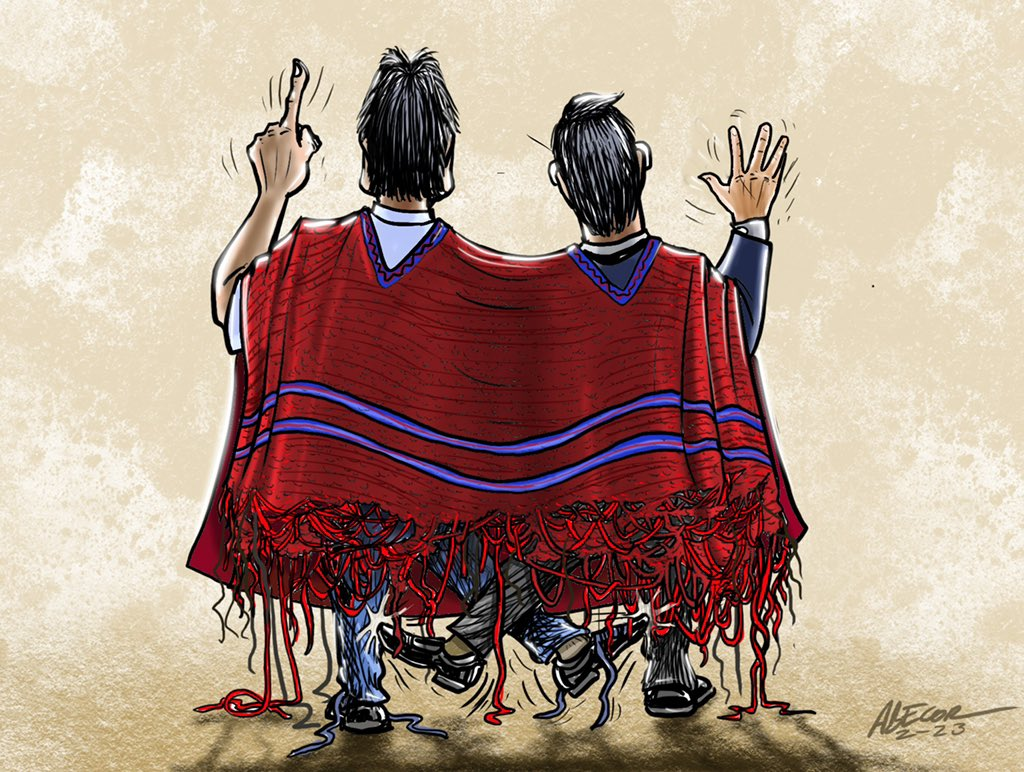
Suspicions of an agreement between Evo Morales and Luis Arce are not unfounded, considering that Chavismo applied a similar strategy in Venezuela in 2000. Back then, Hugo Chávez and Francisco Arias Cárdenas feigned rivalry to monopolize the political spectrum and prevent the rise of a strong opposition candidate. Now, in Bolivia, Morales and Arce stage a conflict that, far from weakening the Movement for Socialism (MAS), keeps the electorate focused on their disputes and leaves no space for the opposition.
Morales has been in hiding for almost four months since an arrest warrant was issued against him for alleged human trafficking. However, despite the judicial measure, authorities have failed to capture him. Meanwhile, Arce claims to be unaware of his whereabouts, though his Minister of Government, Eduardo Del Castillo, revealed that the former president is under a sort of house arrest inside the Kawsachun Coca radio station in Cochabamba.
From there, Morales remains a key asset for the Bolivian left, emphasizing his differences with Arce and keeping his followers mobilized. This traps the electorate in a false dilemma between two factions of MAS, marginalizing any opposition alternative.
A calculated political game
The parallel with the Venezuelan case is evident. In 2000, the apparent dispute between Chávez and Arias Cárdenas fragmented the vote, securing a landslide victory for Chavismo. Morales and Arce’s strategy could be aimed at a similar goal: preventing the emergence of an opposition leader who could seriously challenge their hegemony.
Morales, for his part, has declared his intention to found a new party or take control of an existing one to run for president again. However, the conditions are adverse. Bolivia has 13 legally recognized parties and five peasant organizations, which Morales would have to convince to support him. Additionally, the Supreme Electoral Tribunal requires that a new party be established at least 120 days before the elections and collect 107,000 signatures in five of the country’s nine regions—a nearly impossible task for a candidate in hiding.
Given these obstacles, an alliance with Arce could be Morales’ most viable option. In politics, reconciliations are not uncommon, and MAS might find a formula to retain power without excessive fragmentation.
Legal obstacles for Morales
However, Morales faces another major hurdle: indefinite reelection is no longer possible. A 2023 constitutional ruling established that a president can only be reelected once, either consecutively or non-consecutively, rejecting the previous doctrine that considered reelection a human right. Morales has already served three consecutive terms (2006-2009, 2010-2015, and 2015-2019), making him ineligible for the 2025 elections. This raises questions about his true strategy: does he really intend to run, or is his role merely to divide the vote to benefit MAS?
Opposition under siege
While MAS plays its internal strategy, the Bolivian opposition faces systematic persecution. The courts have reopened a case against former president Jorge Quiroga, who is positioning himself as a candidate. For him, this is no coincidence but a maneuver to disqualify his candidacy. “This is a setup,” he denounces, asserting that the government’s goal is to eliminate any possibility of political alternation.
The courts summoned him while he was traveling in the United States, preventing him from appearing. His case is linked to a 15-year-old lawsuit from Banco Unión, further reinforcing suspicions that this is a political persecution.
In response to this scenario, Quiroga has joined forces with other opposition leaders, including Samuel Doria Medina, Carlos Mesa, and Luis Fernando Camacho (currently detained in Chonchocoro, accused of conspiring against Morales). Their goal is to present a unified front in the presidential elections, but repression and the lack of democratic guarantees make their progress difficult.
The struggle between Morales and Arce appears to be a political ploy aimed at perpetuating MAS’s hold on power. While they pretend to fight for leadership, the opposition is systematically weakened through judicial persecution and harassment. If the political game continues on this path, Bolivia will face elections without a real alternative, consolidating a scenario where socialism remains in power without genuine opposition.
Por Gabriela Moreno, El Dia:
Las sospechas de un acuerdo entre Evo Morales y Luis Arce no son descabelladas, considerando que el chavismo aplicó una estrategia similar en Venezuela en el 2000. Entonces, Hugo Chávez y Francisco Arias Cárdenas fingieron rivalidad para monopolizar el espectro político y evitar el ascenso de un candidato opositor fuerte. Ahora, en Bolivia, Morales y Arce protagonizan un conflicto que, lejos de debilitar al Movimiento al Socialismo (MAS), mantiene al electorado concentrado en sus disputas y deja sin espacio a la oposición.
Morales se encuentra en la clandestinidad desde hace casi cuatro meses, tras emitirse una orden de captura en su contra por supuesta trata de personas. No obstante, a pesar de la medida judicial, las autoridades no han logrado su detención. Mientras tanto, Arce asegura desconocer su paradero, aunque su ministro de Gobierno, Eduardo Del Castillo, reveló que el exmandatario se encuentra en una especie de detención domiciliaria dentro de la radio Kawsachun Coca, en Cochabamba.
Desde allí, Morales sigue siendo un activo clave para la izquierda boliviana, promoviendo sus diferencias con Arce y manteniendo movilizados a sus seguidores. Esto encierra al electorado en un falso dilema entre dos vertientes del MAS, marginando cualquier alternativa opositora.
Un juego político calculado
El paralelismo con el caso venezolano es evidente. En el 2000, la aparente disputa entre Chávez y Arias Cárdenas fragmentó el voto, asegurando una victoria aplastante para el chavismo. La estrategia de Morales y Arce podría estar encaminada a un objetivo similar: impedir que surja un liderazgo opositor que desafíe seriamente su hegemonía.
Morales, por su parte, ha declarado su intención de fundar un nuevo partido o tomar control de uno ya existente para postularse nuevamente a la presidencia. Sin embargo, las condiciones son adversas. Bolivia cuenta con 13 partidos con personería jurídica y cinco agrupaciones campesinas, que Morales debería convencer para que lo respalden. Además, el Tribunal Supremo Electoral establece que la creación de un partido requiere al menos 120 días y la recolección de 107.000 firmas en cinco de las nueve regiones del país, lo que parece imposible para un candidato en la clandestinidad.
Frente a estos obstáculos, una alianza con Arce podría ser la salida más viable para Morales. En política, las reconciliaciones no son extrañas, y el MAS podría encontrar una fórmula para mantener el poder sin fracturarse demasiado.
Obstáculos legales para Morales
No obstante, Morales enfrenta otro problema clave: la reelección indefinida ya no es viable. Una sentencia constitucional de 2023 estableció que un presidente solo puede ser reelegido una vez de manera continua o discontinua, desechando la doctrina anterior que consideraba la reelección un derecho humano. Morales ya gobernó tres veces consecutivas (2006-2009, 2010-2015 y 2015-2019), por lo que estaría inhabilitado para las elecciones de 2025. Esto pone en duda su verdadera estrategia: ¿pretende postularse realmente o su rol es simplemente dividir el voto para beneficiar al MAS?
Oposición bajo asedio
Mientras el MAS juega su estrategia interna, la oposición boliviana enfrenta una persecución sistemática. Los tribunales han reactivado un juicio contra el expresidente Jorge Quiroga, quien se perfila como candidato. Para él, esto no es casualidad, sino una maniobra para inhabilitar su postulación. “Esto es una tramoya”, denuncia, asegurando que el objetivo del gobierno es eliminar cualquier posibilidad de alternancia.
Los tribunales lo citaron mientras estaba en un viaje a Estados Unidos, impidiéndole comparecer. Su caso se vincula a una querella del Banco Unión de hace 15 años, lo que refuerza las sospechas de que se trata de una persecución política.
Ante este panorama, Quiroga ha unido fuerzas con otros líderes opositores, como Samuel Doria Medina, Carlos Mesa y Luis Fernando Camacho (actualmente detenido en Chonchocoro acusado de conspiración contra Morales). Su objetivo es presentarse como un bloque unitario en las elecciones presidenciales, pero la represión y la falta de garantías democráticas dificultan su avance.
La pugna entre Morales y Arce parece ser un artificio político destinado a perpetuar el poder del MAS. Mientras ambos fingen disputarse el liderazgo, la oposición es sistemáticamente debilitada mediante la persecución judicial y el hostigamiento. Si el juego político sigue este curso, Bolivia enfrentará unas elecciones sin una verdadera alternativa, consolidando un escenario donde el socialismo se mantiene en el poder sin oposición real.
https://eldia.com.bo/2025-02-06/opinion/miradas/la-farsa-electoral-de-evo-morales-y-luis-arce.html

 Bolivian Thoughts | Pensamientos Bolivianos (Bilingual/Bilingüe)