
By Ewin Chura/Leyla Mendieta Cruz, Unitel; Eju.tv:
The Vice Minister of Civil Defense, Juan Carlos Calvimontes, stated that since the rainy season began in late 2024, a total of 23 people have died. In Cobija, Pando, families were evacuated
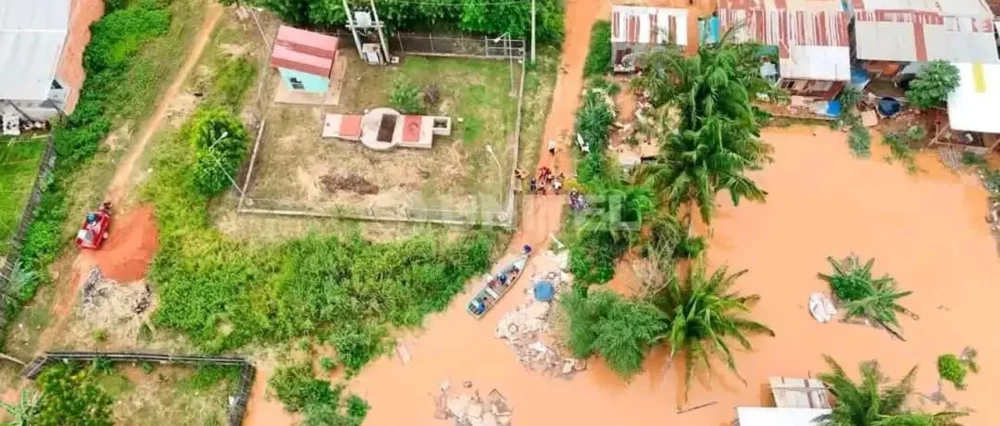
[Photo: Vice Ministry of Defense] / This is what Cobija, the capital of Pando, looks like
The Vice Minister of Civil Defense, Juan Carlos Calvimontes, reported that after six continuous hours of rain, the Bahía stream overflowed on Tuesday in Cobija, Pando, affecting 100 families. In response, he mentioned that 30 families were evacuated to a shelter set up at the La Peta Municipal Coliseum.
He also stated that nationwide, since the rainy season began in November of last year, the death toll has reached 23, with incidents occurring in the departments of Chuquisaca, La Paz, Tarija, Cochabamba, Santa Cruz, and Potosí. He added that two people remain missing.
A week ago, Civil Defense had reported 19 fatalities due to the rains, meaning that in just seven days, four more people lost their lives due to the floods.
He detailed that the flooding in Cobija mainly affected three neighborhoods: Petrolero, Bahía, and the one known as Evo Morales. “The overflow was not from the Acre River but from the Bahía stream,” he emphasized.
Nationwide impact
A total of 109,156 families have been affected or displaced across the country. Additionally, 22 municipalities have declared a state of disaster.
Calvimontes highlighted that the National Service of Meteorology and Hydrology (Senamhi) has issued an alert for La Paz, Oruro, Cochabamba, Santa Cruz, and Beni, warning of the possibility of river overflows.
He also noted that an extreme heat alert remains in effect for the Chaco region, both in Tarija and Santa Cruz.
Por Ewin Chura/Leyla Mendieta Cruz, Unitel; Eju.tv:
El viceministro de Defensa Civil, Juan Carlos Calvimontes, señaló que en la época de lluvias, que empezó a finales del 2024, suman 23 personas fallecidas. En Cobija, Pando, se evacúo familias
[Foto: Viceministerio de Defensa] / Así luce Cobija, capital de Pando
El viceministro de Defensa Civil, Juan Carlos Calvimontes, informó que después de seis horas continuas de lluvias el arroyo Bahía se desbordó el martes en Cobija, Pando, y afectó a 100 familias. ante ello, mencionó que se evacuó a 30 familias a un albergue que se habilitó en el Coliseo Municipal La Peta.
Mientras señaló que a nivel nacional en la época de lluvias, que comenzó el noviembre del año pasado, suman 23 personas fallecidas, en situaciones ocurridas en los departamento de Chuquisaca, La Paz, Tarija y Cochabamba, Santa Cruz y Potosí. Agregó que hay dos personas desaparecidas.
Hace una semana, Defensa Civil informaba que los fallecidos por lluvias eran 19; es decir, en siete días, cuatro personas más fallecieron a causa de las inundaciones.
Detalló que el agua en Cobija inundó principalmente tres barrios, Petrolero, Bahía y el conocido como Evo Morales. “El desborde no fue del río Acre, fue del arroyo Bahía”, enfatizó.
A nivel nacional
En el país suman 109.156 familias entre afectadas y damnificadas. En el país hay 22 municipios declarados en desastre.
Calvimontes remarcó que el Servicio Nacional de Meteorología e Hidrología (Senamhi) emitió una alerta para La Paz, Oruro, Cochabamba, Santa Cruz y Beni, sitios en los que existe la probabilidad de desborde de ríos.
Remarcó que también está vigente la alerta por extremo calor en la región del Chaco, tanto el tarijeño como el cruceño.

 Bolivian Thoughts | Pensamientos Bolivianos (Bilingual/Bilingüe)