
By Mirna Echave, Vision 360:
Development and Conservation
Safety for climbing and reaching açaí fruits, whether for consumption or trade, prevents people from cutting down these wild palms, helping to preserve them in the Bolivian Amazon.
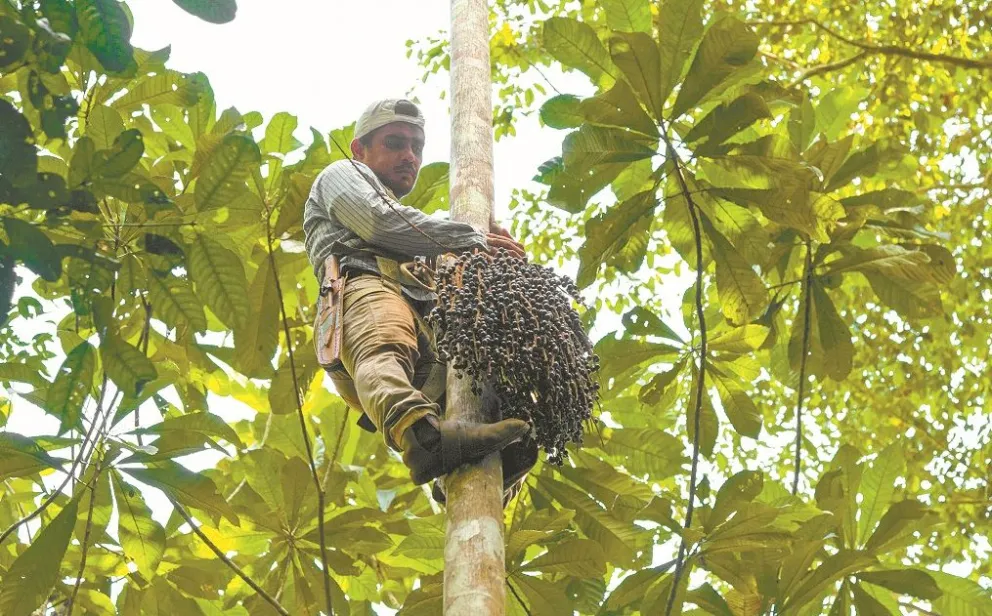
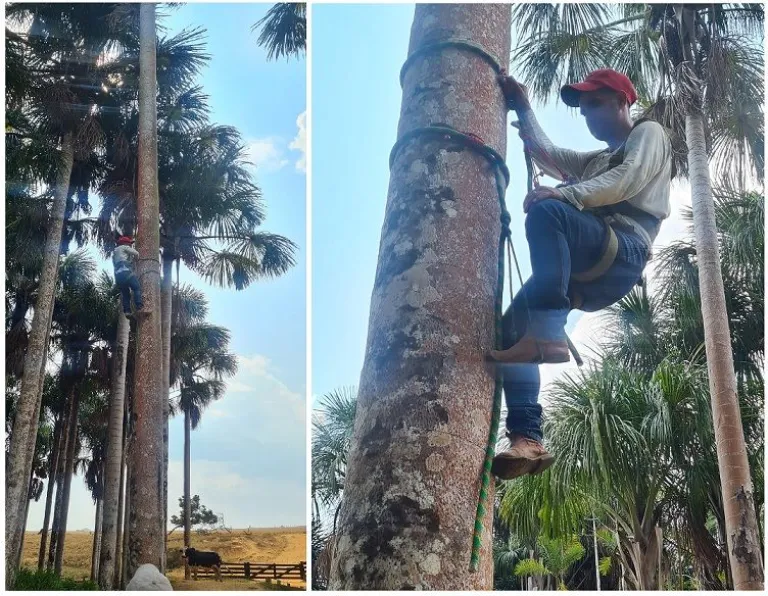
Açaí clusters can weigh up to 18 kilograms, and lowering them from such heights can be dangerous. Photo: Conservación Amazónica
The conservation of the Amazon and the productive development of those living deep within its forests now have a new ally: a “made in Bolivia” harness that allows açaí harvesters to climb trees over 20 meters tall with greater safety, promoting a multitude of social and environmental benefits.
The initiative was developed as part of the projects carried out by Conservación Amazónica, with support from experts in the use of climbing devices and specialists in harvesting wild fruits—the residents of Pando themselves.
“The harness is for the safety of the harvester and also to make them more comfortable during the harvest,” reported Abraham Poma from Conservación Amazónica.
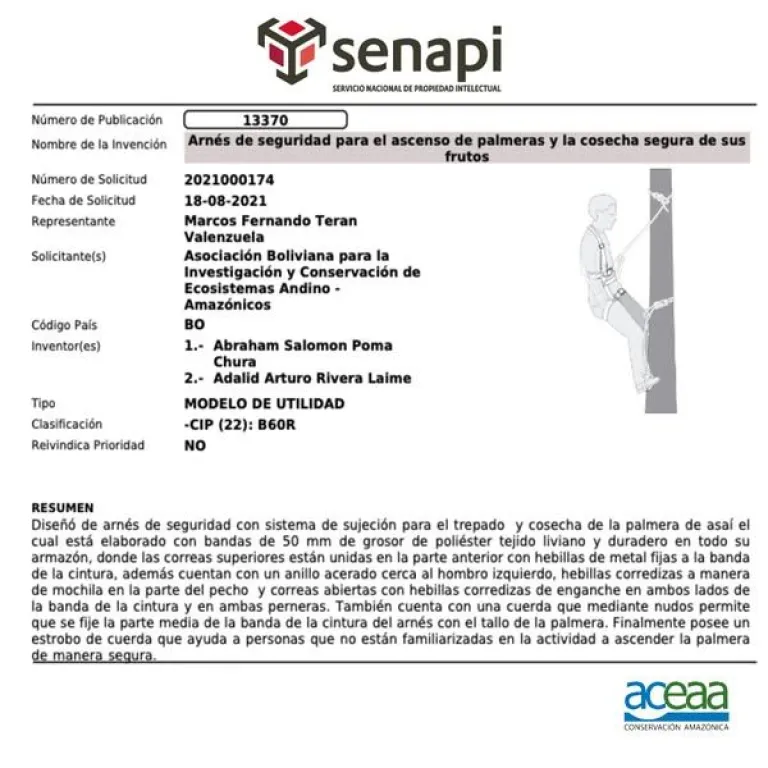
The design was patented in 2021 with the National Intellectual Property Service (Senapi) as a “Safety Harness for Climbing Palm Trees,” according to Abraham Poma, a forest management specialist at Conservación Amazónica.
Currently, the patent for a second harness is being prepared. Derived from the first design, it is adapted for harvesting royal palm or majo, as its safety measures differ due to the thicker trunk.
The Need
Liliana Lorini, director of the local empowerment program at Conservación Amazónica, explained that this NGO works on productive development alongside local stakeholders, the inhabitants of natural forests.
They support them in their development processes, seeking ways to improve their situation while respecting and conserving the natural resources they live with daily.
“We work under a value chain approach, addressing four areas. The first is forest management, the second is transformation, the third is commercialization, and, crosscuttingly, we work on organizational strengthening. Within this value chain approach, we work with various chains that are utilized in the forest,” Lorini explains.
In this context, they realized that one way to ensure the development of wild açaí palms was to prevent them from being cut down for their fruit. These trees are slender, about 40 centimeters in diameter at maturity. Some learned to climb them to reach their clusters, while others simply cut them down to make the fruit fall.
The issue became more noticeable when the fruit gained popularity in city markets. It became commercialized, and more people sought it more frequently; the same happened with other Amazonian fruits.
Creation of the Harness
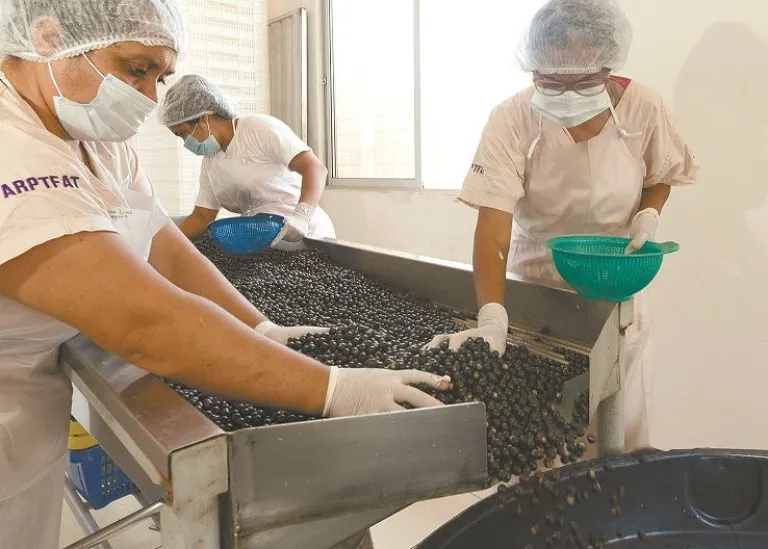
Continuing to “fell” the palm trees would have led to the depletion of açaí. Therefore, to work directly with natural resources “in the forest” and preserve them, technology and tools began to be developed alongside local producers, for instance, in Santa Rosa de Abuná.
“The safety climbing harness, designed to access forest resources, is part of a capacity-building program aimed at ensuring better utilization and safety, especially for harvesters,” said Lorini.
In 2018, the local population recognized the need to protect the palm trees and their fruits for better harvesting practices. This led to the initiation of the harness’s development in collaboration with Conservación Amazónica.
There, at the foot of the dense vegetation, especially young men would tie a sort of rope around their feet to hug the tree and support themselves as they climbed. Sometimes, they would place a rope over their shoulder, under their arm, to hold onto while they harvested the clusters. After obtaining the fruit, still hugging the trunk, they would slip.
Although there are very agile individuals, accustomed to these climbs and descents, using the friction of their arms or legs, and since the fruit weighed between 15 and 18 kilos, accidents were common. A fall from height could be fatal or leave the person with severe injuries and permanent damage.
“We saw the need to implement some technology, primarily for the safety of the harvester and also to make them more comfortable during the harvest, because this way they can use both hands,” commented Poma.
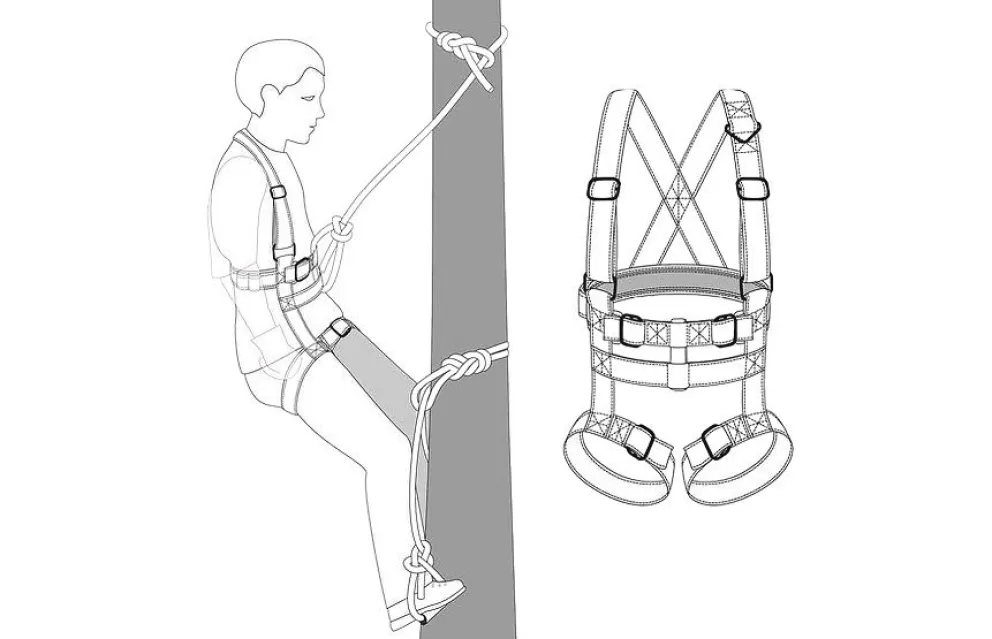
The harness allows them to be suspended, almost sitting, while using both hands to perform a good harvest without damaging the fruits or the bunch and without harming the tree.
However, before achieving the right model for this specific activity, the technicians had to create at least three prototypes, test them, redesign them, discard some parts, ensure good material quality, and gain approval from the community members, who would ultimately be the ones using it.
According to the technician, the metal rings or buckles were removed because they made the harness heavier. Initially, they made a waist model with straps for the legs, but there was still the risk that if someone slipped, they might flip over and fall out of the harness. So, they added additional straps to secure the shoulders, ensuring a more secure fit, so that the person would remain suspended but seated in case of a slip.
Benefits
With all the modifications and adjustments, the harness weighs just over a kilogram. This is important for the producer, as they must walk up to 10 to 15 kilometers for hours to reach the areas where the asaí grows, deep in the forest, in nature.
The straps are made of woven polyester and are five centimeters thick, making them more secure and firm. Its construction, also done in Bolivia, includes reinforcements and stitches that enhance the design’s sturdiness. All of this is thought out to ensure safety for the harvesters.
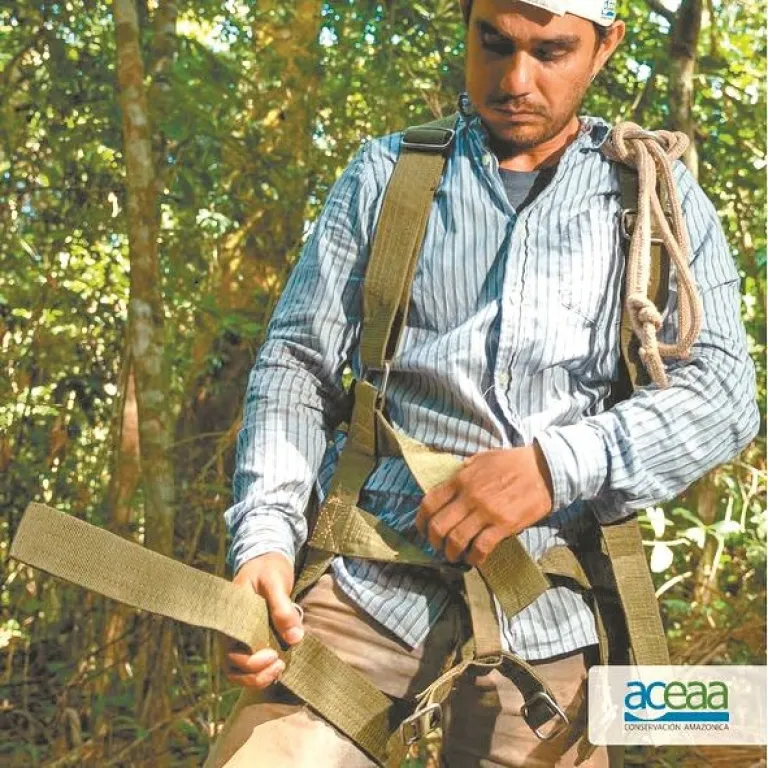
To date, according to the specialist, Conservación Amazónica has provided around 300 harnesses to the açai producers in Pando, who also participated in a long training and evaluation process to ensure the safe use of this equipment, teaching them to take care of the harness and the tools used with it, such as approved ropes for this work, while also promoting the conservation of the wild palm trees of the Amazon.
The New Model
The harness has been successful, which is why it was patented with all the required specifications to verify its effectiveness, scope, and, of course, to ensure that it had not been created before.
Now, the organization announced the completion of a new design, an adaptation of the first harness, which will be applied to the harvest of royal palm and majo, whose trunks are much thicker and require different tools.
For example, alongside the new harness, a longer rope loop and a type of pedals for foot support while climbing are necessary.
In search of empowerment for environmental care
For 14 years, Conservación Amazónica’s projects have focused on protecting this part of the planet, specifically in Bolivia.
For this reason, their work in the natural regions of Pando aims to foster societal empowerment towards the care of nature, according to Natalia Gil Ostria, the Strategic Communication Coordinator for the NGO.
“One of the areas where we’ve worked the most is the department of Pando, which has a forest in fairly good condition. This has been achieved thanks to the sustainable use of Amazonian fruits,” she commented.
She explains that, within the framework of the institutional vision, they work on creating conservation spaces, management, and developing plans to ensure their preservation.
“On the other hand, we focus on science and technology, which provide us with all the technological tools to carry out surveys of these areas, allowing us to assess the quality of resources and the condition of the territory,” she stated.
An essential aspect of all this work is the local population, with whom they develop local empowerment, providing tools so that people can engage in conservation efforts and better manage their surroundings.
“The focus, above all, is to make the most out of these fruits. I think it’s important for the general population to know that wild harvesting is happening, and that consuming these products, which we sometimes don’t see in the market, helps conserve the forest and keep it standing,” she said.
Por Mirna Echave, Vision 360:
Desarrollo y conservación
La seguridad para trepar y alcanzar los frutos del asaí, para consumo o comercio, permite que la gente deje de cortar estas paleras silvestres y así se conserven en la naturaleza de la Amazonía boliviana.
Los racimos del asaí pueden pesar hasta 18 kilos y bajarlos desde la altura puede ser peligroso. Foto: Conservación Amazónica
La conservación de la Amazonía y el desarrollo productivo de quienes habitan en la espesura de sus bosques ahora tienen un nuevo aliado: un arnés “hecho en Bolivia”, que permite que los cosechadores de asaí alcancen a trepar árboles de más de 20 metros, con mayor seguridad, lo cual además promueve una multiplicidad de beneficios sociales y medioambientales.
La iniciativa se forjó dentro de los proyectos que lleva adelante Conservación Amazónica, con el apoyo de expertos en el uso de dispositivos de escalada, así como de expertos en la cosecha de frutos silvestres: los mismos pobladores de Pando.
“El arnés es para la seguridad del cosechador y también para que ellos estén más cómodos en el momento de la cosecha”, informó Abraham Poma, de Conservación Amazónica.
El diseño fue patentado en el Servicio Nacional de Propiedad Intelectual (Senapi) en 2021, como “Arnés de Seguridad para el trepado de palmeras”, según el especialista en manejo forestal de Conservación Amazónica, Abraham Poma.
Hoy se prepara la patente del segundo arnés, derivado del primero, pero ajustado para la cosecha de palma real o majo, cuyas medidas de seguridad difieren porque el tronco es más grueso.
La necesidad
Liliana Lorini, directora del programa de empoderamiento local de Conservación Amazónica, explicó que esta ONG trabaja en el desarrollo productivo junto con los actores locales, los habitantes de los bosques naturales.
Los acompañan en sus procesos de desarrollo, es decir que buscan las formas para que su situación mejore, pero dentro del respeto y conservación de los recursos naturales con los que conviven a diario.
“Trabajamos bajo un enfoque de cadena de valor, atendiendo cuatro ámbitos. El primero es el del manejo del bosque, el segundo es el de transformación, el tercero de comercialización y, transversalmente, estamos trabajando con el fortalecimiento organizacional. Dentro de este enfoque de cadena de valor, trabajamos con varias cadenas, justamente que son aprovechadas en el bosque”, señala Lorini.
En ese contexto vieron que una de las formas para asegurar el desarrollo de las palmeras silvestres de asaí era que no las corten por sus frutos. Estos árboles son delgados, de unos 40 centímetros de diámetro en su madurez, por lo que hubo quienes aprendieron a treparlos para alcanzar sus racimos, pero otros simplemente los cortaban para que caigan.
La situación se notó más cuando este fruto se hizo conocido en mercados de las ciudades. Se volvió comercial y más personas los buscaban con mayor frecuencia; lo mismo pasó con otros frutos amazónicos.
Creación del arnés
El seguir “tumbando” las palmeras hubiera terminado con el asaí. Entonces, para trabajar con los recursos naturales “directamente en el bosque” y preservarlos, fue que se empezó a desarrollar tecnología e instrumentos, junto con los mismos productores locales, por ejemplo, en Santa Rosa de Abuná.
“El arnés de trepado seguro, para acceder a los recursos del bosque, se marca dentro de un programa de fortalecimiento de capacidades, para tener un mejor aprovechamiento y seguridad, sobre todo con los cosechadores”, dijo Lorini.
En 2018 la misma población entendió la necesidad de proteger a las palmeras y a sus frutos, para un mejor aprovechamiento en la recolección. Entonces, con Conservación Amazónica, se empezó a gestar la creación del arnés.
Allí, en las faldas de la tupida vegetación, en especial los hombres jóvenes, se colocaban una especie de sogas en los pies, para abrazar el árbol y poder apoyarse a medida que trepaban. A veces, se ponían una cuerda sobre el hombro, debajo del brazo, para sujetarse mientras arrancaban el racimo. Luego, tras conseguir el fruto, abrazados al tronco, resbalaban.
Aunque hay personas muy ágiles, ya acostumbradas a estas subidas y bajadas, usando el roce de sus brazos o piernas, y como el fruto pesaba entre 15 y 18 kilos, no faltaron los accidentes. Una caída de altura podía ser mortal o dejar a la persona con lesiones graves y daños permanentes.
“Vimos la necesidad de implementar alguna tecnología, más que todo para la seguridad del cosechador y también para que estén más cómodos en el momento de la cosecha, porque así pueden usar ambas manos”, comentó Poma.
El arnés les permite estar colgados, casi sentados, incluso utilizar ambas manos, realizar una buena cosecha, sin afectar los frutos ni el racimo y sin causar daños al árbol.
Pero antes de lograr el modelo adecuado a esta actividad en específico, los técnicos tuvieron que hacer al menos tres prototipos, probarlos, rediseñarlos, descartar algunas partes, asegurarse de que se trate de un buen material, y lograr la aprobación de los comunarios, quienes finalmente son los que lo usarían.
Según el técnico, les quitaron los aros metálicos o maillones, porque los hacían más pesados, y al principio hicieron un modelo a la cintura, con cintas para las piernas, pero aún había el riesgo de que, en caso de un resbalón, la persona se diera vuelta y se saliera del arnés. Por ello agregaron otras cintas para sujetar hombros, para una seguridad integral, de manera que la persona quede colgada pero sentada, en caso de que resbalara.
Beneficios
Con todas las modificaciones e implementos, el arnés pesa un poco más de un kilo. Y esto es importante para el productor, puesto que debe caminar incluso por horas, de 10 a 15 kilómetros, para llegar a las zonas donde crece el asaí, en medio del bosque, en la naturaleza.
Las cintas son de poliéster tejido, tienen un grosor de cinco centímetros, lo que hace que sean más aprensivas y firmes. Su confección, que también se realiza en Bolivia, cuenta con refuerzos y costuras que dan mayor firmeza al diseño. Todo ello pensado en que son objetos que aportan seguridad a los cosechadores.
Hasta la fecha, según el especialista, Conservación Amazónica logró dotar de unos 300 arneses a los productores de asaí de Pando, quienes también participaron en un largo proceso de capacitación y evaluación para que el uso de este material sea seguro, para que aprendan a cuidar el arnés y los implementos que trabajan junto con éste, como cuerdas homologadas paraesta labor, pero también que consoliden el cuidado de las palmeras silvestres de la Amazonía.
El nuevo modelo
El arnés fue exitoso, por ello fue patentado en el Senapi con todos los requisitos exigidos para verificar su efectividad, alcance y, por supuesto, que no se haya creado antes.
Ahora, la institución anunció la conclusión de un nuevo diseño, una adaptación del primer arnés, pero que será aplicado a la cosecha de palma real y majo, cuyos troncos son mucho más gruesos y requieren otros implementos.
Por ejemplo, junto con el nuevo arnés es necesario utilizar un lazo de cuerda más largo y una especie de pedales para apoyar los pies para escalar.
En busca del empoderamiento para el cuidado medioambiental
Desde hace 14 años, los proyectos de Conservación Amazónica buscan justamente el cuidado de esta parte del planeta, en Bolivia.
Por ello, su mirada en las regiones naturales de Pando busca fomentar el empoderamiento de la sociedad hacia el cuidado de la naturaleza, según Natalia Gil Ostria, la coordinadora de Comunicación Estratégica de esta ONG.
“Uno de los espacios en los que más hemos trabajado es el departamento de Pando, que tiene un bosque en bastante buen estado. Esto se ha dado gracias al aprovechamiento sostenible de los frutos amazónicos”, comentó.
Señala que, en el marco de la visión institucional, trabajan en la creación de espacios de conservación, de manejo y en la generación de planes para que se conserven.
“Por otra parte, trabajamos el tema de ciencia y tecnología, que nos aporta con todas las herramientas tecnológicas para hacer un relevamiento de estos espacios, en los que podemos ver justamente la calidad de los recursos que tienen y ver también el estado del territorio”, señaló.
Asimismo, el componente importante en toda esta labor es la población, con la que desarrollan el empoderamiento local y a la que se entregan las herramientas para que trabajen en conservación y puedan aprovechar mejor su espacio.
“El enfoque, sobre todo, es aprovechar de la manera mejor posible estos frutos. Creo que es importante que la población en general también esté al tanto de que se hace una cosecha silvestre y que el consumir estos productos, que a veces no los vemos en el mercado, aportan a que se conserve el bosque y se mantenga en pie”, dijo.

 Bolivian Thoughts | Pensamientos Bolivianos (Bilingual/Bilingüe)