
By Daniela Romero, EFE; Vision 360:
24 years of history
The workshop of the Alanoca Nina family is in the city of El Alto, where the spaces are organized for the different processes required for the crafts.
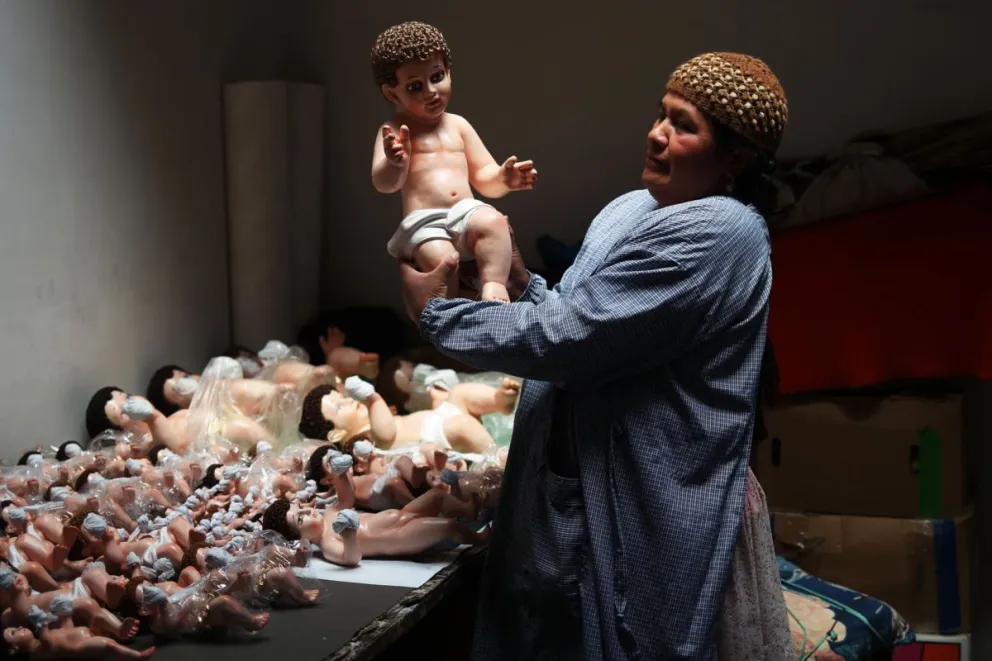
Photograph from December 10, 2024, of Olma Nina holding a figurine of the Baby Jesus in the ‘Alaski’ workshop in El Alto (Bolivia). Photo: EFE
The Baby Jesus, his parents Mary and Joseph, the Three Wise Men, shepherds, and angels are made by dozens in Bolivia by the Alanoca Nina family, who have been dedicated to creating plaster crafts for Christmas for 24 years. Their work reaches Argentina and Peru.
Ovando Alanoca and his wife Olma Nina met in the 1990s in a plaster craft workshop, where they began learning as assistants, from preparing molds to painting the figures that would later be sold wholesale.
“Since I was 14, I arrived at a workshop and my boss opened the doors for me. That house was my school. The years passed, I became a teacher, and gradually I improved and specialized in painting the details of the crafts to give them a good finish,” Alanoca shared.
The artisan couple has three children. Their eldest helps with publicity on social media, the middle child is the one who named the workshop “Alaski,” which in Aymara means “to buy,” and their youngest daughter accompanies her mother in all the activities she undertakes.
Olma’s specialty is putting hair on the Baby Jesus figure, which they make in various sizes, some measuring 7 cm in length and others up to 45 cm.
After leaving the workshop where they both worked, they decided to marry and start a family, but before that, they set out to start their own craft business.
Over time, they gained recognition for the fine finish of their crafts, and they were not only called merchants in La Paz but also in other regions. Today, they receive orders from neighboring countries like Argentina and Peru.
“We deliver wholesale, I have clients from other regions, from here at the Christmas fair. They start making orders from mid-November. We deliver by the dozen, and merchants display my work,” Alanoca explained.
The Alanoca Nina family’s workshop is located in the city of El Alto, next to La Paz, and the spaces are distributed for the different processes required for the crafts.
Alanoca explained that first, they need to prepare the molds for the different figures with a special liquid, and then plaster mixed with water is poured into them.
“The plaster is applied layer by layer with water, and we wait for it to dry for about 20 minutes,” he added.
Once the craft is dry, it is removed from the mold, and imperfections are smoothed with sandpaper.
“A base coat is applied to the figure, and once it dries, we paint by hand the details like eyes, hands, and faces,” said the artisan.
This process is repeated at least 200 times for each batch of crafts to avoid wasting materials, and then the figures are ready for sale.
Olma Nina is responsible for adding hair to the Baby Jesus figures. On her work table, there are dozens of figures waiting, and with patience, she places hair on each one, which arrives from China and other countries.
When she finishes placing the hair, Nina thanks and speaks to the Baby Jesus.
“Thank you, baby, you’ve stayed still,” she says, quickly lifting another figure to do the same work.
Por Daniela Romero, EFE; Vision 360:
24 años de historia
El taller de la familia Alanoca Nina está en la ciudad de El Alto, y en él se distribuyen los espacios para los diferentes procesos que requieren las artesanías.
Fotografía del 10 de diciembre de 2024 de Olma Nina sosteniendo una imagen del Niño Jesús en el taller ‘Alaski’ en El Alto (Bolivia). Foto: EFE
El Niño Jesús, sus padres María y José, los tres Reyes Magos, pastores y ángeles son fabricados por docenas en Bolivia por la familia Alanoca Nina, la cual se dedica desde hace 24 años a realizar artesanías en yeso para la época de Navidad y su trabajo llega hasta Argentina y Perú.
Ovando Alanoca y su esposa Olma Nina se conocieron en los años 90 en un taller de artesanías en yeso, allí comenzaron a aprender como ayudantes desde preparar un molde hasta cómo se pinta a los personajes que después serán vendidos al por mayor.
“Desde que tenía 14 años llegué a un taller y mi jefe me abrió las puertas, esa casa ha sido para mí una escuela. Los años pasaron, he sido maestro, poco a poco me superé y me he especializado en pintura para los detalles de las artesanías para que tengan un buen acabado”, contó Alanoca.
La pareja de artesanos tiene tres hijos, la mayor les ayuda con la publicidad en las redes sociales, el hijo del medio fue quien puso el nombre del taller “Alaski”, que en aimara significa “comprar”, y la hija mejor es quien acompaña a su madre en todas las actividades que realiza.
La especialidad de su esposa es colocar cabello al Niño Jesús, figura que hacen de diferentes tamaños, unos miden 7 centímetros de largo y otros hasta 45 centímetros.
Al salir del taller en el que ambos trabajaban, decidieron casarse y formar una familia, pero antes se propusieron emprender su propio negocio de artesanías.
Con el paso del tiempo se dieron a conocer por el fino acabado de sus artesanías y ya no solo los llamaban comerciantes de La Paz, sino también de otras regiones y actualmente tienen pedidos desde países vecinos como Argentina y Perú.
“Entregamos al por mayor, tengo clientes del interior, de aquí de la feria de Navidad, ya nos hacen pedidos desde mediados de noviembre, entregamos por docenas y los comerciantes exponen mi trabajo”, explicó Alanoca.
El taller de la familia Alanoca Nina está en la ciudad de El Alto, contigua a La Paz, y en él se distribuyen los espacios para los diferentes procesos que requieren las artesanías.
Alanoca explicó que primero tienen que prepararse los moldes de los diferentes personajes con un líquido especial y luego se introduce el yeso mezclado con agua.
“Se va colocando el yeso con agua por capas y se espera a que seque unos 20 minutos”, añadió.
Una vez que la artesanía ya está seca, se la saca del molde y con una lija se quita las imperfecciones.
“Se hace un pintado base que llevará el personaje y luego de que seque se le pinta a mano detalles como ojos, manos y rostros”, dijo el artesano.
Ese procedimiento se realiza por lo menos para 200 artesanías para no perder el material que se usa, y las artesanías ya están listas para venderse.
Nina se encarga de poner el cabello al Niño Jesús, en su mesa de trabajo hay decenas de figuras que esperan y ella con paciencia coloca a cada uno el cabello que les llega de China y de otros países.
Cuando termina de colocar el cabello, Nina agradece y le habla al Niño Jesús.
“Gracias, bebé, te has quedado quieto”, le dice y rápidamente alza otro niño para hacer el mismo trabajo.

 Bolivian Thoughts | Pensamientos Bolivianos (Bilingual/Bilingüe)