
By José Luis Vargas Vaca, anabolivia.org; eju.tv:
Fourth live record in Bolivia of the enigmatic Leopardus bracattus
This little-studied species faces threats such as agricultural and livestock activities, illegal hunting, and the presence of domestic dogs.
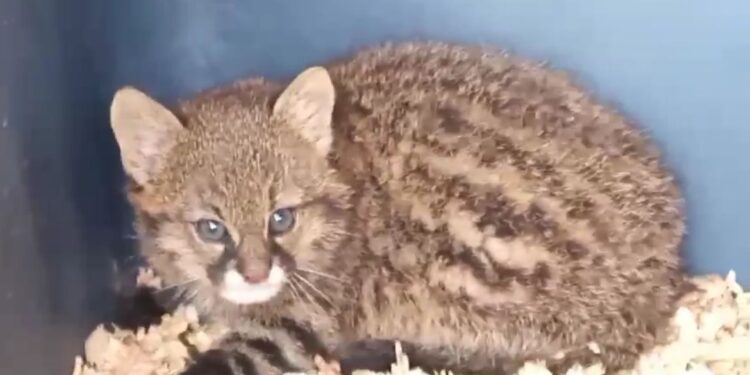
Fires in the forests destroyed hundreds of hectares of trees and wildlife in the department of Beni, Bolivia. However, this environmental tragedy—largely human-caused—once again led to the fourth recorded sighting of a live Leopardus bracattus, also known as the Pantanal Cat, reported Dr. Marcos Greminger.
The approximately six-week-old cub was rescued near the San Ramón-Trinidad road as it fled the flames. It was found by environmental engineer Douglas Bruckner, a technician from the Secretariat of Productive Development, Natural Resources, and Environment of the Beni Government.
Scientific Discovery
Bruckner immediately contacted researcher and professor Marcos Greminger from the José Ballivián Autonomous University of Beni (UABJB). Greminger then informed the Forest and Environmental Protection Police (POFOMA) about this crucial scientific discovery. Together with the authorities, and following all safety protocols, the young mammal was secured.
“We conducted biometric measurements on the animal, which is a beautiful six-week-old female. A protocol is underway. First, we treated her medically to deworm her both internally and externally,” Greminger explained in an interview with ANA.
The cub was also hydrated and given “vitamins and electrolytes orally, followed by a feeding protocol. She is responding excellently to the feeding and rehabilitation protocols,” added the rescuer, who has been busy this season saving wildlife affected by devastating fires.
Growls
When Greminger was feeding her inside the cage, the animal crouched against one of the kennel walls and growled, which is clearly heard in a video [watch below] recorded by the researcher. Additionally, according to literature, the species habitually makes meowing, hissing, and purring sounds.
Currently, all the legal paperwork is being completed to transfer the beautiful female cub to the Tres Estrellas Biological Station—a temporary wildlife refuge dedicated to the care and protection of the Blue-throated Macaw. The refuge is managed by the Loro Parque Foundation, an environmental NGO based in the United States.
Meanwhile, specialized technicians from the Secretariat of Productive Development, Natural Resources, and Environment of the Beni Government will carry out inspections and monitoring alongside POFOMA personnel and Dr. Greminger.
This discovery marks the fourth sighting of this species. The first occurred in 2021, with the subsequent sightings recorded between 2023 and 2024.

Por José Luis Vargas Vaca, anabolivia.org; eju.tv:
Cuarto registro vivo en Bolivia del enigmático Leopardus Bracacctus
Esta especie, poco estudiada, enfrenta amenazas como: la actividad agrícola y ganadera, la cacería ilegal y la presencia de perros domésticos.
Los incendios de los bosques aniquilaron a cientos de hectáreas de árboles y animales silvestres en el departamento de Beni-Bolivia, sin embargo esta tragedia ambiental -provocada en mucho casos- una vez más permitió un cuarto registro o hallazgo de un ejemplar vivo de Leopardus Bracacctus, también conocido como Gato del Pantanal, informó el doctor Marcos Greminger.
La cría de aproximadamente mes y medio fue rescatada en las cercanías del camino San Ramón-Trinidad, mientras huía de las llamas, fue encontrado por el ingeniero ambiental Douglas Bruckner, técnico de la Secretaría de Desarrollo Productivo, Recursos Naturales y Medio Ambiente de la Gobernación del Beni.
Descubrimiento científico
Inmediatamente, Bruckner, se contactó con el docente investigador Marcos Greminger, de la Universidad Autónoma del Beni José Ballivián (UABJB), quién a su vez, hizo conocer de este importantísimo descubrimiento científico a efectivos de la Policía Forestal y Preservación del Medio Ambiente (POFOMA). Junto a estas autoridades guardando todos los protocolos de seguridad, se puso a buen recaudo al pequeño mamífero.
“Realizamos la biometría al animal, que es una hermosa hembra de mes y medio; se está haciendo un protocolo. En primer lugar, se la médico para poderla desparasitar interna como externamente”, explicó Greminger en una entrevista con ANA.
Asimismo, se hidrató al espécimen y se le dio “vitaminas y electrolitos vía oral, para después empezar con el protocolo de alimentación; está respondiendo excelente a los protocolos de alimentación y la rehabilitación”, precisó, el también rescatista, que esta última temporada tuvo un trabajo ajetreado rescatando fauna silvestre a consecuencia de los voraces incendios.
Gruñidos
Precisamente, cuando Greminger la alimenta dentro de la jaula, el animalito se agazapó en una de las paredes del canil, y le lanzó gruñidos, que se escuchan claramente en un video [mirarlo abajo] realizado por el investigador. Además, según la literatura tiene el hábito de efectuar maullidos, siseos y ronroneos.
Al momento, se realiza todo el papeleo legal, para que este hermoso espécimen hembra, sea llevada a la Estación Biológica: Tres Estrellas, —dedicada al cuidado, preservación protección de la Paraba Barba Azul—que es un refugio temporal de fauna silvestre. Está a cargo de la Fundación Loro Parque, una ONG ambientalista de Estados Unidos.
Paralelamente, los técnicos especializados de la Secretaría de Desarrollo Productivo, Recursos Naturales y Medio Ambiente de la Gobernación de Beni; realizarán las inspecciones y el seguimiento junto al personal de POFOMA y el doctor Greminger.
Este descubrimiento se constituye en el cuarto avistamiento de esta especie, el primero fue en 2021 y los restantes entre 2023 a 2024.
https://eju.tv/2024/11/cuarto-registro-vivo-en-bolivia-del-enigmatico-leopardus-bracacctus/

 Bolivian Thoughts | Pensamientos Bolivianos (Bilingual/Bilingüe)