
1904 / 1944: THE “CHAUCHEROS” (Part two. History of transportation in Oruro)
1904, THE FIRST AUTOMOBILE IN BOLIVIA
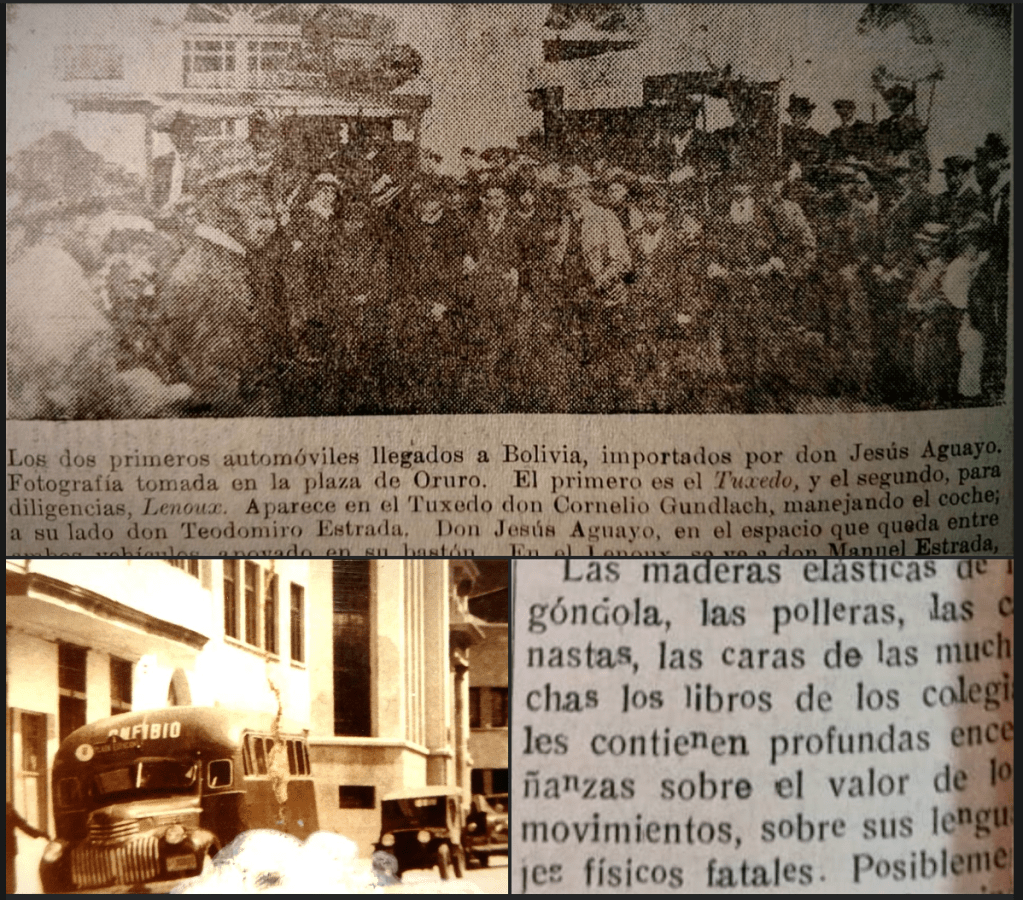
Don Rene Canelas recounts: “In 1904, the first cars, the first automobiles, arrived from the United States by Mr. Jesús Aguayo. Their small plates read ‘SPECIAL CARRIAGE’ ‘MANUFACTURED EXCLUSIVELY FOR MR. J. AGUAYO. UNDER HIS INSTRUCTIONS, CINCINNATI, OHIO, USA,” they were from the NOX factory, one type TUXEDO and another type diligence, for passengers.
The automobiles were intended for Cochabamba, but upon reaching Oruro – our chronicler relates – a bet was made, where Arturo Posnansky bet 5,000 Bs, that he would beat a diligence, with the AUTOMOBILE winning the bet, with Mr. Moíses Ascarrunz, the then prefect of Oruro, as witness… the “horseless carriage” ENTERED the city of La Paz, amidst the excitement of its citizens who saw for the FIRST TIME SUCH A STRANGE DEVICE arriving from Oruro.
1917, THE FIRST ‘CHAUCHERO’
The first passenger transport, ancestor of the so-called GONDOLAS or BUSES, was Mr. JULIO VILLALPANDO, a mining industrialist from Challapata, who, thanks to the mining buoy of his mines ‘Terremoto’ and ‘Electra’ in Challapata, IMPORTED THE FIRST TRUCKS TO BOLIVIA with a capacity of 4 tons brand ‘MORELAND’, arrived from Antofagasta in 1917, he also received THE FIRST TWO BUSES of two and a half tons (to replace the transport mules).
The two buses were put into service in ORURO, DEDICATED to passenger transport to be used only on SUNDAYS from the MODEL QUARTER (today Camacho) to the 10 DE FEBRERO SQUARE (the truck cost £1,060 and the two buses £1,300), a fortune in STERLING POUNDS. The BUSES were convertible, meaning that the seats and awnings were removed for a capacity of 20 passengers, with the FARE BEING 5 CENTS, hence the people called them ‘CHAUCHERO’ because the smallest coin was called ‘chaucha’ (from which the word chauchite, or chauchitar, is also derived, referring to the smallest).
1944, THE FIRST ‘CHAUCHERO’ BUILT IN ORURO
It was in the year 1944, when the skilled mechanics and bus drivers of that time, Mr. José La Torre and Jorge Cueto Rojas R., used and reconditioned the CHASSIS OF A FORD TRUCK, to build a BODY for a capacity of ’45 seated and 20 standing’, the technical inspection of the engine and brakes was favorable, and it entered service that November.
Inside, some boards served as seats, where passengers accommodated themselves as they could in the only transportation service: “The elastic woods of the gondola, the skirts, the baskets, the faces of the girls, the books of the schoolchildren contain deep teachings about the value of movements, about their fatal physical languages. Possibly Albert Einstein imagined many aspects of his theory of relativity inside a gondola.”
/ The initial cost was 5 CENTS from the Barracks to the main square.
/ The end, this nice story has finished.
M. Salas A.
Source: Magazine of the Society of History and Geography of Oruro, 1949. I thank Maurice Cazorla who provided me with the photo of this magazine.
Newspaper NOTICIAS, several years consulted (1937 to 1944)
1904 / 1944: LOS CHAUCHEROS (Parte segunda. Historia del transporte en Oruro)
1904, EL PRIMER AUTOMOVIL EN BOLIVIA
Cuenta don Rene Canelas: “Llego en 1904 los primeros coches los primeros automóviles traidos desde Estados Unidos por don Jesús Aguayo, sus pequeñas placas decían ‘SPECIAL CARRIAGE’ ‘MANUFACTURED EXCLUSIVELY FOR MR. J. AGUAYO. UNDER HIS INSTRUCTIONS, CINCINNATI, OHIO, USA”, eran de la fabrica NOX, uno tipo TUXEDO y otro tipo diligencia, para pasajeros.
Los automoviles, se destinaron para Cochabamba, pero al encontrarse en Oruro -relata nuestro cronista- se trabó una apuesta, donde Arturo Posnansky, apostó 5.000 Bs, le ganaría en una diligencia, siendo que el AUTOMOVIL ganó la apuesta, siendo testigo don Moíses Ascarrunz, prefecto orureño de entonces…el “coche sin caballos” INGRESÓ a la ciudad de La Paz, ante el arrebato de sus ciudadanos que miraban por PRIMERA VEZ UN APARATO TAN EXTRAÑO llegado desde Oruro.
1917, EL PRIMER ‘CHAUCHERO’
El primer transporte de pasajeros, ancestro de los llamados GONDOLAS o MICROS, fue don JULIO VILLALPANDO, industrial minero de Challapata, que gracias a la boya minera de sus minas ‘Terremoto’ y ‘Electra’ de Challapata, hizo llegar IMPORTAR LOS PRIMEROS CAMIONES A BOLIVIA con una capacidad de 4 toneladas marca ‘MORELAND’, llegados desde Antofagasta en 1917, recibió también los DOS PRIMEROS OMNIBUSES de dos y media toneladas (para reemplazar a las mulas de transporte).
Los dos colectivos fueron entregados al servicio de ORURO, DEDICÁNDOSE al transporte de pasajeros a ser utilizado solo para los DÍAS DOMINGOS desde el CUARTEL MODELO (hoy Camacho) hasta la PLAZA 10 DE FEBRERO (El camión costo £ 1.060 y los dos omnibuses a £1.300), todo un dineral en LIBRAS ESTERLINAS. Los OMBINUSES eras convertibles, es decir, se quitaban los asientos y los toldos para una capacidad de 20 pasajeros, PAGANDOSE el PASAJE A 5 CENTAVOS, de ahí que el pueblo le llamó ‘CHAUCHERO’ pues se decía ‘chaucha’ a la moneda mas pequeña (de ahí tambien se deriva la palabra chauchite, o chauchitar, en referencia a los mas pequeño).
1944, EL PRIMER ‘CHAUCHERO’ CONSTRUIDO EN ORURO
Fue el año de 1944, cuando los diestros mecánicos y colectiveros de entonces don José La Torre y Jorge Cueto Rojas R., usaron y reacondicionaron el CHASIS DE UN CAMIÓN FORD, para construir una CARROCERÍA para una capacidad de ’45 personas sentadas y 20 de a pié’, habiendo sido favorable la inspección técnica de transito al funcionamiento del motor y frenos, entró en servicio aquel mes de noviembre.
En su interior, unas tablas servían de asiento, donde los pasajeros se acomodaban como podían en la único servicio de transporte: “Las maderas elásticas de la góndola, las polleras, las canastas, las caras de las muchachas, los libros de los colegiales contienen profundas enseñanzas sobre el valor de los movimientos, sobre sus lenguajes físicos fatales. Posiblemente Alberto Einstein, imagine muchos de los aspectos de su teoría de la relatividad en el interior de una góndola”
/ El costo inicial fueron 5 CENTAVOS desde el Cuartel a la plaza principal.
/ Colorin colorado, este bonito cuento se ha terminado.
M. Salas A.
Fuente: Revista de la Sociedad de Historia y Geografía de Oruro, 1949. Agradezco a Maurice Cazorla que me proporcionó la foto de esta revista.
Periódico NOTICIAS, varios años consultados (1937 al 1944)

 Bolivian Thoughts | Pensamientos Bolivianos (Bilingual/Bilingüe)