By Oscar A. Heredia, El Diario:
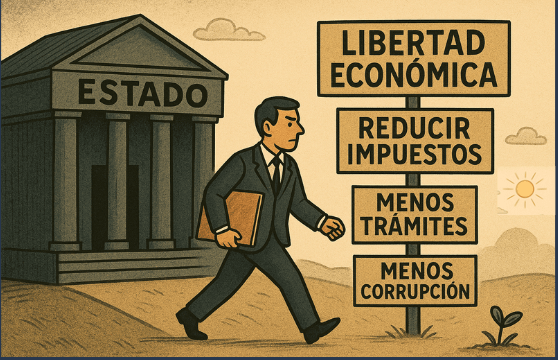
Bolivia wants to change its economy, but it is still trying to do so with a state built for a reality that no longer exists. For years, the availability of resources made it possible to finance policies and postpone uncomfortable questions. Today, those questions have returned: how to produce more, attract investment, create jobs, and ensure that every public resource delivers a visible result.
But there is an earlier, less frequently discussed, and perhaps more decisive question: Do we have the institutions that this economy needs?
An economy does not function solely on capital, labor, markets, and natural resources. It also depends on rules, permits, contracts, roads, registries, information, coordination, and public decisions. All of this may seem administrative until something goes wrong. When it does, it ceases to be an office matter and becomes an economic cost.
Consider something simple. A producer who waits months for authorization loses an opportunity to produce. A company facing contradictory regulations must factor in uncertainty. A municipality that delays a public works project postpones infrastructure development. And a citizen who must visit several government offices pays with hours of their life, a cost that almost never appears in the national accounts.
Bolivia routinely calculates how much it costs to build a public works project. It rarely calculates how much it costs when the state fails to function properly.
That is the point that deserves to become part of the economic debate: Institutions also produce.
Douglass C. North explained that institutions influence transaction costs and, through them, economic performance. Peter B. Evans demonstrated, through his studies of productive transformation, that state capacity also depends on how the state is organized and how it relates to economic and social actors. The practical consequence is straightforward: When an institution makes producing, investing, or starting a business more difficult, slower, or more uncertain, it affects the economy. When it functions properly, it reduces costs.
That is why the discussion about the state should not begin by asking whether we need a large or small state. A state can be large and weak at the same time. It can have a budget, public employees, offices, and regulations, yet remain incapable of promptly resolving the very problems it was created to address.
The more useful question is: What can the state actually accomplish, and at what cost?
The current economic situation makes this question particularly relevant. Bolivia faces a stabilization and reform program linked to an agreement with the International Monetary Fund (IMF), approved by the Legislative Assembly for approximately $1.9 billion. The program includes deficit reduction, monetary discipline, a flexible exchange rate regime, and reforms aimed at improving productivity and investment. The elimination of subsidies is part of the adjustment.
But an economic reform can change prices, taxes, or regulations. If the institutions responsible for implementing it continue operating as they did under the previous government, some of its benefits may be lost along the way.
This brings us to another central issue: regional autonomy. In August, the national government and the nine departmental governors agreed on the 50/50 Agenda, which proposes reviewing the distribution of resources, the allocation of responsibilities, and the financial situation of departmental governments, while strengthening their management capacity and coordination.
The debate cannot be reduced to how much money each level of government will receive. It must also examine what each can accomplish with those resources, what personnel and technical capabilities it possesses, what rules and information guide its actions, and who is accountable for the results. Decentralizing responsibilities without building institutional capacity may simply end up distributing frustration.
The practical side of transforming the state does not consist of creating or eliminating ministries or passing another law. It involves reviewing how decisions are made, how long they take, who is accountable, what information supports them, and what happens when a policy fails.
A mature institution is not one that never makes mistakes. It is one that can detect errors in time, correct them, and prevent them from becoming routine.
This matters especially when resources are scarce. When money is plentiful, certain institutional deficiencies can remain hidden behind public spending. When fiscal space narrows, every delay, duplication, unnecessary procedure, coordination failure, or misguided decision carries a price.
This is where the profound connection between changing the economy and changing the state becomes clear. They are not two separate reforms. An economy seeking to diversify, produce, attract investment, and generate employment needs institutions that make these activities more predictable, less costly, and more feasible.
Transforming the state does not necessarily mean employing more public officials, nor does it mean spending less as a matter of principle. It means achieving better results with available resources, transferring responsibilities along with the conditions necessary to fulfill them, and establishing clear, stable, and enforceable rules.
An institution’s performance should not be measured by how many procedures it processes or how much of the budget it manages, but by what problems it solves, how long it takes, and what results it delivers to society.
This perspective also changes the conversation about the economy. It is no longer enough to ask how much we produce. We must ask how much it costs us to produce under a given set of regulations. It is no longer enough to measure how much the state invests. We must examine how long it takes for that investment to become a road, a hospital, a school, or a productive opportunity. It is no longer enough to debate resources. We must examine the institutional capacity that transforms those resources into results.
So, should we change the economy or change the state?
Both transformations are interconnected. If Bolivia wants a different economy, it needs different institutions: not necessarily larger ones, but institutions that are more reliable and capable of fulfilling their responsibilities, with clear rules and well-defined accountability.
The state does not merely administer the economy. It can also make economic activity less or more expensive.
And here lies the idea we should begin discussing more seriously: Bolivia does not simply need to produce more. It needs its institutions to stop generating unnecessary costs.
Institutions also produce. When they function well, they produce time savings, trust, investment, and results. When they fail, they produce costs. And those costs, even if they never appear on an invoice, are ultimately paid by everyone.
The author is a political and economic analyst and former Rector of the Universidad Mayor de San Andrés (UMSA).
Por Oscar A. Heredia Vargas, El Diario:
Bolivia quiere cambiar su economía, pero todavía intenta hacerlo con un Estado construido para una realidad que ya no existe. Durante años, la disponibilidad de recursos permitió financiar políticas y postergar preguntas incómodas. Hoy regresan: cómo producir más, atraer inversión, generar empleo y hacer que cada recurso público tenga un resultado visible.
Pero hay una pregunta anterior, menos discutida y quizá más decisiva: ¿tenemos las instituciones que necesita esa economía?
Porque una economía no funciona solamente con capital, trabajo, mercados y recursos naturales. También funciona con reglas, permisos, contratos, carreteras, registros, información, coordinación y decisiones públicas. Todo eso parece administrativo hasta que falla. Cuando falla, deja de ser un asunto de oficina y se convierte en un costo económico.
Pensemos en algo sencillo. Un productor que espera meses por una autorización pierde una oportunidad de producir. Una empresa que enfrenta reglas contradictorias incorpora incertidumbre. Un municipio que demora una obra posterga infraestructura. Y un ciudadano que recorre varias oficinas paga con horas de su vida un costo que casi nunca aparece en las cuentas nacionales.
Bolivia suele calcular cuánto cuesta hacer una obra. Pocas veces calcula cuánto cuesta que el Estado no funcione bien.
Ese es el punto que merece ser incorporado al debate económico: las instituciones también producen.
Douglass C. North explicó que las instituciones inciden sobre los costos de transacción y, por esa vía, sobre el desempeño económico. Peter B. Evans mostró, desde el estudio de la transformación productiva, que la capacidad estatal depende también de cómo se organiza el Estado y de su relación con los actores económicos y sociales. La consecuencia práctica es sencilla: cuando una institución hace más difícil, lento o incierto producir, invertir o emprender, afecta la economía; cuando funciona bien, reduce costos.
Por eso la discusión sobre el Estado no debería comenzar preguntando si necesitamos un Estado grande o pequeño. Un Estado puede ser grande y débil al mismo tiempo. Puede tener presupuesto, funcionarios, oficinas y normas, pero ser incapaz de resolver con oportunidad aquello para lo que fue creado.
La pregunta útil es otra: ¿qué puede hacer realmente el Estado y con qué costo?
La coyuntura vuelve esta cuestión concreta. Bolivia enfrenta un programa de estabilización y reformas asociado al acuerdo con el FMI, aprobado por la Asamblea Legislativa por unos 1.900 millones de dólares, con reducción del déficit, disciplina monetaria, régimen cambiario flexible y reformas orientadas a productividad e inversión. La eliminación de subsidios forma parte del ajuste.
Pero una reforma económica puede cambiar precios, impuestos o reglas. Si las instituciones encargadas de aplicarla siguen funcionando de la misma manera que en el anterior gobierno, una parte de sus beneficios puede perderse en el camino.
Aquí aparece otro asunto central: las autonomías. En agosto, el Gobierno nacional y los nueve gobernadores acordaron la Agenda 50/50, que plantea revisar la distribución de recursos, las competencias y la situación financiera de las gobernaciones, además de fortalecer su gestión y coordinación.
El debate no puede reducirse a cuánto dinero recibirá cada nivel de gobierno. También debe preguntarse qué podrá hacer con esos recursos, con qué equipos, con qué reglas, con qué información y con qué responsabilidad sobre los resultados. Descentralizar responsabilidades sin construir capacidad puede terminar distribuyendo frustraciones.
La parte práctica del cambio de Estado no consiste en crear o cerrar ministerios, ni en aprobar otra ley. Consiste en revisar cómo se toman las decisiones, cuánto tardan, quién responde, qué información las sustenta y qué ocurre cuando una política fracasa.
Una institución madura no es la que nunca se equivoca. Es la que puede detectar el error a tiempo, corregirlo y evitar que se convierta en una costumbre.
Esto importa especialmente cuando los recursos son escasos. Cuando sobra dinero, algunas deficiencias institucionales pueden quedar ocultas detrás del gasto. Cuando el margen fiscal se reduce, cada demora, duplicación, trámite innecesario, mala coordinación o decisión equivocada adquiere un precio.
Ahí está la relación profunda entre cambiar la economía y cambiar el Estado. No son dos reformas separadas. Una economía que busca diversificarse, producir, invertir y generar empleo necesita instituciones que hagan esas actividades más previsibles, menos costosas y más posibles.
Cambiar el Estado no significa necesariamente tener más funcionarios ni gastar menos por definición. Significa conseguir mejores resultados con los recursos disponibles: transferir competencias con condiciones para ejercerlas y construir reglas claras, estables y aplicables.
El indicador de una institución no debería ser cuántos trámites procesa o cuánto presupuesto administra, sino qué problema resuelve, cuánto tiempo necesita y qué resultado obtiene la sociedad.
Esa mirada también cambia la conversación sobre la economía. Ya no basta con preguntar cuánto producimos. Hay que preguntar cuánto nos cuesta producir bajo determinadas reglas. Ya no basta con medir cuánto invierte el Estado. Hay que observar cuánto tarda esa inversión en convertirse en una carretera, un hospital, una escuela o una oportunidad productiva. Ya no basta con discutir recursos. Hay que mirar la capacidad institucional que convierte esos recursos en resultados.
Entonces, ¿cambiar la economía o cambiar el Estado?
Ambas transformaciones están conectadas. Si Bolivia quiere una economía distinta, necesita instituciones distintas: no necesariamente más grandes, sino más confiables y capaces de cumplir su función, con reglas claras y responsabilidades definidas.
Porque el Estado no solamente administra la economía. También puede abaratarla o encarecerla.
Y aquí está la idea que deberíamos empezar a discutir con mayor seriedad: Bolivia no solo necesita producir más. Necesita que sus instituciones dejen de producir costos innecesarios.
Las instituciones también producen. Cuando funcionan, producen tiempo, confianza, inversión y resultados. Cuando fallan, producen costos. Y esos costos, aunque no aparezcan en ninguna factura, terminan pagándolos todos.
El autor es analista político y económico, ex Rector de la UMSA.
https://www.eldiario.net/portal/2026/10/22/cambiar-la-economia-o-cambiar-el-estado/


Leave a Reply