By Mauricio Quiroz, El Deber:
Article 83 of the Armed Forces Organic Law requires prior authorization from the Ministry of Defense. The provision raises questions about state oversight of those who joined the Russian Army, but failing to comply with it does not prove mercenary activity, nor does it rule out the possibility that some may have been victims of human trafficking in the context of the Russia–Ukraine war.
Before signing a military contract or joining the armed forces of another country, native-born Bolivians must obtain authorization from the Ministry of Defense. This requirement has been in force for more than three decades, but it had not been part of the public debate surrounding citizens who were taken to Russia to participate in the war in Ukraine.
This finding is part of a document prepared by the Laboratory for Policy Analysis, International Relations and Diplomacy (Laprid), a private organization made up of career diplomats that conducted a preliminary examination of the legal situation of Bolivians linked to Russian troops.
The basis for this argument is Article 83 of Law 1405, the Organic Law of the Armed Forces, enacted on December 30, 1992, and currently published within the Ministry of Defense’s external regulations.
“Native-born Bolivians, in order to perform military service in foreign armed forces, must first request and obtain authorization from the Ministry of National Defense, either directly or through the country’s Military Attachés, Embassies, or Consulates,” the law states.
The Law Does Not Establish an Automatic Penalty
Article 83 imposes an obligation, but it does not contain a specific criminal penalty for anyone who joins a foreign army without permission. Nor does it specify the procedure to be followed, the requirements that must be submitted, how long the authorization lasts, or under what conditions it may be denied.
Article 4 of the Bolivian Criminal Code embodies the principle of legality: no one may be convicted for conduct that was not expressly defined as a crime, nor may anyone receive a penalty that was not established by law.
Being a Foreigner and Receiving a Salary Is Not Enough
Article 47 of Additional Protocol I to the Geneva Conventions requires six conditions to be met simultaneously for a person to be classified as a mercenary. These include being specially recruited to fight, taking direct part in hostilities, acting primarily for private financial gain, not being a national or resident of a party to the conflict, and not being a member of its armed forces.
This means that being a foreigner, receiving money, or appearing in a war zone is not enough on its own. In fact, formal incorporation into the Russian Armed Forces could prevent one of the requirements of the international definition from being met, since it requires that the person not belong to the armed forces of one of the parties to the conflict.
Permission Does Not Rule Out Possible Human Trafficking
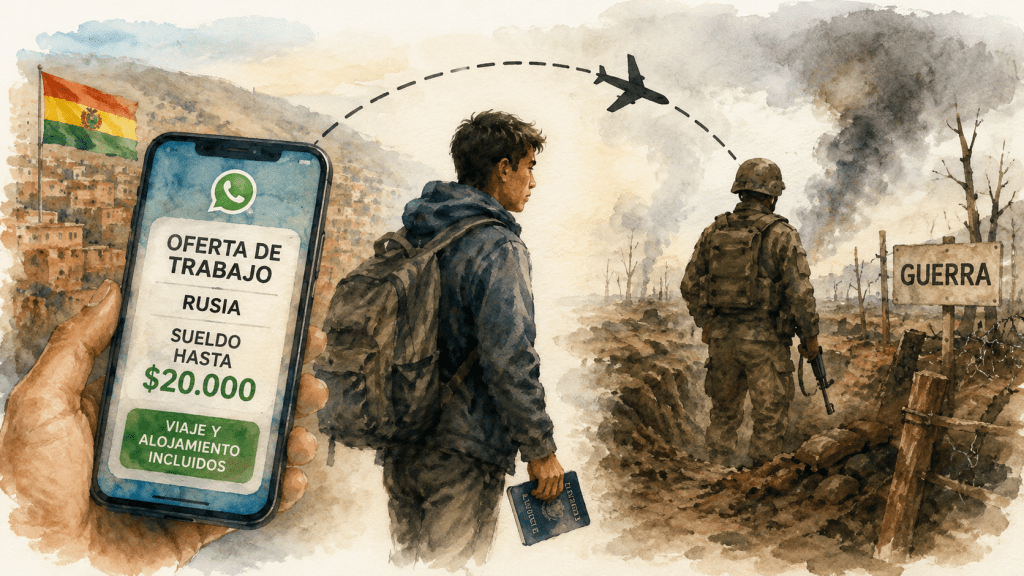
Prosecutors are focusing their investigations on determining whether individuals were recruited through false job offers, exploitation of economic vulnerability, contracts that changed upon arrival in Russia, or pressure to join military units.
The United Nations Office on Drugs and Crime states that trafficking may involve the recruitment, transportation, transfer, or receipt of persons through force, fraud, deception, coercion, or abuse of a position of vulnerability for the purpose of exploitation. When any of these means are used, the victim’s initial consent loses its legal relevance.
For that reason, investigators must reconstruct each case individually: what offer was made, who paid for the trip, what documents were signed, whether the individuals understood the language, whether they knew they would be sent to the front lines, and whether they were able to leave the service.
The existence of a signature, a payment, or a military contract does not answer those questions. A person may appear to have been formally incorporated into an army while having previously been recruited through deception or exploitation of vulnerability.
The Case Already Involves Dozens of Bolivians
The Foreign Ministry reported that it is monitoring 26 cases involving citizens linked to the Russian Armed Forces. According to figures presented by Foreign Minister Fernando Aramayo, 20 still hold active military contracts, four have been injured, one has died, and another has been repatriated. The government had not yet confirmed the whereabouts of 19 of the reported Bolivians.
Meanwhile, the Public Prosecutor’s Office has opened four investigations in Santa Cruz, Tarija, and Beni into alleged human trafficking for the purpose of recruitment into armed conflicts. The preliminary universe includes 31 possible victims, although prosecutors clarified that this figure must be verified through testimony, documents, migration records, and other evidence.
In addition, the Independent International Commission of Inquiry on Ukraine continues to examine human rights violations, breaches of international humanitarian law, and war-related crimes. Its mandate was renewed on March 31, 2026, but so far there has been no specific international conclusion regarding the situation of Bolivians incorporated into Russian forces.
Por Mauricio Quiroz, El Deber:
El artículo 83 de la Ley Orgánica de las Fuerzas Armadas exige una autorización previa del Ministerio de Defensa. La norma abre preguntas sobre el control estatal de quienes fueron incorporados al Ejército ruso, pero su incumplimiento no prueba mercenarismo ni descarta que algunos hayan sido víctimas de trata en el caso de la guerra entre Rusia y Ucrania.
Antes de firmar un contrato militar o incorporarse a las Fuerzas Armadas de otro país, los bolivianos de origen deben obtener una autorización del Ministerio de Defensa. La obligación está vigente desde hace más de tres décadas, pero no había sido incorporada al debate público sobre los ciudadanos trasladados a Rusia para participar en la guerra contra Ucrania.
El hallazgo forma parte de un documento elaborado por el Laboratorio de Análisis de Políticas, Relaciones Internacionales y Diplomacia (Laprid), una entidad privada formada por diplomáticos de carrera que examinó preliminarmente la situación jurídica de los bolivianos vinculados con las tropas rusas.
La base de ese planteamiento está en el artículo 83 de la Ley 1405, Orgánica de las Fuerzas Armadas, promulgada el 30 de diciembre de 1992 y publicada actualmente dentro de la normativa externa del Ministerio de Defensa.
“Los bolivianos de origen, para prestar el Servicio Militar en Fuerzas Armadas extranjeras, previamente deberán solicitar y obtener la autorización del Ministerio de Defensa Nacional, sea en forma directa o a través de las Agregadurías Militares, Embajadas o Consulados del país”, establece textualmente la norma.
La norma no fija una pena automática
El artículo 83 establece una obligación, pero no contiene una sanción penal específica para quien se incorpore a un ejército extranjero sin permiso. Tampoco señala qué procedimiento debe seguirse, qué requisitos deben presentarse, cuánto dura la autorización o bajo qué condiciones puede ser rechazada.
El artículo 4 del Código Penal boliviano recoge este principio de legalidad: nadie puede ser condenado por una conducta que no estuviera expresamente prevista como delito ni recibir una pena que no hubiese sido establecida por ley.
No basta con ser extranjero y recibir un salario
El artículo 47 del Protocolo adicional I a los Convenios de Ginebra exige que concurran simultáneamente seis condiciones para calificar a una persona como mercenaria. Entre ellas están haber sido reclutada especialmente para combatir, participar directamente en las hostilidades, actuar motivada esencialmente por una ventaja económica, no ser nacional ni residente de una parte en conflicto y no formar parte de sus Fuerzas Armadas.
Esto significa que ser extranjero, recibir dinero o aparecer en una zona de guerra no basta por sí solo. Incluso la incorporación formal a las Fuerzas Armadas rusas podría impedir que se cumpla uno de los requisitos de la definición internacional, que exige no pertenecer a las fuerzas de una de las partes.
El permiso tampoco descarta una posible trata
Las investigaciones fiscales se concentran en establecer si hubo personas captadas mediante falsas propuestas laborales, abuso de suvulnerabilidad económica, contratos que cambiaron al llegar a Rusia o presiones para incorporarse a unidades militares.
La Oficina de las Naciones Unidas contra la Droga y el Delito señala que la trata puede comprender la captación, el traslado o la recepción de personas mediante fuerza, fraude, engaño, coacción o abuso de una posición de vulnerabilidad, con el propósito de explotarlas. Cuando se emplea alguno de esos medios, el consentimiento inicial de la víctima pierde relevancia jurídica.
Por eso, la investigación debe reconstruir cada caso por separado: qué oferta recibieron, quién pagó el viaje, qué documentos firmaron, si comprendían el idioma, si sabían que serían enviados al frente y si podían abandonar el servicio.
La existencia de una firma, un pago o un contrato militar no resuelve esas preguntas. Una persona puede aparecer formalmente incorporada a un ejército y haber sido captada previamente mediante engaño o abuso de vulnerabilidad.
El caso ya alcanza a decenas de bolivianos
La Cancillería informó que mantiene bajo seguimiento 26 casos de ciudadanos vinculados con las Fuerzas Armadas rusas. Según el balance presentado por el canciller Fernando Aramayo, 20 mantienen contratos militares activos, cuatro están heridos, uno falleció y otro fue repatriado. El Gobierno todavía no había confirmado la ubicación de 19 de los bolivianos reportados.
Paralelamente, el Ministerio Público abrió cuatro investigaciones en Santa Cruz, Tarija y Beni por presunta trata de personas con fines de reclutamiento para conflictos armados. El universo preliminar alcanza a 31 posibles víctimas, aunque la Fiscalía aclaró que esa cifra deberá comprobarse con declaraciones, documentos, registros migratorios y otros elementos.
Además, la Comisión Internacional Independiente de Investigación sobre Ucrania continúa examinando violaciones de derechos humanos, infracciones al derecho internacional humanitario y delitos relacionados con la guerra. Su mandato fue renovado el 31 de marzo de 2026, pero hasta ahora no existe una conclusión internacional específica sobre la situación de los bolivianos incorporados a las fuerzas rusas.
https://eldeber.com.bo/pais/bolivianos-deben-pedir-permiso-servir-tropas-extranjeras_1784838503


Leave a Reply