
By Germaine Barriga, Vision 360:
La Paz: 33 artisans produce all kinds of footwear at the famous Tumusla Shoe Fair
The artisans organized themselves and managed to set up a shoe fair with their own resources, where footwear for children, women, and men can be purchased in different styles and made with good-quality materials.
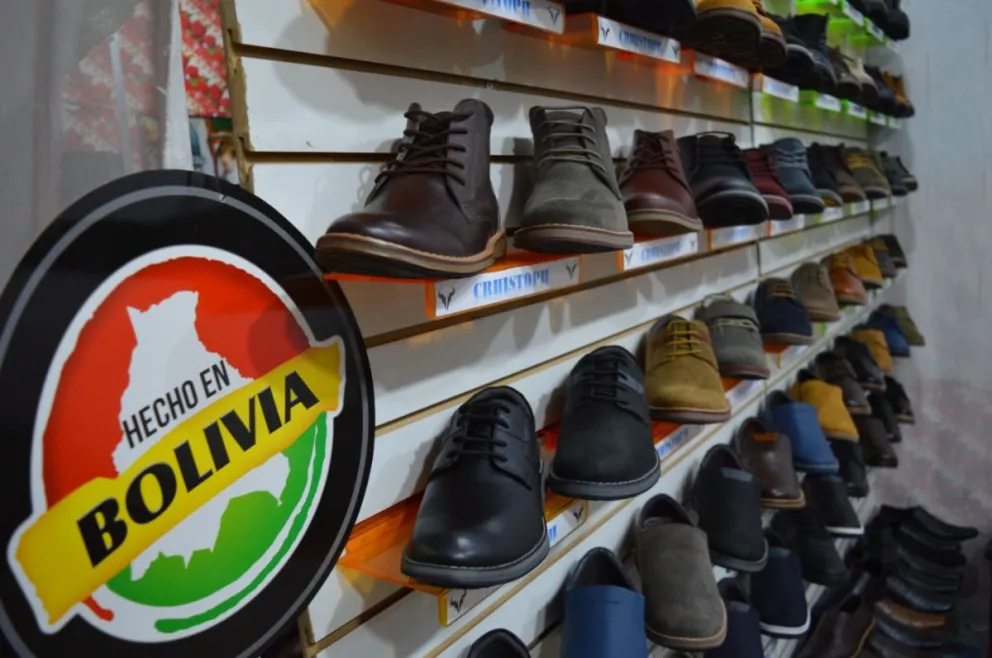
The Aprocalpa Association, better known as the Great Tumusla Shoe Fair, where each member produces different varieties of footwear for children, women, and men. Photo: El Diario
Thirty-three artisans, members of the Association of Footwear Producers of La Paz (Aprocalpa), produce all kinds of leather shoes. They decided to organize and set up the Great Tumusla Shoe Fair in a garage, where they offer very high-quality products.
Soledad Pérez, owner of Fabri shoes, and Antonia Quispe, owner of Calzados Antony, told Economía y Empresa how they managed to establish themselves despite smuggling and the negative conditions facing the national economy.
Pérez explained that the Fabri brand specializes in orthopedic shoes for children, which are very well made with 100% high-quality leather. “We have nothing to envy from abroad; we have good production,” she said.
She recalled that, together with other producers, they formed the Aprocalpa Association, better known as the Great Tumusla Shoe Fair, where each member produces different types of footwear for children, women, and men, as well as for the military and for medical professionals.
The idea of organizing arose among the “shoemakers,” as they call themselves in the trade, when they found a garage on Tumusla Street that did not even have lighting. They decided to rent the place and organize the fair, where they display their production.
The fair brings together producers who wanted to invest in Bolivia and show that industry can be developed locally. It has demonstrated that “La Paz hands can produce,” making them pioneers in this new way of doing business.
Only leather is domestic; the rest comes from Peru and Brazil
Pérez explained that the leather used in their shoes is third-grade, because higher-quality leather is unfortunately exported. However, that same leather returns to the country and Bolivians buy it at much higher prices.
The only material produced in Bolivia for footwear manufacturing is third-grade leather; thread, eyelets, laces, linings, and other inputs come from Peru or Brazil. “In Bolivia, we produce nothing else,” she stated.
She added that because they must import inputs, they are highly dependent on the dollar and on suppliers, who arbitrarily raise material prices.
Because of this situation, she said it is very difficult to lower their prices. As a result, people prefer to buy Chinese-made shoes costing around 60 bolivianos, while their products cost about 120 bolivianos.
However, she emphasized that they have received no support of any kind for this initiative. “Nobody supports what is produced in Bolivia.” She noted that the group contributes to the country’s economy: “we pay our rent every month, we built our own stands; each person chose how to design their stand, what materials to use, and how to present their products.”
She said producers are the economic backbone of the country because they generate jobs, yet despite being under the Ministry of Productive Development and Plural Economy, they receive no support in key areas such as marketing, sales, promotion, publications, or exports. “We have never received real and genuine support,” she stated.
Pérez added that they received no support from either the government of former president Luis Arce or the current president Rodrigo Paz. She addressed the national government: “we do not have a proper place to showcase our products, we have no incentives, we have not been supported in any way, and this government has not helped either.”
According to her, there is no real support, questioning what kind of help an authority could provide if they have never produced a sweater, a shoe, or a brick. She argued that decision-making spaces should include real producers who understand production needs.
They demand training to achieve a skilled workforce
She said one of the main problems they face is labor. For that reason, they have requested an innovation center where artisans can receive better training. “Bolivia needs color, trends, and fashion, but unfortunately today we do not have places where people can train or provide us with skilled labor,” she said.
She also mentioned new technologies that have changed payment methods, such as QR systems. With pride, she noted that their production center was the first where mobile wallets were implemented, helping somewhat with sector recovery.
However, she said that due to the economic crisis they are now practically “just surviving,” as they have had to reduce the number of workers. Regarding machinery, she explained that they opted to purchase second-hand machines from neighboring countries, repaired by technicians from Peru and Brazil.
She added that acquiring modern machinery is difficult due to its high cost, ranging from $30,000 to $70,000.
She called on the government to support the sector through tax measures, market access, training, and especially the fight against smuggling and proper enforcement of Laws 947, 1257, and 1053, which could allow them to work with dignity.
For her part, Antonia Quispe, owner of Calzados Antony, said she and her husband have worked in footwear manufacturing for more than 17 years. She noted that the most difficult challenge is dealing with the cost of materials from Peru and other countries, since they are not produced in Bolivia.
Her business employs family members—children and nephews—who work in different areas. She runs the store on Tumusla Street, while her children design footwear models and her nephews work in the production workshop.
She explained that they produce all types of ankle boots for women, as well as other footwear. A pair of ankle boots costs 80 bolivianos to produce and sells for 160 to 170 bolivianos, covering expenses such as electricity and water. However, she acknowledged that due to the economic situation, it is difficult to keep up with debt payments.
Quispe added that artisans receive some support from the Productive Development Bank (BDP), which offers training courses to association members. Like her colleague, she called for real government support, noting that they generate jobs and are registered with the National Tax Service (SIN). “We contribute to Bolivia,” she affirmed.
Por Germaine Barriga Velarde, Vision 360:
La Paz: 33 artesanos producen calzados de todo tipo en la famosa Feria del Calzado en la Tumusla
Los artesanos se organizaron y lograron instalar una feria del calzado con sus propios recursos, donde se puede adquirir calzados para niños, damas y varones, de diferentes modelos y fabricados con buen material.
La Asociación Aprocalpa, más conocida como la Gran Feria del Calzado de la Tumusla, donde cada uno de los afiliados produce diferentes variedades de calzados, para niños, damas y caballeros. Foto El Diario
Treinta y tres artesanos, asociados en la Asociación de Productores de Calzados La Paz (Aprocalpa), producen calzados de cuero de todo tipo, que decidieron organizarse e instalar en un garaje la Gran Feria del Calzado de la Tumusla, donde ofrecen un producto de muy buena calidad.
Soledad Pérez, propietaria de los calzados Fabri, y Antonia Quispe, dueña de la empresa Calzados Antony, relataron a Economía y Empresa cómo lograron establecerse, a pesar del contrabando y las condiciones negativas que enfrenta la economía nacional.
Pérez dijo que la marca de los calzados Fabri es ortopédica para niños, que son muy bien hechos, con 100% de cuero de buena calidad. “No tenemos nada que envidiar al extranjero, tenemos una buena producción”, precisó.
Recordó que, junto a otros productores, formaron la Asociación Aprocalpa, más conocida como la Gran Feria del Calzado de la Tumusla, donde cada uno de los afiliados produce diferentes variedades de calzados para niños, damas y caballeros, para el cuartel y también para médicos.
La idea de organizarse surgió entre los “zapateros”, como nos decimos en el gremio, sostuvo, cuando vieron un garaje en la calle Tumusla, donde no había ni siquiera una luminaria, y decidieron alquilar el lugar para organizar la feria, donde exponen su producción.
La feria reúne a los productores que quisieron invertir en Bolivia y demostrar que se puede hacer industria, y se pudo demostrar que “las manos paceñas pueden elaborar, entonces somos pioneros en esta nueva manera de hacer mercado”, afirmó.
Solo el cuero es nacional, lo demás viene de Perú y Brasil
Pérez informó que el material de los zapatos que produce es de cuero de tercera calidad, porque el de primera calidad, lastimosamente, se va al extranjero. Sin embargo, ese cuero vuelve al país y los bolivianos lo compran a precios muy altos.
Lo único que se produce en Bolivia para la producción de zapatos es el cuero de tercera calidad; el hilo, los ojalillos, cordones, forros y otros son de procedencia peruana o brasileña. En Bolivia no producimos nada, afirmó.
Dijo que, debido a que necesitan importar los insumos para fabricar los calzados, dependen mucho del dólar y de los proveedores, que elevan los precios de los materiales de forma arbitraria.
Debido a esa situación, consideró que es muy difícil abaratar el costo de sus productos; debido a ello, las personas prefieren comprar zapatos de industria china, porque les cuestan solo 60 Bs, mientras que estos calzados tienen un precio de 120 Bs, explicó.
Sin embargo, sostuvo que en esta iniciativa que tuvieron no recibieron apoyo de ninguna índole. “Nadie apoya lo que es producido en Bolivia”. Relató que el grupo de artesanos aporta a la economía del país: “pagamos cada mes nuestros alquileres, hemos hecho construir nuestros stands; cada uno ha elegido cómo diseñar su stand, con qué material, cómo va a estar adornado o cómo va a ser la presentación de sus productos”.
Dijo que los productores son el brazo económico del país, porque generan fuentes de trabajo y, aunque dependen del Ministerio de Desarrollo Productivo y Economía Plural, no se les brinda apoyo en áreas que son necesarias, como en marketing, ventas, promociones y publicaciones, y en temas de exportación. “Jamás hemos recibido un tipo de apoyo real y verdadero”, afirmó.
Pérez afirmó que ni con el Gobierno del expresidente Luis Arce ni con el del presidente Rodrigo Paz recibieron apoyo. Se dirigió al Gobierno nacional para expresarle que: “no tenemos un lugar propio donde exponer nuestros productos, no tenemos incentivos, no nos han apoyado de ninguna manera y este Gobierno tampoco”.
Según la empresaria, no hay un apoyo real, porque cuestionó qué tipo de apoyo podría brindar una autoridad que en su vida ha producido una chompa, un zapato o un ladrillo; por ello, consideró que en esos espacios donde se toman decisiones deben estar productores que realmente sepan la necesidad y lo que es producción.
Demanda capacitación para tener mano de obra cualificada
Afirmó que uno de los problemas que enfrentan es la mano de obra; por ello, solicitaron un centro de innovación donde se pueda capacitar de una manera más adecuada a los artesanos. “Bolivia necesita color, tendencia y moda, pero lastimosamente en la actualidad no disponemos de lugares donde la gente se pueda capacitar o pueda darnos una mano de obra calificada”, manifestó.
También se refirió a las nuevas tecnologías, que revolucionaron la forma de pago, como el uso del QR; con orgullo dijo que fue el primer centro productivo donde funcionaba la billetera móvil, lo que ayudó un poco a la reactivación del sector.
Sin embargo, consideró que, debido a la crisis económica, ahora prácticamente “están sobreviviendo”, debido a que tuvieron que reducir el número de obreros en la empresa. Con relación a la maquinaria, mencionó que optaron por la compra de máquinas a medio uso de países vecinos, que son refaccionadas por técnicos de Perú y Brasil.
Dijo que es difícil adquirir maquinarias con tecnología de última generación, porque cuestan mucho; algunas están en 30 mil dólares y otras en 70 mil dólares.
Demandó del Gobierno acciones para apoyar a ese sector, entre ellas el tema impositivo, los mercados, la capacitación y, sobre todo, la lucha contra el contrabando y la aplicación correcta de las leyes 947, 1257 y 1053, porque son leyes que pueden hacer que nosotros podamos trabajar de una manera digna.
Por su parte, la propietaria de la empresa Calzados Antony, Antonia Quispe, relató que junto a su esposo trabajan desde hace más de 17 años en el rubro de fabricar calzados. Dijo que lo más difícil es lidiar con el costo de los materiales que vienen de Perú y otros países, porque en Bolivia no se producen.
En la empresa trabajan sus familiares, sus hijos y sobrinos, que se distribuyen en las diferentes áreas de trabajo; ella atiende la tienda, ubicada en la Tumusla, mientras sus hijos trabajan en el diseño de los modelos de calzados y sus dos sobrinos realizan sus tareas en el taller de confección.
Precisó que fabrican botines de todo tipo para damas, pero también otro tipo de calzados. El costo de un par de botines es 80 Bs y en la tienda se venden a 160 o 170 Bs; con eso cubren los gastos, como la luz y el agua. Sin embargo, reconoció que, debido a la situación de la economía, es difícil cumplir con el pago de las deudas.
Quispe informó que, como artesanos, reciben el apoyo del Banco de Desarrollo Productivo (BDP), que siempre invita a cursos de actualización a los afiliados de esa asociación. Al igual que su compañera, solicitó que el Gobierno preste un apoyo real, porque generan fuentes de trabajo y también están inscritos en el Servicio de Impuestos Nacionales (SIN). “Nosotros aportamos a Bolivia”, afirmó.

 Bolivian Thoughts | Pensamientos Bolivianos (Bilingual/Bilingüe)