
By Álvaro Rosales, Unitel:
The fall of Marset marks the first major blow of the ‘Shield of the Americas’ against transnational crime, according to the U.S.
From Bolivia, the anti-drug czar maintained that neutralizing a criminal leader is only the first step and stressed that international cooperation is key, since neutralizing Marset was only a first step
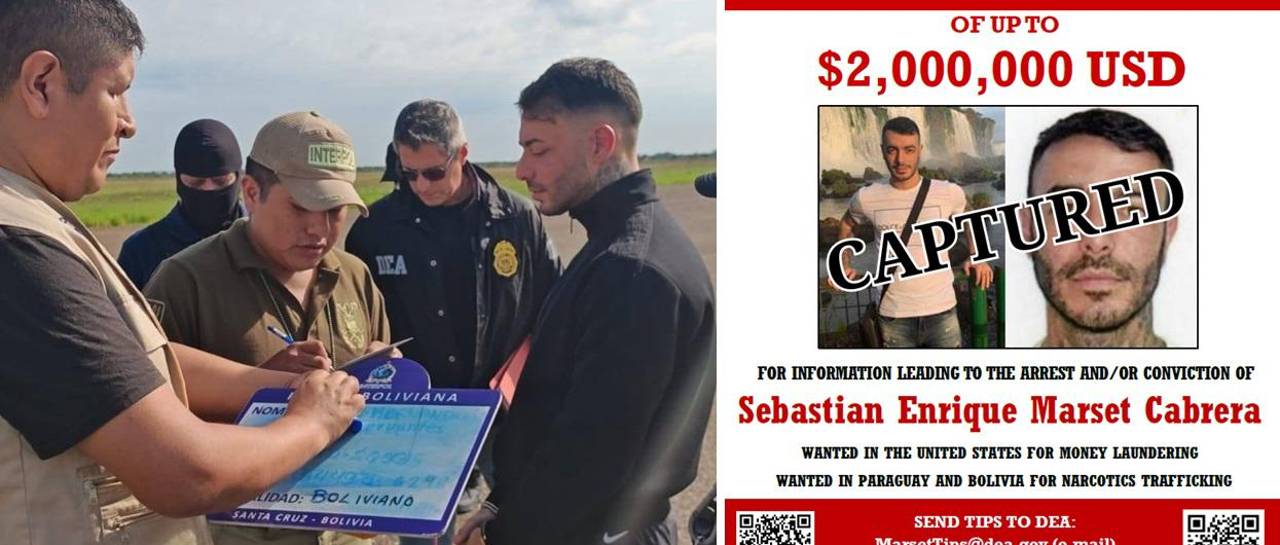
Marset was expelled from Bolivia to the United States on the morning of Friday, March 13
The capture of Uruguayan crime boss Sebastián Marset is portrayed by U.S. authorities as the first major result of the ‘Shield of the Americas’ summit, an initiative aimed at strengthening cooperation among countries to, among other actions, confront transnational organized crime.
Following Marset’s capture in the capital of Santa Cruz, the U.S. Department of State noted that the arrest of the drug trafficker marks the end of his criminal trajectory, a development also celebrated by authorities in Paraguay and Uruguay.
“The reign of terror and chaos of Sebastián Marset has ended. Thanks to the leadership of President Rodrigo Paz and the rapid strengthening of police cooperation between the United States and Bolivia, the notorious drug trafficker will face justice. The ‘Shield of the Americas’ is making our region safer and stronger,” states a report from the Department of State.
For his part, Republican Congressman Mario Díaz-Balart, a member of the House of Representatives, considered the operation to be an advance for regional security, emphasizing that Marset’s capture represents an important victory for regional security.
“Through initiatives such as the Shield of the Americas, the United States is helping its partners and allies combat transnational crime and make our hemisphere safer,” said Mario Díaz-Balart.
From Bolivia, the U.S. perspective coincides in viewing Marset’s capture as a turning point, although it warns that the fall of a criminal leader does not mean the end of the structure that supported him, according to the report from the anti-drug czar, Ernesto Justiniano.
For Justiniano, the main challenge is to dismantle the networks that operate behind these organizations, which makes international cooperation crucial through mechanisms for information exchange and coordination among states.
“The apprehension of Sebastián Marset marks a turning point in the fight against drug trafficking in Bolivia. But neutralizing a criminal leader is only the first step,” said Justiniano, who emphasized that these structures operate through networks that extend across several countries.
In that context, the vice minister reported that, following the capture, simultaneous operations were activated to verify, control, and secure territory in different regions of the country, with the aim of identifying air infrastructure, aircraft, aviation fuel, weapons, and possible logistical support linked to drug trafficking networks.
For the Bolivian government, the objective now is to strike the structure that allowed Marset to operate for years in several countries. Police commander Mirko Sokol therefore announced investigations to determine who collaborated with the Uruguayan crime boss, including former government authorities.
Meanwhile, Uruguayan Senator Gabriel Gurméndez stated that the operation marks a change in the dynamics of the fight against drug trafficking and said that the Shield of the Americas worked in Bolivia.
Marset will now face justice in the United States, which will determine his future.
Por Álvaro Rosales Melgar, Unitel:
Caída de Marset marca el primer gran golpe del ‘Escudo de las Américas’ contra el crimen transnacional, según EEUU
Desde Bolivia, el zar antidrogas sostuvo que neutralizar a un líder criminal es solo el primer paso y remarcó que resulta clave la cooperación internacional ya que neutralizar a Marset fue solo un primer paso
Marset fue expulsado de Bolivia hacia EEUU la mañana de este viernes 13 de marzo
La captura del capo uruguayo Sebastián Marset es reflejada por autoridades estadounidenses como el primer gran resultado de la cumbre ‘Escudo de las Américas’, una iniciativa orientada a reforzar la cooperación entre países para, entre otras acciones, enfrentar el crimen organizado transnacional.
Tras la captura de Marset en la capital cruceña, el Departamento de Estado de EEUU señaló que la detención del narcotraficante marca el fin de su trayectoria criminal, tema que también celebrado por autoridades de Paraguay y Uuruguay.
“El reinado de terror y caos de Sebastián Marset ha terminado. Gracias al liderazgo del presidente Rodrigo Paz y al rápido fortalecimiento de la cooperación policial entre Estados Unidos y Bolivia, el notorio narcotraficante enfrentará a la justicia. El ‘Escudo de las Américas’ está haciendo que nuestra región sea más segura y fuerte”, reza un reporte del Departamento de Estado.
Por su parte, el congresista republicano Mario Díaz-Balart, miembro de la Cámara de Representantes, contempló que la operación constituye un avance para la seguridad regional, enfatizando que la captura de Marset representa un importante triunfo para la seguridad regional.
“Mediante iniciativas como el Escudo de las Américas, Estados Unidos está ayudando a sus socios y aliados a combatir la delincuencia transnacional y a hacer que nuestro hemisferio sea más seguro”, sostuvo Mario Díaz-Balart
Desde Bolivia, el enfoque de EEUU coincide en que la captura de Marset representa un punto de inflexión, aunque advierte que la caída de un líder criminal no significa el fin de la estructura que lo sostenía, según el reporte del zar antidrogas, Ernesto Justiniano.
Para Justiniano, el desafío principal es desarticular las redes que operan detrás de estas organizaciones, por lo que resulta clave la cooperación internacional, mediante mecanismos de intercambio de información y coordinación entre Estados
“La aprehensión de Sebastián Marset marca un punto de inflexión en la lucha contra el narcotráfico en Bolivia. Pero neutralizar a un líder criminal es solo el primer paso”, expresó Justiniano, quien subrayó que estas estructuras operan mediante redes que se extienden por varios países.
En ese contexto, el viceministro reportò que, tras la captura, se activaron operativos simultáneos de verificación, control y aseguramiento territorial en diferentes regiones del país, con miras identificar infraestructura aérea, aeronaves, combustible de aviación, armamento y posibles apoyos logísticos vinculados a redes del narcotráfico.
Para el Gobierno boliviano, el objetivo ahora es golpear la estructura que permitió a Marset operar durante años en varios países, por lo que el comandante de la Policía, Mirko Sokol, anunció investigaciones para conocer quiènes colaboraron con el capo uruguayo, incluidas exautoridades de Gobierno.
Entretanto, el senador uruguayo Gabriel Gurméndez manifestó que la operación marca un cambio en la dinámica del combate al narcotráfico y dijo que el Escudo de las Américas funcionó en Bolivia.
Ahora Marset enfrentará a la justicia de EEUU, la cual definirá su futuro.

 Bolivian Thoughts | Pensamientos Bolivianos (Bilingual/Bilingüe)