
By El Diario:
Although the gender gap in financial inclusion in the region persists, it has been narrowing since the first measurement of the study in 2021. In Bolivia, the gap between genders is minimal.
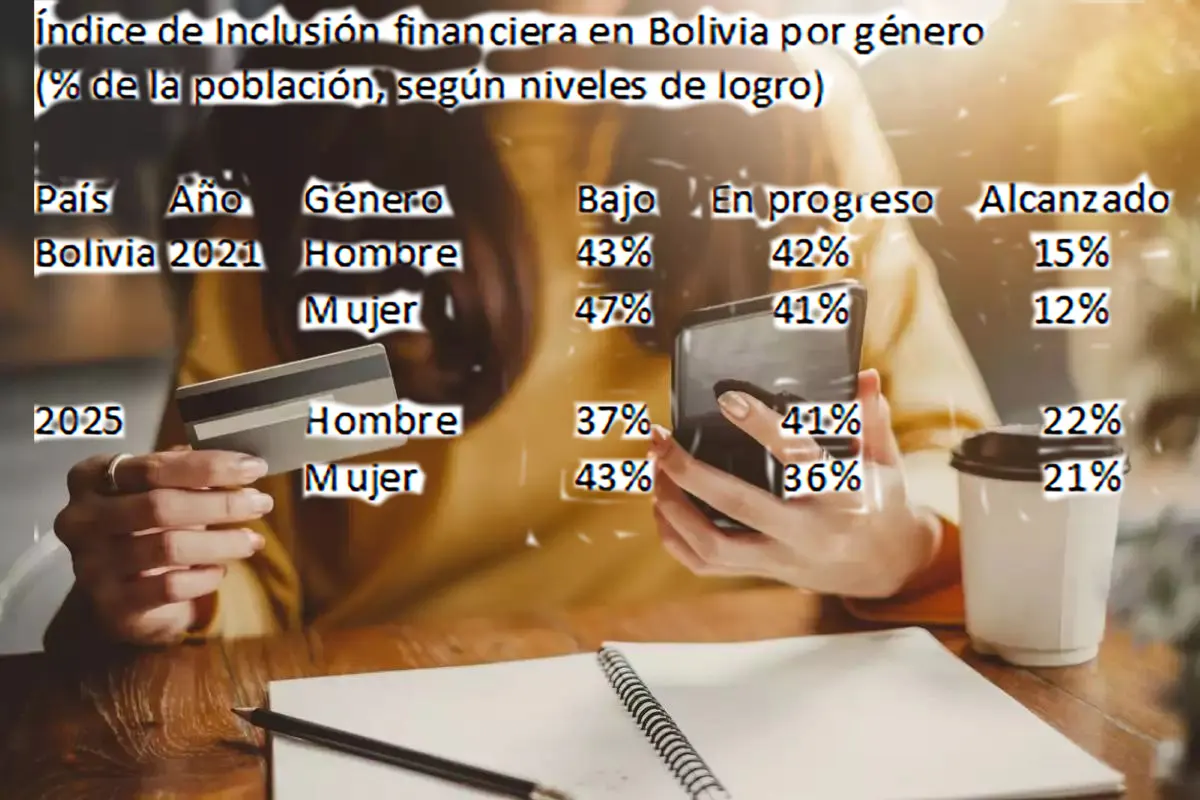
The financial inclusion index grew in Bolivia from 12% to 21% between 2021 and 2025 among women, reaching 42 points compared to 44 for men in the overall score of the 2025 Financial Inclusion Index (FII), according to the Gender Gaps sub-study presented for the fifth consecutive year by Credicorp’s Banco de Ideas.
Credicorp’s Banco de Ideas presented, for the fifth consecutive year, the Gender Gaps in Financial Inclusion sub-study, derived from the Financial Inclusion Index (FII). In Bolivia, the gap in this area is minimal.
The document analyzes the evolution of financial inclusion by gender among people over 18 years of age in eight countries in the region: Peru, Argentina, Bolivia, Chile, Colombia, Ecuador, Mexico, and Panama.
The increase in the percentage of inclusion registered a rise of 9 percentage points, while men went from 15% to 22%. As a result, in 2025 the gender gap in the level reached is only 1 percentage point, one of the lowest in the region.
This trend aligns with the regional progress, where financial inclusion has grown steadily between 2021 and 2025. In this context, digital tools have been a key driver: the ownership of digital wallets among Bolivian women rose from 15% in 2021 to 44% in 2025, with no gender gaps, and between 2024 and 2025 alone it grew by 14 percentage points.
In addition, their use for payments and purchases has expanded rapidly; 27% of women used them in 2025, compared to 3% in 2022. Digitalization is a key factor for more equitable financial inclusion in the country, the document states.
“Bolivia has been showing sustained progress in the financial inclusion of women, reflecting a system that evolves and expands its reach. Greater access to and use of financial tools—especially digital ones—confirm that we are moving in the right direction and motivate us to continue promoting solutions that strengthen women’s economic autonomy and generate more real opportunities for their development,” said Mariana López, People Strategy Manager at BCP Bolivia.
Credicorp’s Financial Inclusion Index evaluates this topic through indicators of access, use, and perceived quality of the financial system. The research additionally includes an intersectional analysis to identify the differences recorded among women according to demographic variables such as age, occupation, and socioeconomic level, among others.
Between 2021 and 2025, women in Bolivia showed progress in all dimensions of financial inclusion. In the average holding of credit products, the country does not present significant differences between men and women (0.44 for women and 0.43 for men), unlike the regional average.
Likewise, the frequency of use of financial products doubled; both genders went from 3 to 6 uses per month on average. In the means used for payments and purchases, no gender gaps are observed, confirming a sustained and increasingly equitable evolution of the Bolivian financial system.
Regional Results
In Latin America, the report shows that 27% of adult women (over 18 years old) are at the achieved level of financial inclusion, which represents almost double the first measurement carried out in 2021, when this proportion was 16%. Argentina leads the region with the highest participation of women at this level (48%), while Colombia records the lowest (17%). In this context, Bolivia stands six percentage points below the regional average.
Encouraging signs are also observed on other fronts. The gap between formal and informal workers and between entrepreneurs and non-entrepreneurs has narrowed, reflecting greater democratization in access to financial products.
Overall, the results confirm that financial inclusion is advancing, but they raise the challenge of deepening differentiated strategies that allow more women—especially those in rural areas, with lower incomes, and over 43 years old—to integrate in a sustained way into the financial system.
Por El Diario:
Si bien la brecha de género en inclusión financiera en la región persiste, esta se viene reduciendo desde la primera medición del estudio en 2021. En Bolivia, la brecha entre géneros es mínima.
El índice de inclusión financiera creció en Bolivia del 12% al 21% entre 2021 y 2025, con mujeres, alcanzando 42 puntos frente a 44 de hombres en el puntaje general del IIF 2025, según el subestudio Brechas de Género presentado por quinto año consecutivo por el Banco de Ideas Credicorp.
El Banco de Ideas Credicorp presentó por quinto año consecutivo el subestudio Brechas de Género en la Inclusión Financiera, derivado del Índice de Inclusión Financiera (IIF). En Bolivia, la brecha en esta materia es mínima.
En ese documento se analiza la evolución de la inclusión financiera por género, en personas mayores de 18 años, en ocho países de la región: Perú, Argentina, Bolivia, Chile, Colombia, Ecuador, México y Panamá.
El incremento del porcentaje de inclusión registró un aumento de 9 puntos porcentuales, mientras que los hombres pasaron de 15% a 22%. Como resultado, en 2025 la brecha de género en el nivel alcanzado es de solo 1 punto porcentual, una de las más bajas de la región.
Esa tendencia se alinea con el avance regional, donde la inclusión financiera ha crecido de manera sostenida entre 2021 y 2025. En este contexto, las herramientas digitales han sido un motor clave: la tenencia de billeteras digitales entre las bolivianas pasó del 15% en 2021 al 44% en 2025, sin brechas de género, y solo entre 2024 y 2025 creció 14 puntos porcentuales.
Además, su uso para pagos y compras se ha expandido de forma acelerada, 27% de mujeres las uso en 2025, frente al 3% en 2022. La digitalización es un factor clave para una inclusión financiera más equitativa en el país, señala el documento.
“Bolivia viene mostrando avances sostenidos en la inclusión financiera de las mujeres, reflejo de un sistema que evoluciona y amplía su alcance. El mayor acceso y uso de herramientas financieras —especialmente las digitales— confirman que estamos avanzando en la dirección correcta y nos motivan a seguir impulsando soluciones que fortalezcan la autonomía económica de las mujeres y generen más oportunidades reales para su desarrollo”, señaló la gerente de Estrategia de Personas del BCP Bolivia, Mariana López.
El Índice de Inclusión Financiera de Credicorp evalúa esta temática a través de indicadores de acceso, uso y calidad percibida del sistema financiero. La investigación, adicionalmente, considera un análisis interseccional para identificar las diferencias que se registran entre las mujeres según variables demográficas, como edad, ocupación y nivel socioeconómico, entre otros.
Entre 2021 y 2025, las mujeres en Bolivia mostraron avances en todas las dimensiones de la inclusión financiera. En la tenencia promedio de productos de crédito, el país no presenta diferencias significativas entre hombres y mujeres (0.44 en mujeres y 0.43 en hombres), a diferencia del promedio regional.
Asimismo, la frecuencia de uso de productos financieros se duplicó, ambos géneros pasaron de 3 a 6 usos mensuales en promedio. En los medios utilizados para pagos y compras no se observan brechas de género, lo que confirma una evolución sostenida y cada vez más equitativa del sistema financiero boliviano.
Resultados regionales
En Latinoamérica, el informe muestra que el 27% de las mujeres adultas (mayores de 18 años) se encuentra en el nivel alcanzado de inclusión financiera, lo que representa casi el doble de la primera medición realizada en 2021, cuando esta proporción fue del 16%. Argentina lidera la región con la mayor participación de mujeres en este nivel (48%), mientras que Colombia registra la menor (17%). En este contexto, Bolivia se sitúa seis puntos porcentuales por debajo del promedio regional.
También se observan señales alentadoras en otros frentes. La brecha entre trabajadoras formales e informales y entre emprendedoras y no emprendedoras se ha reducido, reflejando una mayor democratización del acceso a productos financieros.
En conjunto, los resultados confirman que la inclusión financiera avanza, pero plantean el desafío de profundizar estrategias diferenciadas que permitan que más mujeres —especialmente rurales, de menores ingresos y mayores de 43 años— se integren de manera sostenida al sistema financiero.
https://www.eldiario.net/portal/2026/03/07/inclusion-financiera-de-mujeres-crece-en-bolivia-2/

 Bolivian Thoughts | Pensamientos Bolivianos (Bilingual/Bilingüe)