
By El Diario:
After the gasoline increase
Minibus fare should cost a maximum of Bs 2.78

The increase in the price of gasoline to Bs 6.96 and diesel to Bs 11.30 would imply, according to technical studies of urban transport cost structures, that the minibus fare in the city of La Paz should be adjusted to a maximum of Bs 2.78 per passenger.
That amount represents an increase of 38 centavos compared to the current fare of Bs 2.40 and falls within the range of variations calculated for different cities in the country, based on the specific weight of fuel in the operating costs of the service.
The study was carried out by economist Eduardo Pando, from the consulting firm Gerenssa.
On Wednesday, the government of President Rodrigo Paz issued Decree 5503, which, among several other aspects, raises the price of a liter of special gasoline to Bs 6.96 and diesel to Bs 9.80, triggering protests in several parts of the country as well as strikes and blockades by transport operators.
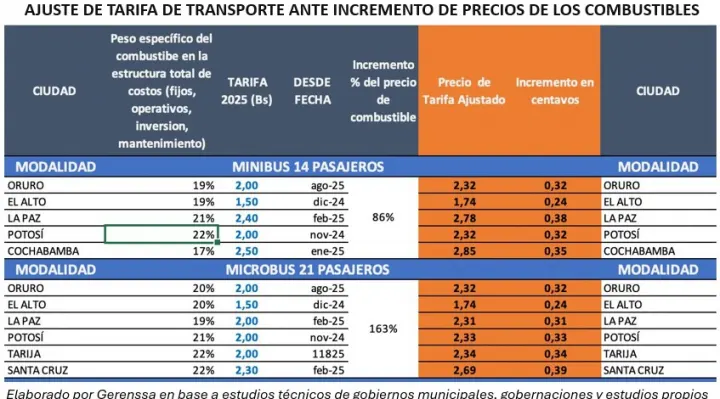
The consulting firm Gerenssa prepared a comparative table based on technical fare studies conducted by municipal governments, departmental governments, and its own analyses, detailing the impact of the fuel price increase on three modes of urban transport: 14-passenger minibuses and 21-passenger microbuses.
The case of La Paz: 14-passenger minibus
In the specific case of La Paz, fuel represents 21% of the total cost structure of a 14-passenger minibus, which includes fixed costs, operating costs, investment, and maintenance.
With a current fare of Bs 2.40 set in February 2025, and considering an 86% increase in fuel prices, the maximum technical adjustment would place the fare at Bs 2.78.
This adjustment is equivalent to an increase of 38 centavos per trip and places La Paz among the cities where the impact of fuel price increases is significant, although not the highest in absolute terms within this mode. (Brújula Digital)
Comparison with other cities
Gerenssa’s analysis shows that, for the 14-passenger minibus mode, the calculated adjustments vary by city and by the weight of fuel in the cost structure.
In Oruro, where fuel represents 19% of costs and the current fare is Bs 2.00, the adjusted price would reach Bs 2.32, an increase of 32 centavos. In El Alto, with the same percentage weight of fuel (19%) and a base fare of Bs 1.50, the adjustment would raise the fare to Bs 1.74, that is, an additional 24 centavos.
In Potosí, where fuel accounts for 22% of costs and the current fare is Bs 2.00, the technical adjustment also places the fare at Bs 2.32, with an increase of 32 centavos. Cochabamba, for its part, shows a fuel weight of 17%, a base fare of Bs 2.50, and an adjusted price of Bs 2.85, which represents an increase of 35 centavos.
Microbuses: similar increases, but with variations
Gerenssa’s table also details the impact of the fuel price increase on the 21-passenger microbus mode, where the percentage increase in fuel price considered (diesel) is higher, at 163%.
In La Paz, fuel represents 19% of the microbus cost structure. With a current fare of Bs 2.00, established in February 2025, the adjusted price would be Bs 2.31, implying an increase of 31 centavos per passenger.
In Oruro, with a fuel weight of 20% and a base fare of Bs 2.00, the technical adjustment raises the fare to Bs 2.32. In El Alto, also with a 20% fuel incidence and a current fare of Bs 1.50, the adjusted fare would be Bs 1.74.
Potosí shows a fuel weight of 21% and a base fare of Bs 2.00, with an adjustment up to Bs 2.33. Tarija, with an incidence of 22% and a fare of Bs 2.00, would reach an adjusted fare of Bs 2.34. Santa Cruz, with the same percentage weight of fuel (22%) and a current fare of Bs 2.30, presents one of the highest increases in absolute terms, with an adjustment up to Bs 2.69, that is, an additional 39 centavos.
Fuel as a key factor in the adjustment
One of the central elements of the analysis is the specific weight of fuel within the total cost structure of urban transport. In none of the cities analyzed does this component exceed 22% of the total, which explains why, even with significant increases in gasoline and diesel prices, the technical fare adjustments are expressed in tens of centavos and not in increases of one or more bolivianos.
In La Paz, both for minibuses and microbuses, the weight of fuel remains below the highest average observed in other cities, which limits the maximum calculated increase to between 31 and 38 centavos, depending on the mode. (Brújula Digital)
Por El Diario:
Tras el alza de la gasolina
Pasaje en minibús debería costar como máximo Bs 2,78
El incremento del precio de la gasolina a Bs 6,96 y del diésel a Bs 11,30 implicaría, de acuerdo con estudios técnicos de estructura de costos del transporte urbano, que la tarifa del minibús en la ciudad de La Paz debería ajustarse como máximo hasta Bs 2,78 por pasajero.
Ese monto supone un aumento de 38 centavos respecto a la tarifa vigente de Bs 2,40 y se encuentra dentro del rango de variaciones calculadas para distintas ciudades del país en función del peso específico del combustible en los costos operativos del servicio.
El estudio fue realizado por el economista Eduardo Pando, de la consultora Gerenssa.
El miércoles el gobierno del presidente Rodrigo Paz emitió el decreto 5503, que, entre varios otros aspectos, sube el precio del litro de la gasolina especial a Bs 6,96 y del diésel a Bs 9,80, lo que desencadenó protestas en varios lugares del país y paros y bloqueos de transportistas.
La consultora Gerenssa realizó un cuadro comparativo elaborado sobre la base de estudios técnicos de tarifas efectuados por gobiernos municipales, gobernaciones y análisis propios, en el que se detalla el impacto del alza de los combustibles en tres modalidades de transporte urbano: minibuses de 14 pasajeros y microbuses de 21 pasajeros.
El caso de La Paz: minibús de 14 pasajeros
En el caso específico de La Paz, el combustible representa el 21% de la estructura total de costos del minibús de 14 pasajeros, que incluye costos fijos, operativos, inversión y mantenimiento.
Con una tarifa vigente de Bs 2,40 establecida en febrero de 2025, y considerando un incremento del 86% en el precio del combustible, el ajuste técnico máximo situaría el pasaje en Bs 2,78.
Ese ajuste equivale a un incremento de 38 centavos por viaje y coloca a La Paz entre las ciudades donde el impacto del alza de combustibles es significativo, aunque no el más elevado en términos absolutos dentro de esta modalidad. (Brújula Digital)
Comparación con otras ciudades
El análisis de Gerenssa muestra que, para la modalidad de minibús de 14 pasajeros, los ajustes calculados varían según la ciudad y el peso del combustible en la estructura de costos.
En Oruro, donde el combustible representa el 19% de los costos y la tarifa vigente es de Bs 2,0, el precio ajustado alcanzaría Bs 2,32, con un incremento de 32 centavos. En El Alto, con el mismo peso porcentual del combustible (19%) y una tarifa base de Bs 1,50, el ajuste llevaría el pasaje a Bs 1,74, es decir, 24 centavos adicionales.
En Potosí, donde el combustible explica el 22% de los costos y la tarifa vigente es de Bs 2, el ajuste técnico también sitúa el pasaje en Bs 2,32, con un aumento de 32 centavos. Cochabamba, por su parte, presenta un peso del combustible del 17%, una tarifa base de Bs 2,50 y un precio ajustado de Bs 2,85, lo que supone un incremento de 35 centavos.
Microbuses: incrementos similares, pero con variaciones
El cuadro de Gerenssa también detalla el impacto del alza de combustibles en la modalidad de micros de 21 pasajeros, donde el incremento porcentual del precio del combustible considerado (diésel) es mayor, del 163%.
En La Paz, el combustible representa el 19% de la estructura de costos del micro. Con una tarifa vigente de Bs 2, establecida en febrero de 2025, el precio ajustado se ubicaría en Bs 2,31, lo que implica un incremento de 31 centavos por pasajero.
En Oruro, con un peso del combustible del 20% y una tarifa base de Bs 2, el ajuste técnico eleva el pasaje a Bs 2,32. En El Alto, también con un 20% de incidencia del combustible y una tarifa vigente de Bs 1,50, el pasaje ajustado sería de Bs 1,74.
Potosí muestra un peso del combustible del 21% y una tarifa base de Bs 2,00, con un ajuste hasta Bs 2,33. Tarija, con una incidencia del 22% y tarifa de Bs 2,00, alcanzaría un pasaje ajustado de Bs 2,34. Santa Cruz, con igual peso porcentual del combustible (22%) y una tarifa vigente de Bs 2,30, presenta uno de los incrementos más altos en términos absolutos, con un ajuste hasta Bs 2,69, es decir, 39 centavos adicionales.
El combustible como factor clave del ajuste
Uno de los elementos centrales del análisis es el peso específico del combustible dentro de la estructura total de costos del transporte urbano. En ninguna de las ciudades analizadas este componente supera el 22% del total, lo que explica por qué, aun con incrementos importantes en el precio de la gasolina y el diésel, los ajustes técnicos de tarifa se expresan en decenas de centavos y no en aumentos de uno o más bolivianos.
En La Paz, tanto en minibuses como en microbuses, el peso del combustible se mantiene por debajo del promedio más alto observado en otras ciudades, lo que limita el incremento máximo calculado a entre 31 y 38 centavos, según la modalidad. (Brújula Digital)
https://www.eldiario.net/portal/2025/12/20/pasaje-en-minibus-deberia-costar-como-maximo-bs-278/

 Bolivian Thoughts | Pensamientos Bolivianos (Bilingual/Bilingüe)