
By El Diario:
Today marks 146 years since the Chilean invasion of Antofagasta
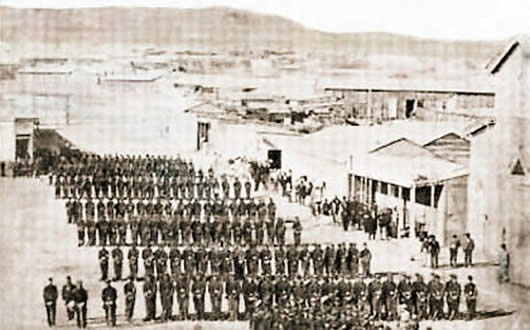
On February 14, 1879, a significant event in Bolivian history occurred when the Chilean invasion of the port of Antofagasta was announced, marking the beginning of the War of the Pacific. 146 years have passed since that tragic episode, which deprived Bolivia of a maritime access.
According to historian and researcher Víctor Hugo Chávez Serrano, it all began on the morning of February 14, 1879, when the Chilean warships “Cochrane” and “O’Higgins” were sighted in the bay of the port of Antofagasta, along with the “Blanco Encalada,” which had been anchored there for a few days.
The ships opened fire, managing to scare the population, who were taken by surprise by the artillery attack, but it was just the start of the assault that would shape the history of the Americas. He pointed out that, in the absence of defense by the Bolivians in the area, Chile proceeded to take over Mejillones, Tocopilla, and Cobija. “The civil response began on March 23, 1879, with our hero of Topater, Eduardo Abaroa, entering history.”
====
Editorial, Los Tiempos:
146 years of the invasion of Antofagasta
On February 14, 1879, 146 years ago, the most tragic and painful chapter of Bolivia’s history began, a chapter that remains open, just as the wounds left by the loss of our maritime access are still open.
During the early hours of that day, two warships — the “Cochrane” and the “O’Higgins” — anchored in the port of Antofagasta, joining the “Blanco Encalada,” another armored ship that had already been stationed there. The invading forces disembarked and took control of the city without encountering any resistance, marking the beginning of the most significant territorial loss suffered by our country. It wasn’t just the access to the sea that was taken from us, but also a territory that, although desert, contained vast mineral riches. Riches that remain the main pillar of the Chilean economy today.
It is enough to see that nearly 60% of Chile’s exports come from the territory that was once Bolivia’s, and which now constitutes Chile’s second region. Copper alone accounted for 50.8% of the country’s exports in 2024.
The loss of these territories and the status of being a coastal nation has undeniably caused an incalculable detriment to the national economy. To that dimension of damage must be added the traumatic effects it had and still has on the national soul and conscience. A trauma that continues to disrupt the collective mindset and condemns us to make victimhood a central aspect of our identity.
This largely explains why the cause of maritime reclamation has been, for the past 146 years, a unifying force for the thoughts and wills of Bolivians. It is the only cause around which other points of disagreement are secondary, granting those who champion it valuable and effective political capital. It is, therefore, a tool that can easily be misused, and worse, abused.
The damage caused by the usurpation we commemorate today thus has a dual dimension: the objective one, primarily reflected in economic harm, and the subjective one, whose manifestations range from poisoning the soul of our children and young people from the most basic levels of their education to the ease with which the issue is open to manipulation.
Regarding the first aspect, experience teaches us that the best approach is a healthy realism that allows the solution to our demand to also be seen in Chile as the beginning of a fruitful relationship between both peoples.
As for its subjective, cultural, and political dimension, it is most advisable to avoid allowing the maritime cause to become a tool for political manipulation.
Por El Diario:
Hoy se cumplen 146 años de la invasión chilena a Antofagasta
El 14 de febrero de 1879 marcó un hito en la historia boliviana, cuando se conoció de la invasión chilena al puerto de Antofagasta, hecho que fue el comienzo de la Guerra del Pacífico. Han transcurrido 146 años de aquel trágico episodio que priva a Bolivia de un salida marítima.
Según el historiador e investigador Víctor Hugo Chávez Serrano, todo comenzó la mañana del 14 de febrero de 1879, cuando en la bahía del puerto de Antofagasta, se avizoraron los barcos de guerra chilenos “Cochrane” y “O’Higgins”, junto con el Blanco Encalada, que estaba anclado desde hace unos días.
Los barcos abrieron fuego logrando atemorizar a la población, sorprendida por el ataque de artillería, pero era el inicio del atropello que marcaría la historia del continente americano.
Señaló que ante la inexistente defensa de parte de los bolivianos en la zona, Chile procede a la toma de Mejillones, Tocopilla y Cobija. “La respuesta civil inicia el 23 de marzo de 1879 en el que pasa a la historia nuestro héroe del Topater, Eduardo Abaroa”.
====
Editorial, Los Tiempos:
146 años de la invasión a Antofagasta
El 14 de febrero de 1879, hace ya 146 años, comenzó a escribirse el capítulo más trágico y doloroso de la historia de Bolivia, que aún se mantiene abierto, como abiertas están todavía las heridas que dejó la pérdida de nuestra costa marítima.
Durante las primeras horas de la madrugada de ese día, dos buques de guerra —el “Cochrane” y el “O’Higgins”— atracaron en el puerto de Antofagasta, donde se unieron al “Blanco Encalada”, otro barco blindado que ya estaba en el lugar. Las fuerzas invasoras desembarcaron y se apoderaron de la ciudad sin hallar ninguna resistencia, comenzando el peor despojo territorial sufrido por nuestro país. No fue sólo la salida al mar lo que se nos arrebató, sino un territorio que, aunque desértico, contenía enormes riquezas minerales. Tantas que aún hoy son el principal pilar de la economía chilena.
Basta ver que casi el 60% de las exportaciones chilenas proviene del que fue territorio boliviano y ahora constituye la segunda región chilena. Sólo el cobre representó en 2024 el 50,8% de las exportaciones de ese país.
La pérdida de esos territorios y de la condición de país costero ha causado sin duda un perjuicio incuantificable a la economía nacional. Y a esa dimensión del daño deben añadirse los efectos traumáticos que tuvo y aún tiene sobre el alma y la consciencia nacional. Un trauma que aún hoy deja sentir sus efectos perturbadores sobre la mentalidad colectiva y nos condena a hacer del victimismo un factor principal de nuestra identidad.
Así se explica en gran medida que la causa de la reivindicación marítima haya sido durante los últimos 146 años un factor aglutinador de los pensamientos y voluntades de los bolivianos. Es la única causa alrededor de la que los demás motivos de discrepancia son secundarios y dan por eso a quien la enarbola un capital político muy valioso y eficaz. Es, por consiguiente, un instrumento que fácilmente se puede prestar al uso indebido y, peor aún, al abuso.
Los daños causados por la usurpación que hoy se conmemora tienen pues una doble dimensión: la objetiva, plasmada principalmente en los perjuicios económicos, por una parte, y, por otra, la subjetiva, cuyas manifestaciones van desde el envenenamiento del alma de nuestros niños y jóvenes, desde los más básicos niveles de su formación, hasta la facilidad con que el tema se presta a manipulaciones.
Sobre el primer aspecto, las experiencias enseñan que lo mejor es un sano realismo que permita que la solución a nuestra demanda sea vista también en Chile como el inicio de una fructífera relación entre ambos pueblos.
Respecto de su dimensión subjetiva, cultural y política, lo más conveniente es evitar que la causa marítima se convierta en un instrumento de manipulación política.
https://www.lostiempos.com/actualidad/opinion/20250214/editorial/146-anos-invasion-antofagasta

 Bolivian Thoughts | Pensamientos Bolivianos (Bilingual/Bilingüe)