
By DANIEL ZENTENO, La Razon:
As of November 2024, the United Arab Emirates accounted for 96% of purchases of Bolivian gold jewelry.

A goldsmith in his workshop.
The gold jewelry sector experienced significant growth in 2024. After a 2023 marked by low figures and limited markets, jewelry exports reached $168.4 million by November 2024, compared to the modest $8.3 million recorded for all of 2023.
This nearly 2,000% increase reflects the sector’s recovery and its consolidation in new international markets.
According to data from the National Institute of Statistics (INE), during 2023, the United States was the primary and only destination for Bolivian gold jewelry, absorbing 331 kilos valued at $7 million. However, in 2024, the scenario changed drastically with the United Arab Emirates emerging as the main market, surpassing the U.S.
This outlet contacted the private Bolivian Institute of Foreign Trade (IBCE) to understand the reasons behind the recovery of the gold jewelry sector. “This increase in value is related to the rise in gold prices, which went up by 23% between 2023 and 2024, driving a 654% expansion in export volume by November of last year compared to the entire 2023 period,” said IBCE General Manager Gary Rodríguez, describing the increase as “a true leap.”
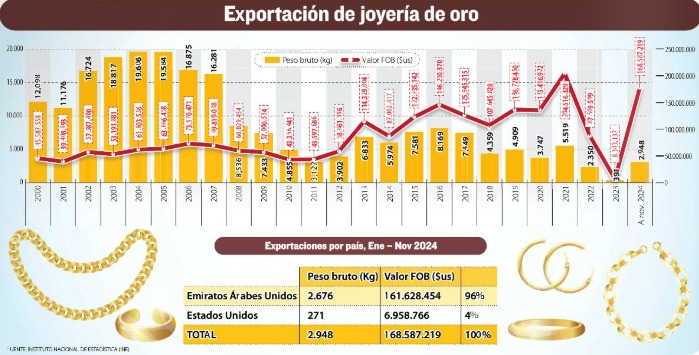
The growth in exports is also accompanied by a significant increase in gold jewelry production. While Bolivia barely produced 400 kilograms in 2023, by November 2024, production reached nearly 3 metric tons.
This productive increase serves as a solid foundation to meet the growing international demand and capitalize on market opportunities.
EXPONENTIAL GROWTH
According to the Bolivian Institute of Foreign Trade (IBCE), the gold jewelry sector accounts for 2.2% of the country’s total export revenue by November 2024.
Although still a modest fraction, this percentage gains importance considering the exponential growth recorded in the last year compared to the previous period.
The decline in 2022 and 2023 had left the sector in a vulnerable position. In 2022, Bolivia exported 2,350 kilograms of gold jewelry valued at $87.5 million, a 57% drop compared to 2021. Since then, exports had been in steady decline until 2023.
This slump was accompanied by the loss of strategic markets like Turkey and Italy, which significantly reduced exported volumes. The emergence of the United Arab Emirates reversed this trend, opening new opportunities for the sector.
Additionally, according to Rodríguez, one possible reason for the 2024 export increase is that the generated revenues are in foreign currency.
PROFITS AND EXCHANGE RATE
The IBCE manager explained that the nearly “60%” difference in the exchange rate “between the official dollar and the ‘black market’ dollar is a tremendous incentive to export a high-value, low-volume commodity at an extraordinarily high price, with profits potentially being more financial than commercial in nature,” he told this outlet.
Moreover, the stabilization of international gold prices and improvements in the design and manufacturing quality of Bolivian jewelry have enhanced the product’s competitiveness abroad.
While the current outlook appears promising, the sector still faces significant challenges to maintain this growth momentum. Consolidating trade relationships with emerging markets, improving quality standards, and meeting international regulatory requirements are critical for ensuring the sector’s sustainability in 2025.
For this reason, the IBCE manager noted, “In the international market, nothing is set in stone,” emphasizing that factors like market fluctuations and the specific conditions of each country could lead to the loss of clients, as happened with Italy and Turkey. This unpredictability underscores the fragile nature of international market relations.
Additionally, the fluctuation of international gold prices and competition from other exporting countries remain persistent threats. However, the dynamism shown in 2024 opens the door for Bolivia to solidify its presence in high-value markets and further expand its global market share, attracting new clients.
MARKETS FOR JEWELRY
According to INE data, of the 2,948 kilograms (nearly 3 metric tons) of gold jewelry produced by November 2024, a total of 2,676 kilograms (96%) were exported to the United Arab Emirates, while the remaining 4% (271 kilograms) went to the U.S. market.
Although the emergence of the United Arab Emirates enabled the sector’s recovery last year, it is essential for the country to seek other markets to avoid repeating past situations that resulted in reduced export revenues for the sector.
For instance, in 2022, Bolivia had a much more diversified market. The top five gold jewelry importing countries that year were China, the United Arab Emirates, Switzerland, India, and the United States. Currently, only two of those countries continue importing Bolivian gold jewelry, with the others no longer being international buyers.
Similarly, despite the decline in jewelry production since 2007—when over 16 metric tons were produced—the increase in gold valuation allows the activity to remain profitable, even though production levels are significantly lower.
“As for the prospects for jewelry exports, there could be major surprises,” Rodríguez said when asked about the sector’s outlook for 2025.
EMERGING COMPETITOR
The revival of gold jewelry exports has not only restored confidence among producers and exporters but has also positioned the country as an emerging competitor in the luxury goods market, as it was in previous years. In 2021, Bolivia fell out of the ranking of the world’s top 30 gold jewelry exporters, according to data from the specialized trade portal Trade Map.
However, the rebound in 2024 suggests that this momentum should be seized. Strengthening the production chain, diversifying export destinations, and improving product quality will be essential to consolidating this growth and projecting it into the future.
As Rodríguez noted, the scenario is unpredictable, but Bolivia has demonstrated its productive capacity and high quality, suggesting it could regain the production levels of past decades.
Por DANIEL ZENTENO, La Razón:
Hasta noviembre de 2024, Emiratos Árabes Unidos concentraba el 96% de las compras de joyería de oro boliviana.
Un orfebre en su taller.
El sector de la joyería de oro experimentó un crecimiento importante en 2024. Tras un 2023 marcado por cifras bajas y mercados limitados, las exportaciones de joyería alcanzaron un ingreso de $us 168,4 millones hasta noviembre de 2024, comparado con los modestos $us 8,3 millones registrados en todo 2023.
Este incremento de casi 2.000% refleja la recuperación del sector, así como su consolidación en nuevos mercados internacionales.
Según los datos del Instituto Nacional de Estadística (INE), durante 2023, Estados Unidos era el principal y único destino de las joyas de oro bolivianas, absorbiendo 331 kilos por un valor de $us 7 millones. Sin embargo, en 2024, el panorama cambió drásticamente con la incorporación de los Emiratos Árabes Unidos como el principal mercado, desplazando al mercado estadounidense.
Este medio se contactó con el privado Instituto Boliviano de Comercio Exterior (IBCE) para conocer los motivos por los cuales se logró recuperar el sector de la joyería de oro. “Esta crecida del valor tiene que ver con la subida del precio del oro, que entre 2023 y 2024 subió 23%, lo que ha impulsado a una expansión del volumen exportado a noviembre del pasado año en 654% comparado a toda la gestión 2023”, indicó a La Razón el gerente general del IBCE, Gary Rodríguez, quien calificó al incremento como “un verdadero salto”.
El crecimiento en las exportaciones también está acompañado por un aumento considerable en la producción de joyas de oro. Mientras que en 2023 Bolivia no alcanzó a producir ni una tonelada, bordeando apenas los 400 kilos, a noviembre de 2024 se logró producir un total de casi 3 toneladas.
Este incremento productivo es una base sólida que permitió abastecer la creciente demanda internacional y capitalizar las oportunidades de mercado.
CRECIMIENTO EXPONENCIAL
De acuerdo con el IBCE, el rubro de la joyería de oro representa el 2,2% del total de ingresos por exportaciones que generó el país hasta noviembre de 2024.
Aunque aún es una fracción modesta, este porcentaje cobra relevancia al considerar el crecimiento exponencial registrado en el último año en comparación con la gestión pasada.
El declive registrado en 2022 y 2023 había dejado al sector en una posición vulnerable. En 2022, Bolivia exportó 2.350 kilos de joyas de oro por un valor de $us 87,5 millones, una caída del 57% respecto a 2021. Desde entonces, las exportaciones estuvieron en franca caída hasta la gestión 2023.
Ese desplome estuvo acompañado por la pérdida de mercados estratégicos como Turquía e Italia, lo que redujo significativamente los volúmenes exportados. La irrupción de los Emiratos Árabes permitió revertir esta tendencia, abriendo nuevas puertas para el sector.
Asimismo, de acuerdo con Rodríguez, una posible causa del incremento de las exportaciones en 2024 se debe a que los ingresos que se generan son en moneda extranjera, en divisas.
GANANCIAS Y TIPO DE CAMBIO
Según el gerente del IBCE, la diferencia de casi el “60%” en el tipo de cambio “entre el dólar oficial y el del ‘mercado negro’, resulta un enorme aliciente para exportar una mercancía de altísimo valor y reducido volumen a un precio extraordinariamente alto, pudiendo ser la ganancia más de orden financiero que comercial”, explicó a este medio.
Además, la estabilización de los precios internacionales del oro y la mejora en la calidad de diseño y manufactura de las joyas nacionales contribuyeron a mejorar la competitividad del producto boliviano en el exterior.
Aunque el panorama actual parece ser alentador, el sector todavía enfrenta desafíos importantes para mantener este ritmo de crecimiento. La necesidad de consolidar relaciones comerciales con mercados emergentes, mejorar los estándares de calidad y cumplir con las exigencias regulatorias internacionales son aspectos clave para garantizar la sostenibilidad del sector en 2025.
Por ello, el gerente del IBCE señaló que “en el mercado internacional nada está escrito en piedra”, por lo que existen una serie de factores, como la variación de los mercados internacionales y las condiciones particulares de cada país, que podrían generar que se pierdan clientes, tal como sucedió con Italia y Turquía; siendo ése el lado impredecible en las relaciones con otros mercados.
Por otra parte, la fluctuación de los precios internacionales del oro y la competencia de otros países exportadores continúan siendo amenazas latentes. Sin embargo, el dinamismo mostrado en 2024 abre la posibilidad de que Bolivia consolide su presencia en mercados de alto valor y expanda aún más su cuota de participación global, obteniendo nuevos clientes.
MERCADOS PARA LA JOYERÍA
De acuerdo con los datos del INE, de los 2.948 kilogramos (casi 3 toneladas) de joyas de oro producidas hasta noviembre de 2024, un total de 2.676 kilos, el 96%, se exportaron a los Emiratos Árabes Unidos, mientras que el 4% restante (equivalente a 271 kilogramos) se destinó al mercado estadounidense.
Si bien la aparición de Emiratos Árabes permitió la recuperación del sector en la pasada gestión, también es importante que el país busque otros mercados para que no repita la situación que se vivió en años pasados, lo que provoca menos ingresos en las exportaciones del sector.
Por ejemplo, en 2022 el país tenía un mercado mucho más diversificado. Los cinco principales mercados importadores de artículos de joyería en oro durante ese año eran China, Emiratos Árabes Unidos, Suiza, India y Estados Unidos. Actualmente, solo dos de esos países continúan importando joyas de oro producidas en Bolivia, habiendo perdido a los otros mercados internacionales.
De igual manera, pese a que la producción de joyas está en caída desde 2007, cuando se logró producir más de 16 toneladas, el incremento y la valoración del oro permiten que la actividad se mantenga rentable, pese a que, en teoría, la producción es bastante menor.
“En cuanto a las perspectivas de la exportación de joyería, puede que haya grandes sorpresas”, consideró Rodríguez al ser consultado respecto al panorama del sector para este 2025.
COMPETIDOR EMERGENTE
Por ello, el resurgir de las exportaciones de joyería de oro no solo ha devuelto la confianza a los productores y exportadores, sino que también posiciona al país como un competidor emergente en el mercado de bienes de lujo como lo fue en anteriores años. En 2021, Bolivia salió del ránking de los 30 mayores exportadores de joyería de oro a nivel mundial, de acuerdo con los datos publicados en el portal especializado en comercio exterior Trade Map.
Sin embargo, el repunte en 2024 sugiere que se debe aprovechar esta coyuntura, para lo que se debe fortalecer la cadena productiva, diversificar los destinos de exportación y mejorar la calidad del producto será fundamental para consolidar este crecimiento y proyectarlo hacia el futuro.
Como señaló Rodríguez, el escenario es impredecible, pero el país mostró tener la capacidad productiva y una buena calidad, por lo que podría retomar la producción de décadas pasadas.

 Bolivian Thoughts | Pensamientos Bolivianos (Bilingual/Bilingüe)