
By Luz Mendoza, Eju.tv:
“The Cliff-Fallen General:” José Manuel Pando, from the Perspective of a Writer from Santa Cruz
“The General Driven Off a Cliff” reveals a Trinity of Beings, highlights Darwin Pinto while commenting on the content of the book written by the renowned jurist Juan Carlos Urenda, about the life of the illustrious military leader and former president of Bolivia.
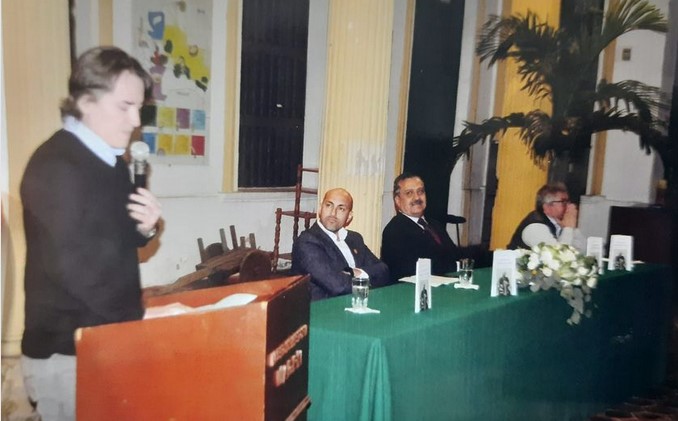
Darwin Pinto Cascán
“This evening, in this marvelous place that guards much of our people’s history -a history written by the brightest minds and the most active spirits born in the Land of Ñuflo de Chaves- I want to speak to you about three beings… Understanding a being as something that exists or that, in some way, is…
This Trinity of Beings consists of: a memory, an object, and a person.
The first being is a memory, that of José Manuel Pando, the Cliff-Fallen General.
José Manuel Pando is a man who goes through the darkest days of the nation and is a frontline protagonist in the War of the Pacific in 1879.
He is one of the few Bolivians who accompanies the Peruvians, even when Bolivia has already withdrawn from the conflict. It is in these war efforts that he receives a wound on his arm, an injury he will carry for the rest of his life.
Twenty years later, already a prestigious military leader and honored parliamentarian, he will be the one to lead the federal forces of La Paz’s liberalism to strike against the Constitution and the unitary and conservative government of Sucre, in the Federal War of 1898-99.
After the victory of La Paz’s federalism, he will also be the one to order the end of the Aymara threat of Willka, his friend and ally in the Federal War, without whose help La Paz could not have defeated the regular army of Bolivia nor the prevailing Constitution.
As President, Pando will march to the Colonies Territory to assist the cruceño Nicolás Suárez and his Cambas rubber tappers, who defend in Acre the integrity of Bolivia and, of course, the interests of Suárez, in a combined effort between public and private sectors to save the territory and Bolivian rubber from Brazilian expansionism. However, Pando’s presence in what would become Pando Department will be futile. Acre is lost in exchange for money, the promise of a railroad, and an exit to the Paraguay River in a swampy area where no port can be built.
It will be his work or that of his government (1899-1904), directly or indirectly, that will lose territory to Chile, Brazil, and Peru. These dismemberments, along with actions against his friend Willka, will be some of the shadows that follow him for the rest of his life with the same intensity as the pain in his arm, a result of the wound in the Pacific.
The country and he are damaged both inside and out. At those moments, one is a reflection of the other.
Soldier in the Pacific, Leader in the Federal War, and President in the Acre War, the Cliff-Fallen General will be a protagonist of those great tragic moments for the country that will be imprinted in his mind, in his being, and will return to him in the last moments of his life.
In addition to all this, or perhaps because of all this, Pando unintentionally becomes a symbol.
He, born in La Paz and a lover of the eastern jungles, represents in himself the great Bolivian contradictions, which, far from generating a Hegelian synthesis -that propels us forward towards progress-, instead correspond to a permanent antithesis that keeps us bound in resentment and astonishment, without advancing anywhere.
By vocation a doctor, Pando becomes a soldier. He has a spirit of freedom and adventure but allows himself to be ensnared by the treacherous web of Altoperuvian politics. He is from La Paz, yes, but also a parliamentarian for Chuquisaca before the Federal War that directly confronts both regions.
He is a federalist and liberal, yes, but also a unitary, centralist, and republican.
He has survived two international wars and a civil war, yes, but he dies in a solitary ravine, in a cold wasteland of sadness and neglect, with no one to mourn him, without a dog to bark at him. Alone.
He is one of the country’s most well-known men, yes, but no one knows who moved the murderous hand against him.
He is an idol of his people, yes, but the republicans of Bautista Saavedra will try to use his death to destroy political enemies, in this case, the liberals of Gutiérrez Guerra.
Only his family will seek justice.
And that brings me to the second being I came to talk to you about tonight: This book.
The second being: the book.
In this work, the author describes with patience and precision the last hours of the Cliff-Fallen General’s life, as well as the judicial process against his supposed murderer. He describes the intense moments of the trial and the supreme hour of a spectacle-execution in the barren and then-uninhabited plains of El Alto.
The book is not a novel nor an official biography. It is a mixture of both, a biographical novel, or a novelized review, or a historical novel that focuses on Pando’s last days, the trial process, and the result of the trial against the supposed murderers.
It is a work based on real events, a succession of well-documented data with touches of fiction to fill those spaces that archives cannot.
This is a work that represents part of the life and death of this man who crossed centuries XIX and XX on horseback, who had to deal with his victories and his failures, and whose cowardly murder is perhaps the most complete metaphor of Bolivian political life.
I say this because in this country political adversaries do not confront each other, they annihilate each other. And almost never directly, but they use tricks, scapegoats, street and judicial ambushes, as well as the classic abuse of power that waters the roots of this country with injustices and, therefore, with desires for revenge.
It is, therefore, an eternal return to calamity…
The work narrates the story of a man in whom moments of that perpetual and dramatic insurgency of Bolivia are recognized, as Charles Arnade would say.
It is almost an engraving of Bolivia frozen at the moment when it is not known whether it will make a great leap forward or if it will destroy itself once and for all.
José Manuel Pando could have been a statesman, but he lived in times when the borders of a weak, vast, sparsely populated republic besieged by its neighbors were being defined, and of course, lacking a real bourgeoisie with a power project beyond the bell tower and the extermination of the political adversary.
Pando only governed for one term, then retired to live in peace, but the shadows of the past and the calculations of Altoperuvian politics pursued him some years later and devoured him on a mountain path.
But then came other men who took his memory and reconstructed it, not precisely to vindicate him -it was not necessary- but to serve as a lesson for us, perhaps, and to see in it the reflection of a country that perhaps still today lives in its own Middle Ages, as it did then, and even before then.
Which brings me to the third being I want to talk to you about tonight.
The third being: the author
The third being is the author. It is he who retrieves Pando’s memory through serious research, brings him to life through writing, and gives him a new body in this book.
The Cliff-Fallen General is a work that allowed me to know better in his facet as a researcher and writer my very respected Juan Carlos Urenda.
What I found, while reading the improved versions of the book, was a meticulous author, attentive to details, committed to the perpetual improvement of his work, and with the humility necessary to receive without any noise any small comment.
His writing exercise can be considered quite disciplined, and his vision is very clear in seeking the best possible book. We readers appreciate that.
From his Santa Cruz culture, the author reveals in this work his deep insight into perhaps the greatest champion of the people of La Paz. I highlight this, the regional perspective on a character from the political center, because the usual has always been the opposite.
Our history as the people of Santa Cruz has been built -almost always- from official Bolivia, the Andean Bolivia, the one that is more than 2,500 meters high, and it has been they who in many cases have reconfigured through the cultural domination apparatuses of the State: who we are, where we come from, and where we are going. Which is totally unnatural, since they cannot know any of this, as they do not know us.
However, the work of local scholars has recovered our history, while other great authors from Santa Cruz, such as Gabriel René Moreno, Enrique Finot, or the two Vázquez Machicado, have scrutinized and contributed to Bolivian history in general without asking anyone’s permission.
Thus, addressing without complexes the history of Bolivia and its most notable characters from the Santa Cruz perspective in the 21st century is an exercise that must be perpetuated as the cultural expression of our evident material development.
I can say, to conclude, that The Cliff-Fallen General is one more step, a very firm step, in that necessary and urgent direction.
Thank you very much.”
Por Luz Mendoza, Eju.tv:
«El General desbarrancado»: José Manuel Pando, desde la mirada de un escritor cruceño
«El General desbarrancado» devela una Trinidad de Seres, subraya Darwin Pinto al comentar el contenido del libro escrito por el reconocido jurista Juan Carlos Urenda, sobre la vida del ilustre militar y expresidente de Bolivia.
Darwin Pinto Cascán
“Esta noche, en este lugar maravilloso que custodia gran parte de la historia de nuestro pueblo, -memoria escrita desde las mentes más brillantes y los espíritus más activos nacidos en la Tierra de Ñuflo de Chaves- quiero hablarles de tres seres… Entendiendo por ser aquello que existe o que, de alguna forma, está…
Esta Trinidad de Seres está conformada por: una memoria, un objeto y una persona.
El primer ser es una memoria, la de José Manuel Pando, el General desbarrancado.
José Manuel Pando es un hombre que atraviesa los días más oscuros de la nacionalidad y es protagonista de primera línea en la guerra del Pacífico de 1879.
Es uno de los pocos bolivianos que acompaña a los peruanos, incluso, cuando Bolivia ya se ha retirado del conflicto. Es en esos afanes de la guerra en que recibe una herida en el brazo, daño que cargará el resto de su vida.
Veinte años después, ya como prestigioso jefe militar y honrado parlamentario, será él quien encabece a las fuerzas federales del liberalismo paceño para golpear a la Constitución y al gobierno unitario y conservador de Sucre, en la Guerra Federal de 1898-99.
Tras la victoria del federalismo paceño, será también él quien ordene acabar con la amenaza aimara del Wilka, su amigo y aliado en la Guerra Federal, sin cuya ayuda La Paz no hubiera podido derrotar al ejército regular de Bolivia ni a la Constitución vigente.
Ya como Presidente, Pando marchará al Territorio de Colonias para prestar ayuda al cruceño Nicolás Suárez y a sus siringueros cambas, que defienden en el Acre la integridad de Bolivia y los intereses de Suárez, claro, en un esfuerzo combinado entre lo público y lo privado que busca salvar del expansionismo bandeirante al territorio y a la goma boliviana. Sin embargo, la presencia de Pando en el futuro departamento de Pando, será inútil. El Acre se pierde a cambio de dinero, la promesa de un tren y una salida al río Paraguay en una zona pantanosa donde no se puede levantar puerto.
Será su obra o la de su gobierno (1899-1904), de manera directa o indirecta, la que perderá territorio ante Chile, Brasil y Perú. Esos desmembramientos, más las acciones contra su amigo el Wilka, serán algunas de las sombras que lo seguirán el resto de su vida con el mismo encono, con que lo tortura el dolor en el brazo, fruto de la herida en el Pacífico.
El país y él están dañados por dentro y por fuera. En esos momentos, uno es reflejo del otro.
Soldado en el Pacífico, Jefe en la Guerra Federal y Presidente en la del Acre, el General Desbarrancado será protagonista de esos grandes momentos trágicos para el país que quedarán impresos en su mente, en su ser y volverán a él en los últimos momentos de su vida.
Además de todo ello o quizá por todo ello, Pando se constituye involuntariamente en un símbolo.
Él, nacido en La Paz y amante de las selvas orientales, representa en sí mismo las grandes contradicciones bolivianas, que lejos de generar una síntesis hegeliana -que nos impulse hacia adelante, hacia el progreso-, por el contrario, se corresponden a una antítesis permanente que nos mantiene amarrados en el rencor y el pasmo sin avanzar hacia ninguna parte.
De vocación médico, Pando se hace soldado. Tiene un espíritu de libertad y aventura, pero se deja envolver con la telaraña traicionera de la politiquería altoperuana. Es paceño, sí, pero también parlamentario por Chuquisaca antes de la Guerra Federal que enfrenta directamente a ambas regiones.
Es federalista y liberal, sí, pero también será unitario, centralista y republicano.
Ha sobrevivido a dos guerras internacionales y a una civil, sí, pero muere en un barranco solitario, en un frío páramo de tristeza y desamparo, sin nadie que lo llore, sin un perro que le ladre. Solo.
Es uno de los hombres más conocidos del país, sí, pero nadie sabe quién movió la mano asesina en su contra.
Es un ídolo de su pueblo, sí, pero los republicanos de Bautista Saavedra tratarán de usar su muerte para destruir a los enemigos políticos, en este caso, los liberales de Gutiérrez Guerra.
Sólo su familia buscará justicia.
Y eso me lleva al segundo ser sobre el que vine a hablarles esta noche: Este libro.
El segundo ser: el libro.
En esta obra, el autor describe con paciencia y precisión las últimas horas de vida del General Desbarrancado, además del proceso judicial en contra de su supuesto asesino. Describe los momentos intensos del juicio y la hora suprema de una ejecución-espectáculo en las planicies pelonas y por entonces deshabitadas de El Alto.
El libro no es una novela y tampoco una biografía oficial. Es una mezcla de ambas, una biografía, o una reseña novelada, o una novela histórica que se centra en los últimos días de Pando, en el proceso y en el resultado del juicio contra los supuestos asesinos.
Es una obra basada en hechos reales, una sucesión de datos bien documentados con pinceladas de ficción para llenar esos espacios que los archivos no pueden.
Esta es una obra que representa parte de la vida y muerte de este hombre que atravesó a caballo los siglos XIX y XX, que debió lidiar con sus victorias y sus fracasos, y cuyo cobarde asesinato es quizá la metáfora más acabada de la vida política boliviana.
Digo esto, porque en este país los adversarios políticos no se confrontan, se aniquilan. Y casi nunca de manera directa, sino que se valen de triquiñuelas, chivos expiatorios, emboscadas callejeras y judiciales, además del clásico abuso de poder que riega las raíces de este país con injusticias y, por lo tanto, con deseos de venganza.
Es, pues, un eterno retorno hacia la calamidad…
La obra narra la historia de un hombre en el que se reconocen momentos de esa perpetua y dramática insurgencia de Bolivia, como diría Charles Arnade.
Es casi un grabado de la Bolivia congelada en el momento justo en el que no se sabe si dará un gran salto hacia adelante o si se destruirá para siempre de una vez por todas.
José Manuel Pando pudo ser un estadista, pero le tocó vivir en tiempos en que se definían las fronteras de una república débil, extensa, poco poblada, sitiada por sus vecinos y claro, carente de una burguesía real con un proyecto de poder más allá del campanario y del exterminio del adversario político.
Pando sólo gobernó un periodo, para luego retirarse a vivir en paz, pero las sombras del pasado y los cálculos de la politiquería altoperuana, fueron tras él algunos años después y lo devoraron en un caminito de montaña.
Pero luego vinieron otros hombres que tomaron su memoria y la reconstruyeron, no precisamente para reivindicarlo -no hacía falta- sino para que su vida nos sirva, quizá, de lección y veamos en ella el reflejo de un país que acaso aún hoy vive en su propia Edad Media, como vivía entonces, y aún antes de entonces.
Lo que me lleva al tercer ser sobre el que quiero hablarles esta noche.
El tercer ser: el autor
El tercer ser es el autor. Es él quien recoge la memoria de Pando por medio de una investigación seria, lo trae a la vida a través de la escritura y le da un nuevo cuerpo en este libro.
El General Desbarrancado es una obra que me permitió conocer mejor en su faceta de investigador y escritor a mi muy respetado Juan Carlos Urenda.
Lo que encontré, mientras leía las versiones mejoradas del libro, fue a un autor meticuloso, atento a los detalles, comprometido con la mejora perpetua de su obra y con la humildad necesaria para recibir sin ruidos de ningún tipo, cualquier pequeño comentario.
Su ejercicio de la escritura puede considerarse como bastante disciplinado y su visión es muy clara en cuanto a buscar el mejor libro posible. Los lectores agradecemos eso.
Desde su cultura cruceña, el autor deja ver en esta obra su mirada profunda sobre el quizá máximo campeón de los paceños. Destaco esto, la mirada regional sobre un personaje del centro político, porque lo habitual siempre ha sido al revés.
Nuestra historia como pueblo cruceño ha sido construida -casi siempre- desde la Bolivia oficial, la andina, la que está a más de 2.500 metros de altura, y han sido ellos los que en muchos casos han reconfigurado a través de los aparatos de dominación cultural del Estado: el quiénes somos, de dónde venimos y adónde vamos. Lo cual es totalmente antinatural, puesto que no pueden saber nada de eso, ya que nos conocen.
Sin embargo, el trabajo de estudiosos locales ha recuperado nuestra historia, mientras que otros grandísimos autores cruceños como, por mencionar algunos: Gabriel René Moreno, Enrique Finot o los dos Vázquez Machicado, han escudriñado y aportado a la historia boliviana en general sin pedirle permiso a nadie.
Así, el abordar sin complejos la historia de Bolivia y la de sus personajes más notables desde la mirada cruceña en el siglo XXI, es un ejercicio que debe perpetuarse como la expresión cultural de nuestro evidente desarrollo material.
Puedo decir, para terminar, que El General Desbarrancado es un paso más, un paso muy firme, en esa necesaria y urgente dirección.
Muchas gracias.”

 Bolivian Thoughts | Pensamientos Bolivianos (Bilingual/Bilingüe)