

El Diario:
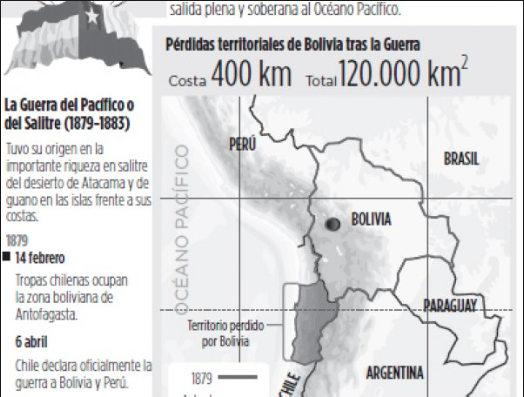
February 14, 1879 marked a milestone in Bolivian history, when it became known about the Chilean invasion of the port of Antofagasta, an event that was the beginning of the Pacific War. Uncertainty, rejection and indignation were some emotions and attitudes that occurred among Bolivians in this tragic episode.
According to the historian and researcher, Victor Hugo Chávez Serrano, it all began on the morning of February 14, 1879, when the Chilean warships “Cochrane” and “O’Higgins” were sighted in the bay of the port of Antofagasta. along with the Blanco Encalada, which had been anchored for a few days. The ships opened fire, managing to frighten the population, surprised by the artillery attack, but it was the beginning of the outrage that would mark the history of the American continent.
He pointed out that given the non-existent defense on the part of the Bolivians in the area, Chile proceeds to take Mejillones, Tocopilla and Cobija. “The civil response began on March 23, 1879, when our hero from Topater, Eduardo Abaroa, went down in history.”
“Under these conditions, despite the alliance with Peru, we were defeated in the fields of the Alliance, in Tacna, on May 26, 1880,” he said.
He explained that the betrayal of our command headed by Narciso Campero and the interests of the oligarchy with Aniceto Arce, who had commercial interests in partnership with Chilean investors, “made us withdraw from the fight after the Alto de la Alianza, which allowed that in January 1881, after the fighting in Chorrillos and Miraflores, this territory was taken by the Mapocho,” he added.
In this context, Peru and Chile sign the Treaty of Ancón on October 20, 1883, then Bolivia and Chile sign the Truce Pact of April 4, 1884. After 20 years, the Treaty of October 20, 1904 is signed, ratified in the Parliament of Bolivia by law of February 4, 1905.
However, Chávez Serrano clarifies that on that occasion the Bolivian territories from the 23rd Parallel to the 24th Parallel (110 km of coast) were not ceded in said Treaty, nor were the islands and islets of that maritime space.
Bolivia – he said – did not lose the Maritime Claim, because it simply did not present it, it is pending presentation and “it is our duty to redirect this policy and do things as they should: File the Arbitration Maritime Claim against Chile for non-compliance with the Treaty of 1904, since it occupies territories and islands not ceded by Bolivia.” In this scenario, the right to sovereign access to the Pacific Ocean will never be renounced, which is why this historical event remains a “pending” issue not only for Bolivia, but also for the region.
El 14 de febrero de 1879 marcó un hito en la historia boliviana, cuando se conoció de la invasión chilena al puerto de Antofagasta, hecho que fue el comienzo de la Guerra del Pacífico. Incertidumbre, el rechazo y la indignación fueron algunas emociones y actitudes que se dieron entre los bolivianos en este trágico episodio.
De acuerdo con el historiador e investigador, Victor Hugo Chávez Serrano, todo comenzó la mañana del 14 de febrero de 1879, cuando en la bahía del puerto de Antofagasta, se avizoraron los barcos de guerra chilenos “Cochrane” y “O’Higgins”, junto con el Blanco Encalada, que estaba anclado desde hace unos días. Los barcos abrieron fuego logrando atemorizar a la población, sorprendida por el ataque de artillería, pero era el inicio del atropello que marcaría la historia del continente americano.
Señaló que ante la inexistente defensa de parte de los bolivianos en la zona, Chile procede a la toma de Mejillones, Tocopilla y Cobija. “La respuesta civil inicia el 23 de marzo de 1879 en el que pasa a la historia nuestro héroe del Topater, Eduardo Abaroa”.
“En estas condiciones, pese a la alianza con el Perú, fuimos derrotados en los campos de la Alianza, en Tacna, el 26 de mayo de 1880”, dijo.
Explicó que la traición de nuestra comandancia a la cabeza de Narciso Campero y los intereses de la oligarquía con Aniceto Arce, quien poseía intereses comerciales en sociedad con inversores chilenos, “hacen que luego del Alto de la Alianza nos retiremos del combate, lo cual permitió que en enero de 1881, tras los combates de Chorrillos y Miraflores, este territorio fuera tomado por el Mapocho”, añadió.
En este contexto, Perú y Chile firman el Tratado de Ancón el 20 de octubre de 1883, luego Bolivia y Chile suscriben el Pacto de Tregua de 4 de abril de 1884. Tras 20 años se firma el Tratado de 20 de octubre de 1904, ratificado en el Parlamento de Bolivia por ley de 4 de febrero de 1905.
Sin embargo, Chávez Serrano aclara que en la oportunidad no se cedieron en dicho Tratado los territorios bolivianos del Paralelo 23 al Paralelo 24 (110 km de costa), tampoco las islas e islotes de ese espacio marítimo.
Bolivia –dijo– no perdió la Demanda Marítima, pues simplemente no la presentó, está pendiente de presentación y “es nuestro deber reencaminar está política y hacer las cosas como se debe: Interponer la Demanda Marítima Arbitral contra Chile por incumplimiento del Tratado de 1904, pues ocupa territorios e Islas no cedidas por Bolivia”. En este escenario no se renunciará jamás al derecho de acceder soberanamente al Océano Pacífico, por lo cual este hecho histórico queda como un tema «pendiente» no sólo para Bolivia, sino también para la región.
https://www.eldiario.net/portal/2024/02/14/145-anos-de-la-invasion-chilena-a-antofagasta/

 Bolivian Thoughts | Pensamientos Bolivianos (Bilingual/Bilingüe)
It is time for Chile to return all of the territorios stolen to Bolivia through an illégal War créâted by European interest in the región. I dont think that Bolivia is doing much for their part to cuntinue thru peacefull means by calling to all thé nations of thé world to force Chile to accede Bolivia a way or access to the Pasific Océan.