
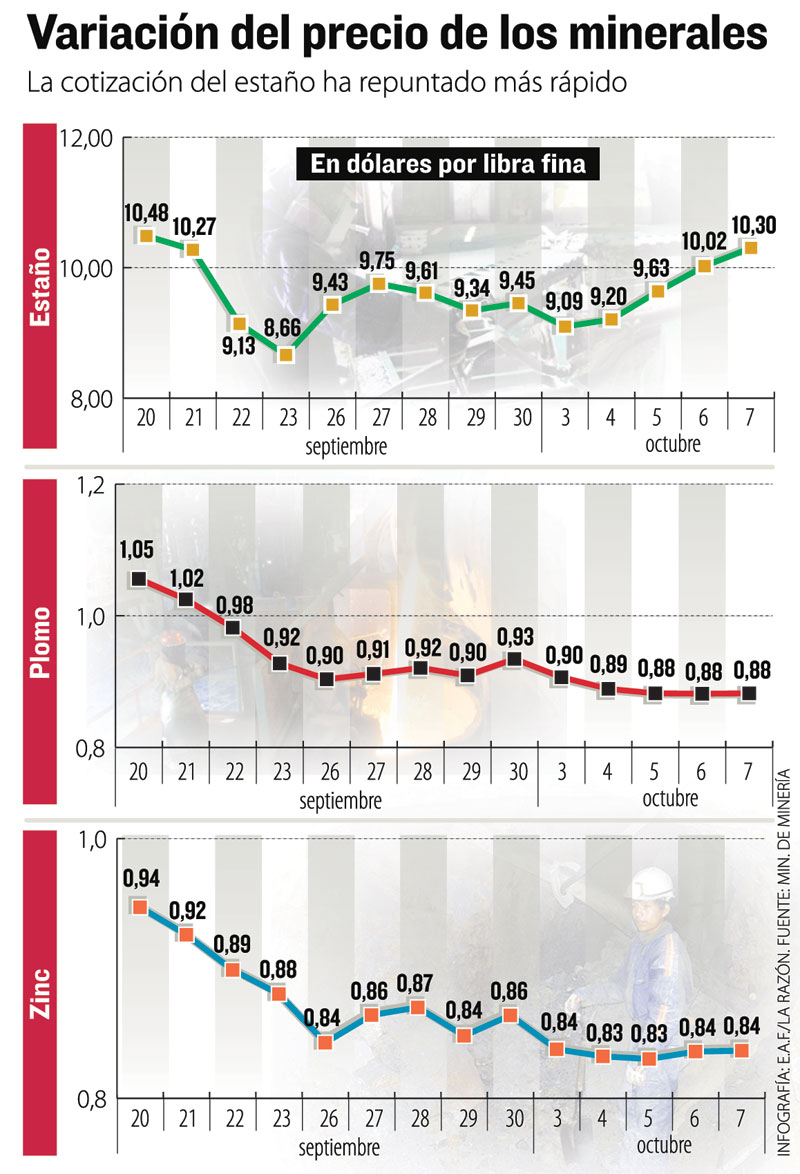
 Mineral prices at the London Metal exchange have slightly gone up for tin. However, lead and zinc remain low.
For Bolivia, these three minerals represent: employment and income for a large portion of the most organized union in Bolivia. The mining workers at the state-owned mines, private and coops are a labor force in the Bolivian economy to regard seriously by any government.
On September 23rd, the price for tin was $8.66 and that represented that Huanuni mine was working at loss. Now, price has gone to $10.02 which is a temporary relief for this sector. Huanuni’s break even represents that for every miner hired, one ton should be produced per day. To date, Huanuni only produces 1,200 tons per day. [so, that is a potential source for social unrest that can add to political instability of current government; who has already lost a lot of credibility over the last 50 days, because of the TIPNIS]
If prices were to drop below $8.50 that is when the government would have to worry, said vice-minister for Mining and Metallurgy Productive Development, Freddy Beltran.
http://www.la-razon.com/version.php?ArticleId=138874&EditionId=2678
Mining royalties who fund the regional governments have went down by 30% for Cochabamba department, from $600K to $400K per month, due to price fluctuations. Jose Fernandez who is responsible for the Mining Secretary for Cochabamba, explained that this reduction came as a result of lower international prices and miners stock their production (hoping to sell at a future time when international prices are better).
http://www.paginasiete.bo/2011-10-08/Economia/Destacados/8Eco02-081011.aspx

 Bolivian Thoughts | Pensamientos Bolivianos (Bilingual/Bilingüe)
Thank you, I used all that is available at WordPress.