
By EFE, Red Uno; Eju.tv:
Bolivian Women Challenge Stereotypes and Promote Their Leadership in Science
Students, professionals, and academics shared experiences to encourage STEM vocations and reduce gender gaps in Bolivia.
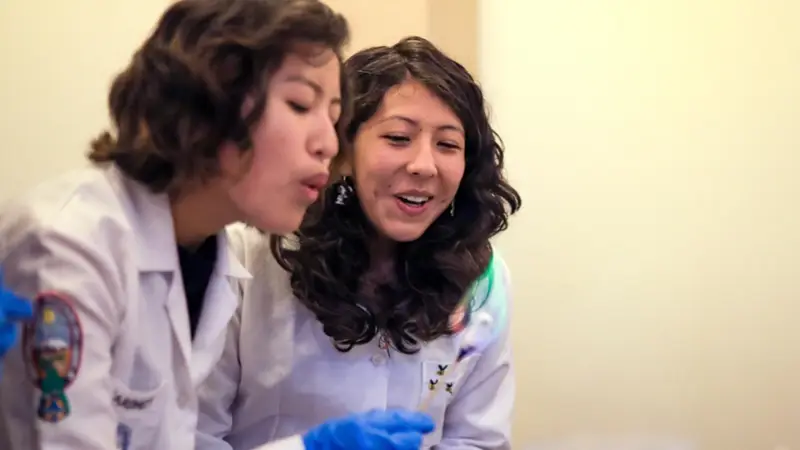
Women of various ages—high school students, university students, professionals, and academics—at a meeting at UMSA. Photo: EFE
Women of different ages—schoolgirls, university students, professionals, and academics—gathered at the state-run Universidad Mayor de San Andrés (UMSA) in Bolivia to exchange experiences and take on challenges on the occasion of the International Day of Women and Girls in Science.
With this activity, the participants set out to overcome limits and stereotypes by creating spaces that promote their leadership in the areas of science, technology, engineering, and mathematics (STEM), in order to reduce gender gaps and contribute to society with high-impact projects.
“For us it is very important to help other girls and women recognize that science is part of our profession (…) and to show that science is fun and pure passion,” Cecilia Soto, president of the Organization for Women in Science for the Developing World (OWSD), told EFE.
Soto highlighted that there are increasingly “more (women) interested in studying science” in Bolivia, despite material or economic limitations and difficulties in accessing funding to finance their own projects, in which she considered the role of universities to be fundamental.
An example of this is Jeloska Chávez, a young woman who recently graduated in computer science from UMSA, who works as a software developer and is one of the most successful examples of young women linked to an occupation traditionally assigned to men.
Chávez explained to EFE that part of her achievements came from seeking “academic opportunities and places where I can apply (the knowledge)” she was acquiring, in addition to valuing that “those spaces are opening up more and more.”
For this young woman, the presence of women in science “is something that has to be worked on constantly,” and she considered that stereotypes still exist that assign specific tasks to each gender, so there is still “a lot of work to do” for the abilities of each woman to become visible.
The activity included the presence of a couple of presenters in robotics and chemical magic, who captured the attention of attendees and sparked curiosity about science.
Such is the case of the booth run by Anahí Mamani, a young woman who leads the platform Ciencia Link Bolivia, where she displayed several prototypes.
This platform is dedicated to selecting research and projects in robotics, programming, 3D printing, artificial intelligence, astronomy, and biotechnology, among others, and to disseminating them in the country.
The Chemistry Magic Club was also present, a circle with more than half a century of existence dedicated to attracting interest in chemistry through visual tricks generated by mixing substances and exposing them to elements such as fire.
“This serves for scientific outreach (and) to show that chemistry is not boring at all and to encourage them to enter the program,” Lorena Chipana, a student from the Faculty of Pure and Natural Sciences at UMSA, told EFE.
February 11 is established by the United Nations as the International Day of Women and Girls in Science to raise awareness about women’s contributions to science and the importance of gender equity in addressing the world’s major global problems.
Por EFE, Red Uno; Eju.tv:
Mujeres bolivianas desafían los estereotipos y promueven su protagonismo en la ciencia
Estudiantes, profesionales y académicas compartieron experiencias para fomentar vocaciones STEM y reducir brechas de género en Bolivia.
Mujeres de varias edades, colegialas, universitarias, profesionales y académicas en reunión de la UMSA. Foto: EFE
Mujeres de varias edades, colegialas, universitarias, profesionales y académicas se reunieron en la estatal Universidad Mayor de San Andrés (UMSA), en Bolivia, para intercambiar experiencias y asumir desafíos con ocasión del Día Internacional de la Mujer y la Niña en la Ciencia.
Con esta actividad las participantes se propusieron vencer los límites y estereotipos a través de espacios de fomento de su protagonismo en las áreas de ciencia, tecnología, ingeniería y matemáticas (STEM, en inglés), para así reducir las brechas de género y contribuir a la sociedad con proyectos de impacto.
«Para nosotras es muy importante ayudar a otras niñas y mujeres a reconocer que la ciencia es parte de nuestra profesión (…) y mostrar que la ciencia es divertida y pura pasión», dijo a EFE la presidenta de la Organización para las Mujeres en Ciencia para el Mundo en Desarrollo (OWSD, en inglés), Cecilia Soto.
Soto destacó que existen cada vez «más (mujeres) interesadas en estudiar ciencia» en Bolivia, a pesar de las limitaciones materiales o económicas y las dificultades de acceso a financiamiento para costear proyectos propios, en los que consideró que el rol de las universidades es fundamental.
Un ejemplo de esto es Jeloska Chávez, una joven recientemente egresada de la carrera de informática de la UMSA, quien trabaja como desarrolladora de software y es uno de los ejemplos más exitosos de mujeres jóvenes ligadas a una ocupación tradicionalmente asignada a los varones.
Chávez explicó a EFE que una parte de sus logros estuvo en buscar «oportunidades académicas y sitios donde pueda aplicar (el conocimiento)» que fue adquiriendo, además de valorar que «cada vez se abren más esos espacios».
Para esta joven, la presencia de las mujeres en la ciencia «es algo que se tiene que estar trabajando constantemente» y consideró que aún existen estereotipos que asignan a cada género tareas específicas, por lo que todavía «hay mucho trabajo que hacer» para que la capacidad de cada una de ellas se visibilice.
La actividad contó con la presencia de un par de expositoras en robótica y magia química, que captaron la atención de los asistentes, además de despertar curiosidad por la ciencia.
Tal es el caso del puesto de Anahí Mamani, una joven que lidera la plataforma Ciencia Link Bolivia, en el que exhibió varios prototipos.
Esta plataforma está dedicada a la selección de investigaciones y proyectos en robótica, programación, impresión 3D, inteligencia artificial, astronomía y biotecnología, entre otros, y a difundirlos en el país.
También estuvo presente el Club de Magia Química, un círculo que tiene más de medio siglo de existencia y que está dedicado a captar la afición por la química mediante trucos visuales que se generan a través de la mezcla de sustancias y su exposición a elementos como el fuego.
«Esto sirve para la divulgación científica (y para) demostrar que la química no es para nada aburrida y que se animen a entrar a la carrera», mencionó a EFE Lorena Chipana, estudiante de la Facultad de Ciencias Puras y Naturales de la UMSA.
El 11 de febrero está instituido por las Naciones Unidas como el Día Internacional de la Mujer y la Niña en la Ciencia para crear conciencia sobre los aportes de las mujeres en la ciencia y la importancia de la equidad de género de cara a la resolución de los principales problemas globales.

 Bolivian Thoughts | Pensamientos Bolivianos (Bilingual/Bilingüe)