
By Mirna Echave, Visión 360:
Promoted in Rural Areas
By pedaling alone, people can make their favorite smoothies, avoid using electricity, and even get a bit of exercise. The project is being promoted in rural areas.
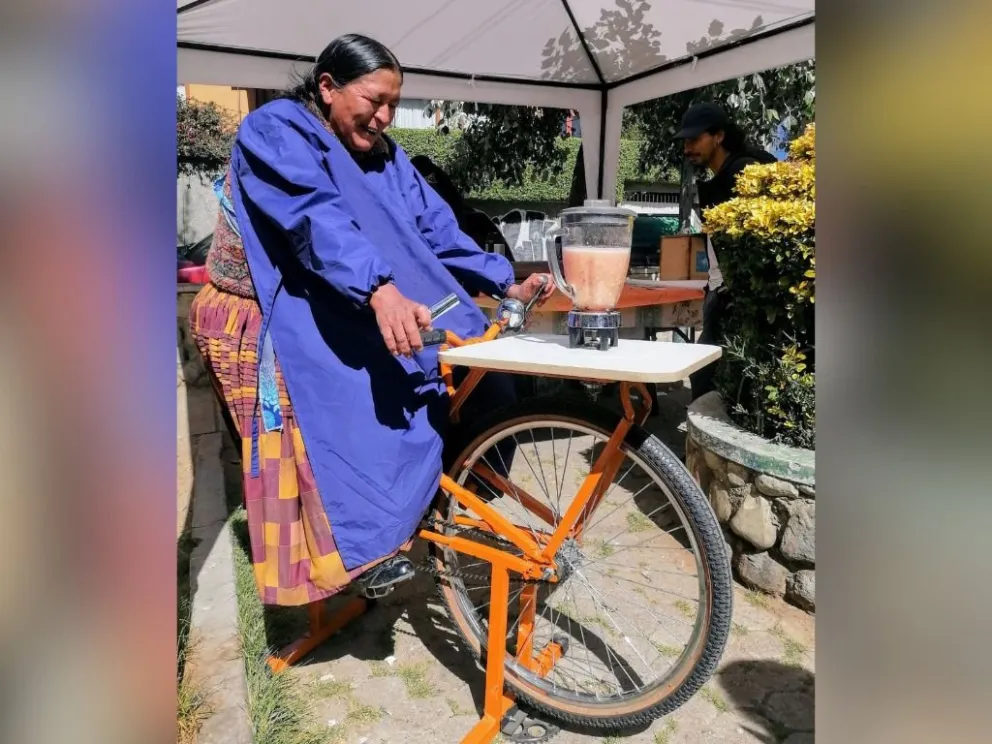
The licuacleta, a curious machine shaped like a bicycle but designed so that pedaling powers the blades of a blender, not only promotes physical activity and reduced electricity use, but also allows you to enjoy a fresh fruit or vegetable juice.
Leandro Maldonado built it about five years ago, and with his wife Paula Mariaca, made it part of a project that promotes healthy eating and environmental care: Kasa Muyu.
Children in the communities where the licuacleta is taken are the most amazed, eagerly taking turns to pedal. Last weekend, it was showcased at the “Diversity is Life” fair at the Central Urban Park in La Paz, where it caught the attention of both children and adults.
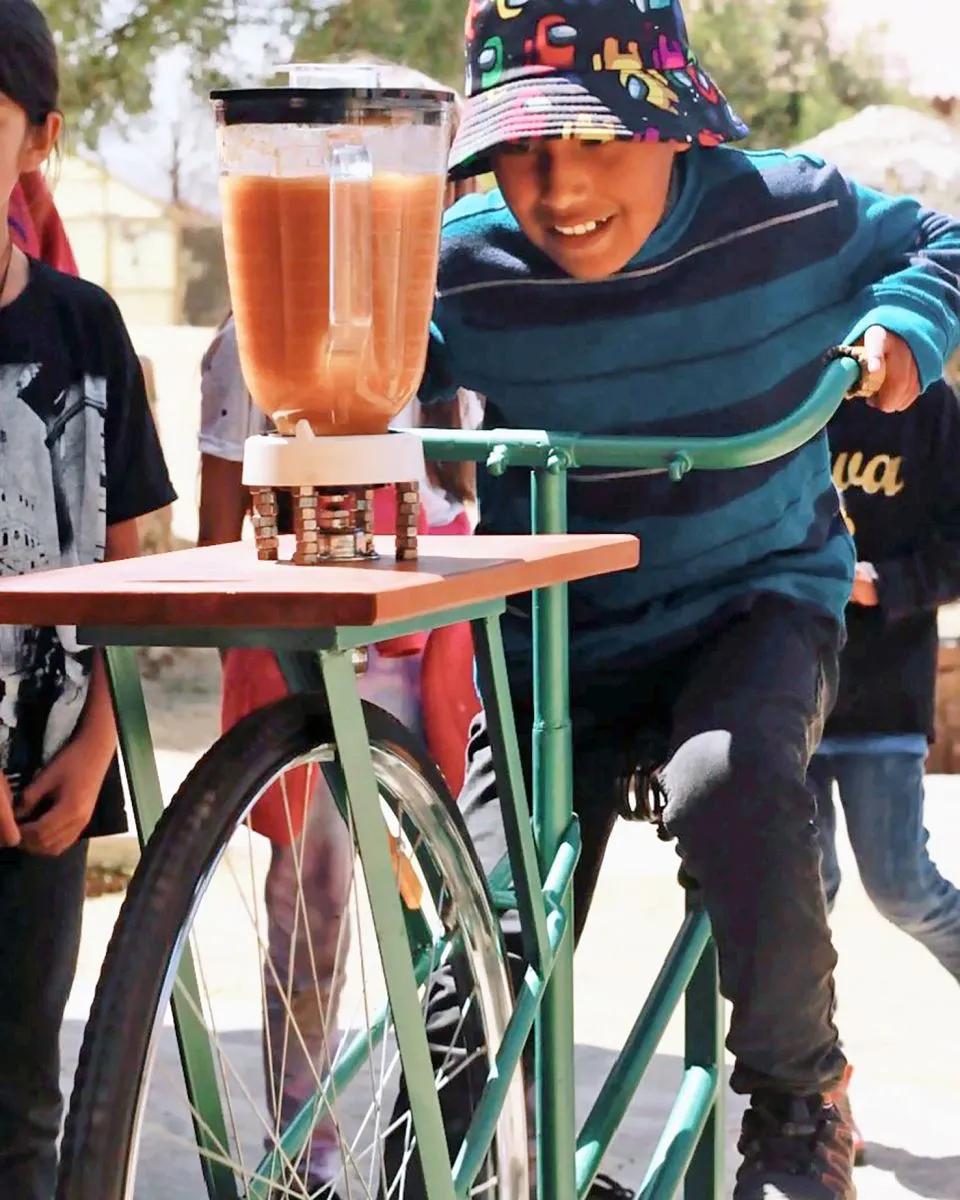
Photo: Kasa Muyu
The Creation
Although the first licuacleta originated in Spain and had notable international promotion, in Bolivia it was born in Cochabamba.
“We lived there, in a house where we had different demonstration systems like composting, gardens, water treatment, rainwater collection, various things. At some point, we began giving workshops to schools in Cercado, Cochabamba, in that space, in our home,” Leandro told Visión 360.
He recalled that it was Paula who suggested building the device to integrate into the project. And since Leandro had welding skills—he grew up in a workshop where his father worked as a mechanic in Uruguay—he learned the trade as well.
“So we could show the entire food cycle, starting from the garden. We held workshops with seedlings, and all the waste from the snacks we made with the kids went into composting. We would get soil from it and take it to the garden. That’s how we tried to close the food cycle using the licuacleta. Everything was always focused around food,” Leandro explained.
To build it, he had to gather tools, a discarded bike frame that was practically useless, and a burned-out blender he found at La Cancha, Cochabamba’s popular market. “We started with a friend, Jhonatan Cires, who is part of Cochabamba’s Critical Mass, very involved with bicycles. We both started putting this together,” he said.
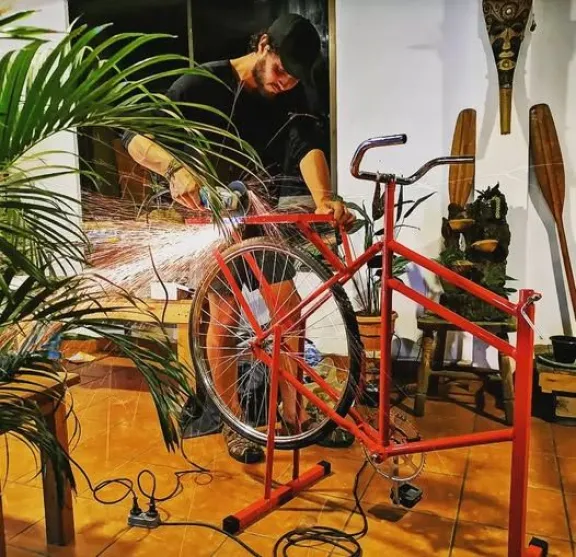
The design they came up with then is still in use today. While the original idea was to use it as a teaching tool, now it can even replace an electric appliance. Leandro has even been asked to give a workshop on how to build licuacletas.
Promotion
The machine, “a clean and responsible technology,” was available for anyone wanting to make a juice, free of charge, at the fair. People could choose any fruit and use bottled water to prepare their smoothie.
This is how the licuacleta was promoted: it works with coordinated pedaling, but instead of the chain driving the wheels, it powers the blender blades.
That is, users had to pedal continuously until the fruit and water in the blender jar were fully blended. An interesting feature of the fair was that participants were encouraged to bring their own cups and plates for tastings or consumption, although those without could use and then wash the ones provided by the project.
The experiment was a success, as it led many people to engage in meaningful conversations about the themes discussed.
“Many times I’ve been asked how it works, and I’m always happy to show it, because if you have the ability to weld and the creativity to build it, then go ahead, right? That’s always been the idea behind the project,” Leandro said.
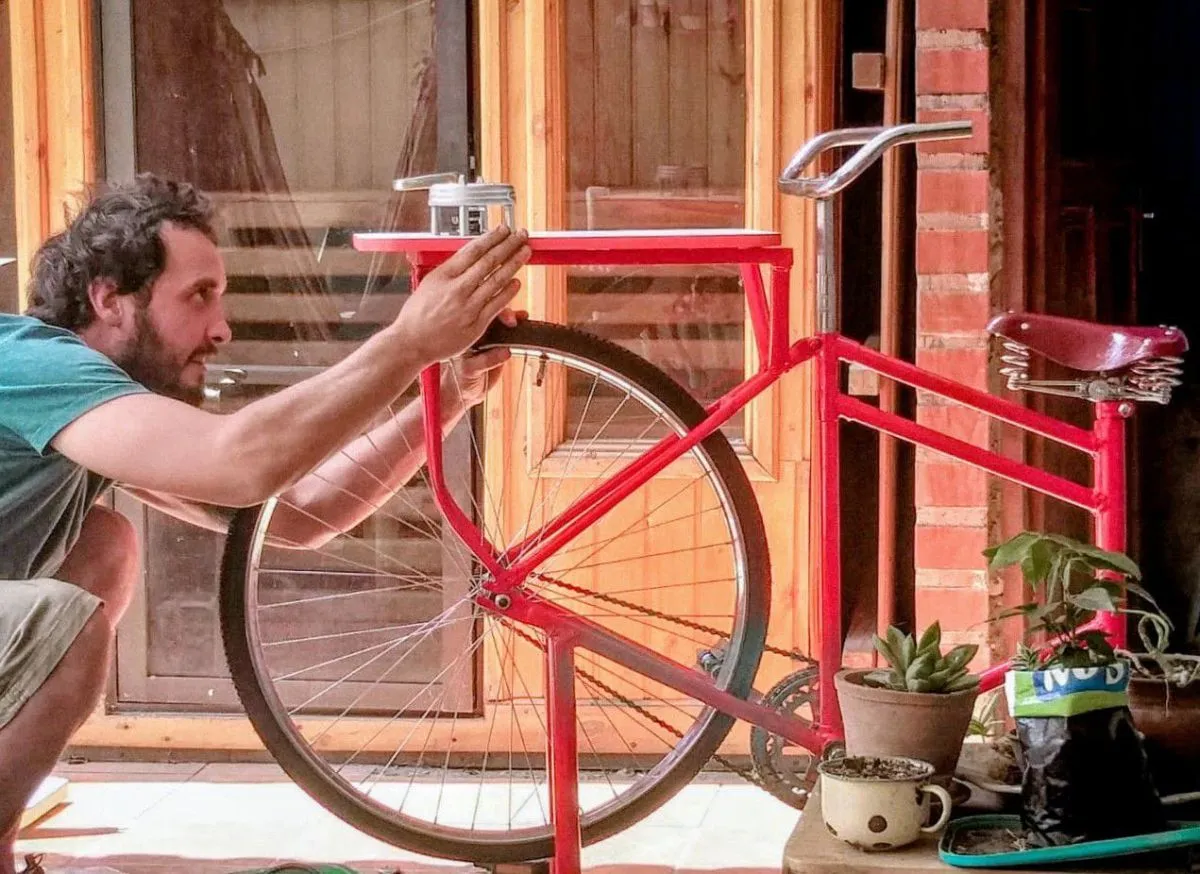
Photo: Kasa Muyu
To date, schools and student projects have replicated the model, such as students from the Suriquiña community in the department of La Paz.
The front wheel is fixed onto a platform, with the blender jar placed above it. The rear wheel is replaced by a stable base, where the seat is mounted.
The project’s reach is increasingly evident, but Kasa Muyu’s work is far from over. According to its founder, they hope to develop more pedal-powered machines that support families, especially food producers in rural areas.
“A blender might not seem all that useful, right? In rural areas, for example, where electricity is hard to access, a blender isn’t considered an essential appliance like, say, a water pump. Sometimes you need to draw water from a well or river for irrigation or other needs—so you’d need a pump or invest in a solar panel. But the great thing about blenders is that they spark curiosity and break the mold—when someone sees a bicycle making juice, it really surprises them,” he said.
Calculations show that with regular pedaling for two minutes, one can “virtually” travel one kilometer—and fully blend a smoothie.
Project Growth
For Leandro, it feels like magic—seeing what happens with children when they are introduced to the licuacleta. “It’s like a new paradigm opens up in their little heads. It’s really beautiful,” he says.
That’s why their goal is to reach more corners of the country. “We travel a lot within Bolivia. We’ve also been to Peru and Uruguay with the blender bike. What we do is visit schools.”
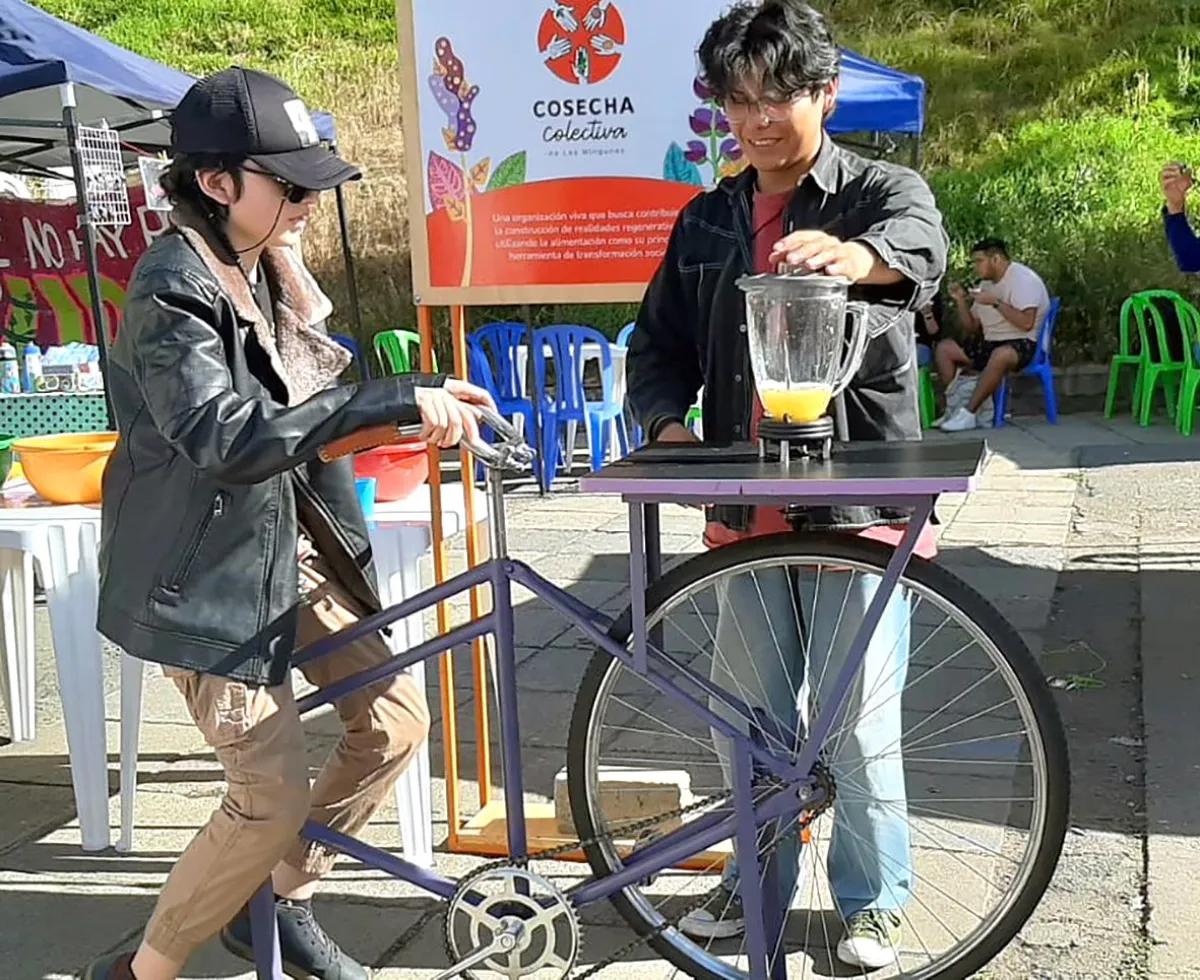
Photo: Mirna Echave
That’s where the cycle begins—gardening, composting, and nutritious food. According to Leandro, introducing the machine also lets them work as if it were a game, encouraging discussions about more serious issues like nutrition and environmental problems, and offering recipe-based solutions.
“And then, it happens—we had kids we taught recipes to at a school in Cochabamba, and later found them at a fair in Tiquipaya, selling a homemade ketchup recipe we had taught them. They had made it, bottled it, and were selling it. It was basically tomato and raw sugar (chancaca), well-cooked, made the way we showed them,” he recalls.
The direct and indirect impact of the licuacletas keeps growing, and according to Leandro, that’s the goal now: “to keep discovering more schools, spreading the idea, encouraging people to create—and to use recycled materials too.”
Por Mirna Echave, Visión 360:
Se promociona en el área rural
A puro pedaleo, la gente puede realizar sus licuados preferidos, evitar el uso de electricidad y, de paso, hacer un poco de ejercicio. El proyecto se difunde en el área rural.
La licuacleta, una curiosa máquina que guarda la forma de una bicicleta, pero dirige el impulso de los pedales a mover las aspas de una licuadora, no solo promueve la actividad física y la reducción del uso de energía eléctrica, sino que permite disfrutar de un jugo fresco de frutas o verduras.
Leandro Maldonado la construyó hace unos cinco años y, con su esposa Paula Mariaca, la hicieron parte de un proyecto con el que promueven la alimentación saludable y el cuidado del medio ambiente: Kasa Muyu.
Los niños de las comunidades a donde llevan a licuacleta son los más sorprendidos y se turnan para subir a pedalear. El pasado fin de semana se la presentó en la feria Diversidad es Vida, en el Parque Urbano Central de la ciudad de La Paz, donde se vio cómo llamaba la atención de grandes y pequeños.
La creación
Si bien la primera licuacleta nació en España y tuvo una interesante promoción mundial, en Bolivia su nacimiento tuvo lugar en Cochabamba.
“Nosotros vivíamos ahí, en una casa en la que teníamos diferentes sistemas demostrativos como compostaje, huertas, tratamientos de agua, recolección de agua de lluvia, diferentes cosas. Entonces, en un momento empezamos a dar talleres con unidades educativas de Cercado, de Cochabamba, en este espacio, en nuestra casa”, contó Leandro a Visión 360.
Recordó que Paula fue quien propuso construir el artefacto para integrarlo al proyecto y como Leandro conocía sobre soldadura, porque creció en un taller donde su papá trabajaba como mecánico, en Uruguay, también aprendió su oficio.
“Entonces podíamos mostrar todo el ciclo de los alimentos desde la huerta; hacíamos talleres con plantines y todos los residuos que usábamos para los refrigerios que cocinábamos con los niños iban al compostaje, sacábamos tierra y llevábamos a la huerta. Así, tratábamos de cerrar el ciclo de alimentación con el uso de la licuacleta. Siempre estaba todo en torno a la alimentación”, contó Leandro.
Para construirla, dice que tuvo que conseguir herramientas, el marco de una bici que estaba ya tirado y que prácticamente ya no servía para nada. También consiguió una licuadora quemada en la Cancha, el mercado popular de Cochabamba. “Empezamos con un amigo, con Jhonatan Cires, que es un amigo integrante de la Masa Crítica de Cochabamba, bien vinculado siempre a las bicicletas. Empezamos los dos a gestar esto así, a crearlo”, comentó.
El diseño que lograron entonces es el que se mantiene hasta la actualidad y si bien la idea, en un principio, fue utilizarlo como una herramienta didáctica, ahora puede llegar a reemplazar a un electrodoméstico, porque a Leandro incluso le pidieron un taller que enseñara a elaborar las licuacletas.
Promoción
La máquina, “una tecnología limpia y responsable” estaba disponible para quien quisiera hacerse un jugo, de forma gratuita, en la mencionada feria. Incluso se podía utilizar cualquier fruta a elección y el agua envasada para preparar el licuado.
De esta forma, se promocionó el uso a la licuacleta, que funciona con el movimiento coordinado con las piernas al pedalear, pero la cadena, en vez de impulsar el rodaje de las llantas, impulsa el giro de las aspas de la licuadora.
Es decir, quienes la usaron tuvieron que pedalear y pedalear hasta terminar de licuar la fruta con agua que se colocó en la jarra. Un aspecto interesante de la feria es que, además, se pidió a los asistentes llevar sus propios vasos y platos para toda degustación o consumo, pero quienes no tenían estos utensilios podían usar los del emprendimiento, y luego lavarlos en el mismo lugar.
El experimento fue exitoso, puesto que permitió que muchas personas recibieran una interesante charla de reflexión sobre los temas ya citados.
“Muchas veces me han preguntado cómo funciona y no tengo reparos a la hora de mostrarlo, porque si tenés la capacidad de soldar y darte maña para hacerlo, hacelo, ¿no? Siempre es como la idea de este proyecto”, aseguró Leandro.
Y a la fecha, hay unidades educativas, proyectos estudiantiles que replicaron el modelo, como lo hicieron estudiantes de la comunidad Suriquiña, del departamento de La Paz.
Se fija la llanta delantera sobre una plataforma y sobre ella se coloca la jarra de la licuadora. La llanta trasera es reemplazada por una base firme, sobre la cual se encuentra el asiento.
El alcance del proyecto es cada vez más evidente, pero la labor de Kasa Muyu está lejos de terminar, porque, según su impulsor, tienen el anhelo de poder desarrollar más bicimáquinas que apoyen a las familias, especialmente a las productoras de alimentos en el área rural.
“Por ahí, una licuadora no es algo tan útil, ¿no? En el área rural, por ejemplo, un lugar de difícil acceso de electricidad, una licuadora no es un electrodoméstico de necesidad básica como puede ser, no sé, una bomba de agua. Porque, a veces, sí tenés que sacar agua de un pozo, de un río, para un riego o algo así; para eso se necesita una bomba o invertir en un panel solar. Pero lo lindo de las licuadoras es que despiertan mucha curiosidad y como que rompen un poco las estructuras de lo establecido, cuando alguien ve una bicicleta y de repente está haciendo un jugo con ella”, dice.
Los cálculos revelaron que, con un pedaleo regular, durante dos minutos, se avanza “virtualmente” un kilómetro, y se logra la preparación completa de un licuado.
El avance del proyecto
Para Leandro es magia. El ver lo que sucede con los niños cuando se les presenta la licuacleta. “Como que se abre un nuevo paradigma en su cabecita, ¿no? Es muy lindo”, afirma.
Por ello, en sus proyecciones está el recorrer más rincones del país. “Nosotros viajamos bastante dentro de Bolivia. Hemos estado por Perú también, por Uruguay también con la bicicleta licuadora. Y lo que hacemos es visitar unidades educativas”.
Foto: Mirna Echave
Allí empieza el ciclo. La huerta, el compostaje y los alimentos nutritivos. Incluso, según Leandro, la presentación de la máquina les ha permitido trabajar como si se tratara de un juego, que les impulsa a cuestionar y a hablar de cosas más serias como los problemas de alimentación o de medio ambiente, y plantear alternativas a través de recetas.
“Y cuando querías acordarte, nos ha pasado, niños a los que les enseñamos recetas en una unidad educativa de Cochabamba, después los encontramos en una feria en Tikipaya, y estaban vendiendo una receta de ketchup artesanal que nosotros les habíamos enseñado. Lo habían hecho, lo habían puesto en frasco y lo habían vendido. Era un ketchup que tenía básicamente tomate y chancaca, pero bien cocido y junto a una elaboración que nosotros les habíamos enseñado a preparar”, recuerda.
El impacto directo e indirecto de las licuacletas se expande y, según Leandro, ahora ese es su objetivo: “ir descubriendo cada vez más unidades educativas, conociendo y abriendo esto. Fomentando a las personas a crear, pero también a utilizar elementos reciclados”.

 Bolivian Thoughts | Pensamientos Bolivianos (Bilingual/Bilingüe)