
By Raúl Rivero,, Brújula Digital:
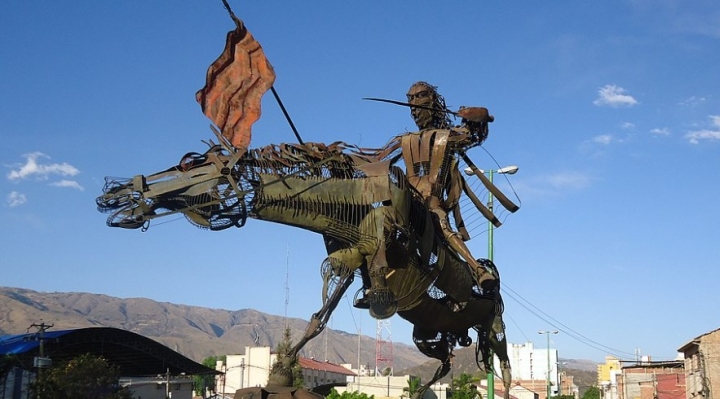
Sculpture representing Alejo Calatayud/Wikicommons
Despite being on the brink of celebrating the 200th anniversary of the proclamation of the independence of Upper Peru, now the Republic of Bolivia, historians continue to delve into the causes that led the inhabitants of the former Audiencia of Charcas to wait 16 years from the establishment of the Juntas of Chuquisaca and La Paz until the signing of the Act of Independence on August 6, 1825. During this period, various uprisings occurred in the main cities of the Audiencia, the creation of small republics, the arrival of three auxiliary armies from the United Provinces of the Río de la Plata, the bloody repressions by the metropolis’ envoys, and the first failed libertarian attempt from the north by the Liberating Army of Gran Colombia, led by Andrés Santa Cruz. Ultimately, the turning point came with the entry of the victorious army into La Paz after the Battle of Ayacucho.
Certainly, these were 16 years of uncertainty for the men and women living in this territory, marked by moments of struggle, anxiety, and tense calm, before Antonio José de Sucre, advised by the Bolivian doctor Casimiro Olañeta – and against Bolívar’s wishes – issued the decree to call for the Assembly that would define Upper Peru’s future. But were the events leading up to these 16 years the sole reason for this seemingly prolonged wait?
Long before the events of 1809, the Audiencia of Charcas experienced a long series of uprisings by Creoles and mestizos, the first being that of craftsman Alejo Calatayud in 1730, right in the heart of Upper Peru, in Cochabamba. These uprisings have been analyzed by various historians, and the question remains whether they truly influenced the early stages of the libertarian struggle of the early 19th century, or whether they were isolated events, reactions to immediate causes.
Notable researchers have tried to answer this question, reaching a common conclusion that there is no direct continuity between the revolts of the 18th century and the struggle that ultimately ended Spanish colonialism in this region of the world. Gustavo Rodríguez Ostria, in his excellent work “Die Killing, Power, War, and Insurrection in Cochabamba, 1781-1812” reminds us that “Aguirre, Viscarra, and later, in the early 20th century, José Macedonio Urquidi, as contemporary historians, made Calatayud into a proto-martyr and an early predecessor of the Independence struggle; creating a solid foundation for regional pride. Was it really the case?”
Drawing on Patricia Cazier’s doctoral thesis (“Rebellion and the Census of the Province of Cochabamba”), which argues that Calatayud and his mestizo followers were merely trying to preserve privileges granted by the Spanish crown, and that their actions never sought to end the colonial system, Rodríguez concludes: “While the 1730 revolt, which was short-lived, did impact the power structures at the time, they didn’t see it as a long-term threat or a sign of a historical subject to fear or revere. It’s notable that during the 1810-1812 insurrection, the figure of Calatayud was never evoked in any of these scenarios. His name simply wasn’t raised.”
Similarly, Charles Arnade (“The dramatic insurgence of Bolivia”) is clear in stating that the rebellions of 1730 in Cochabamba, 1739 in Oruro, 1780 in Cuzco, 1781 in La Paz, and a hundred smaller uprisings did not influence the doctors of Charcas, who, buoyed by favorable news from the metropolis – the Napoleonic invasion, the deposition of Charles IV, the captivity of Ferdinand VII, and the establishment of the Junta of Seville – launched the first cry for liberty in Upper Peru. Arnade states, “At that time, the Spanish regime in Charcas was respected and the king, loved. The entire people fought against the indigenous rebellion at the end of the century, and united, all of Charcas’ people were prepared to help repel the indigenous forces if they had been victorious in Buenos Aires.”
But was it true that the figures later known as the proto-martyrs of independence ignored or dismissed these earlier events and, so to speak, “started from scratch” in their revolt? Perhaps the following will help answer that question.
A few years ago, I came across the existence of a unique figure, the Jesuit Juan Pablo Viscardo y Guzmán, who may have acted as a bridge between the 18th-century rebels and the doctors of Chuquisaca. Unjustly forgotten by our chroniclers, he was resurrected in memory by the Englishman David A. Brading, in his magnificent and meticulous “Indian World, from the Catholic Monarchy to the Creole Republic, 1492-1867” reminding us that the Peruvian priest wrote a letter – published just before his death in 1798 – in London, where he had lived since 1781, in a vain attempt to persuade the British government to conquer the Pacific coast of the Americas. His “Letter Addressed to the American Spaniards” is groundbreaking, as “For the first time, a Creole urged his compatriots to rebel against the Spanish Crown and gain their freedom.”
Rejecting the claims of his Italian Order brothers about a supposed “generosity of spirit” among the Spanish residents in the Americas, Viscardo reviewed, through the thoughts of Montesquieu and Thomas Paine, the disturbances in Cuzco in 1780, noting that “They had been preceded by uprisings in Cochabamba in 1730 and Quito in 1764, when mestizos revolted against the Spanish Europeans; these movements were suppressed thanks to the intervention of the clergy and landowning Creoles.” Additionally, the priest made another invaluable contribution to inciting rebellion among his fellow countrymen by asserting that the reign of Charles III marked a turning point in the relationship between the metropolis and its colonies. From this analysis, Brading concludes that “We find here an invaluable testimony that the Bourbon reconquest of America, initiated by Charles III and his ministers, alienated the Creole elite, which ultimately led to their participation in the independence movements.”
Viscardo’s letter reached Venezuelan patriot Francisco de Miranda through U.S. consul Rufus King in London, bringing it to America and distributing it in key intellectual centers. By 1807, it was avidly read at the Universidad San Francisco Javier, thanks to copies made by Mariano Moreno, the Buenos Aires lawyer who, after visiting Potosí in 1802 and witnessing the dire conditions of the mita, became a defender of indigenous rights. It could not have found a more fertile ground, and surely served as a basis for the libertarian thinking of the doctors who formed the first Juntas of Chuquisaca and Buenos Aires.
Given these historical precedents, understanding the 16 years of struggle requires looking back at least to Viscardo’s proclamation, whose reasons for writing his letter were based, among other considerations, on the Cochabamba uprising of 1730, marking the beginning of the long and winding libertarian birth that only culminated on August 6, 1825.
Raúl Rivero is an economist and writer.
Por Raúl Rivero,, Brújula Digital:
Escultura que representa a Alejo Calatayud/Wikicommons
A pesar de estar a las puertas de la celebración de los 200 años de la proclamación de la independencia del Alto Perú, hoy República de Bolivia, los historiadores no cesan en sus disquisiciones respecto a las causas que obligaron a los habitantes de la antigua Audiencia de Charcas a esperar 16 años desde la constitución de las Juntas de Chuquisaca y La Paz, hasta la firma del Acta de Independencia, el 6 de agosto de 1825, período en que se sucedieron diversos alzamientos en las principales ciudades de la Audiencia; la creación de republiquetas; la llegada de tres ejércitos auxiliares de las Provincias Unidas del Río de la Plata; las sangrientas represiones de los enviados de la metrópoli y el primer frustrado intento libertario desde el norte, por parte del Ejército Libertador de la Gran Colombia, al mando de Andrés Santa Cruz. Al fin el punto de inflexión definitiva fue la entrada a La Paz del ejército victorioso en Ayacucho.
Ciertamente, fueron 16 años de incertidumbre para los hombres y mujeres que habitaban este territorio, en los que se intercalaron momentos de lucha, de zozobra y de tensa calma, antes de que Antonio José de Sucre, aconsejado por el doctor altoperuano Casimiro Olañeta –y contra los deseos de Bolívar–, emita el decreto de convocatoria a la Asamblea que definiría el futuro del Alto Perú. Pero, ¿fueron solamente los sucesos apenas previos a esos 16 años a los que debemos remitirnos para encontrar la respuesta a tan, aparentemente, larga espera?
Mucho antes de los acontecimientos de 1809, la Audiencia de Charcas mostraba una larga y numerosa sucesión de levantamientos de criollos y mestizos –siendo el primero el del artesano Alejo Calatayud en 1730, precisamente en el corazón del Alto Perú, Cochabamba–, los que han sido analizados por diversos historiadores, quedando abierta hasta hoy la incógnita si realmente tuvieron directa influencia en los prolegómenos de la lucha libertaria del segundo decenio del siglo XIX o, en cambio, se trataron de hechos aislados, devenidos como respuestas violentas a razones del momento.
Connotados investigadores se preocuparon de responder dicha incógnita, llegando a la coincidente opinión de no existir un hilo de continuidad entre las revueltas del siglo XVIII y la lucha que en el siguiente siglo dio fin con el colonialismo español en esta parte del mundo. Gustavo Rodríguez Ostria, en su excelente “Morir matando, poder, guerra e insurrección en Cochabamba, 1781-1812”, nos recuerda que “Aguirre, Viscarra, y algo más tarde, albores del siglo XX, José Macedonio Urquidi, como historiadores contemporáneos, hicieron de Calatayud un protomártir y una posta adelantada de la carrera de la Independencia; constituyendo un sólido antecedente para el orgullo regional. ¿Lo fue realmente?”.
Apoyándose en la tesis doctoral de Patricia Cazier (“Rebellion and the Census of the Provincie of Cochabamba”) que afirma que Calatayud y sus huestes mestizas sólo buscaron con su levantamiento preservar los privilegios otorgados por el soberano español y que en ningún momento sus propuestas buscaban la salida del sistema colonial, Rodríguez concluye: “Si bien la revuelta de 1730, que pasó como una ráfaga caliente, impactó en la coyuntura a los grupos de poder, no vieron en ella en el largo plazo una amenaza ni el despertar de un sujeto histórico, que había que temer o venerar. Es sugestivo que durante la insurrección de 1810 a 1812 (…) la figura de Calatayud no fuera evocada en ninguna de estas posibilidades. Simplemente no se levantará su nombre”.
Igualmente, Charles Arnade (“La dramática insurgencia de Bolivia”) es enfático al afirmar que las rebeliones de 1730 en Cochabamba, 1739, en Oruro; 1780, en Cuzco; 1781, en La Paz, y una centena más de pequeñas revueltas y algaradas, no influyeron en los doctores de Charcas, que, aprovechando las auspiciosas noticias que llegaban de la metrópoli –la invasión napoleónica, la deposición de Carlos IV, el cautiverio de Fernando VII y la constitución de la Junta de Sevilla–, lanzaron el primer grito libertario en el Alto Perú. Arnade afirma que, en ese momento “El régimen español en Charcas era respetado y el rey, amado. Unido, todo el pueblo luchó contra la rebelión indígena al final del siglo; y unido, todo el pueblo de Charcas se mantuvo preparado para ayudar a repeler a los indígenas en caso de que éstos hubieran sido victoriosos en el área de Buenos Aires”.
Pero, ¿fue cierto que los luego conocidos como protomártires de la independencia ignoraron o desdeñaron esos antecedentes y, por decirlo de algún modo, “comenzaron de cero” su alzamiento? Tal vez lo que viene a continuación, ayude a encontrar la respuesta.
Hace pocos años tomé conocimiento de la existencia de un singular personaje, el jesuita Juan Pablo Viscardo y Guzmán, quien habría actuado de puente entre los rebeldes del siglo XVIII y los doctores de Chuquisaca. Injustamente olvidado por nuestros cronistas, ha sido rescatado para la memoria por el inglés David A. Brading, en su magnífico y meticuloso “Orbe indiano, de la Monarquía Católica a la República Criolla, 1492-1867”, recordando que el sacerdote peruano escribió una carta –publicada recién poco antes de fallecer en 1798–, en Londres, donde residía desde 1781, tratando vanamente de convencer al gobierno británico que conquistara la costa del Pacífico americano. Su “Carta Dirigida a los Españoles Americanos”, es pionera puesto que “Por primera vez un criollo exhortaba a sus compatriotas a rebelarse contra la Corona española y alcanzar su libertad”.
Rechazando las afirmaciones de sus hermanos de Orden italianos sobre una supuesta “generosidad de ánimo” de los españoles residentes en América, Viscardo se ocupa de revisar, a la luz del pensamiento de Montesquieu y Tomas Paine, los disturbios en Cuzco de 1780, observando que “Habían sido precedidos por levantamientos en Cochabamba en 1730 y en Quito en 1764, cuando los mestizos se amotinaron contra los españoles europeos; estos movimientos fueron sofocados gracias a la intervención del clero y de los terratenientes criollos”. Además, el sacerdote hace otro inapreciable aporte para incitar a la rebelión de sus connacionales, al aseverar que el reinado de Carlos III marcaba un giro en las relaciones de la metrópoli con sus colonias. De este análisis, Brading concluye que “Encontramos aquí un inapreciable testimonio de que la reconquista borbónica de América, iniciada por Carlos III y sus ministros, enajenó a la élite criolla, provocando a la postre su participación en los movimientos de independencia”.
La Carta de Viscardo llegó a manos del patriota venezolano Francisco de Miranda, a través del cónsul de Estados Unidos en Londres, Rufus King, trayéndola a América y distribuyéndola en sus principales centros de pensamiento. Así, en 1807 era leída ávidamente en la Universidad San Francisco Javier, gracias a las copias sacadas por Mariano Moreno, el abogado bonaerense que, desde su viaje a Potosí en 1802, donde conoció las terribles condiciones del mitaje, devino en defensor del indígena. No podía caer en territorio más fértil y, con seguridad, sirvió de base al pensamiento libertario de los doctores que formaron las primeras Juntas de Chuquisaca y Buenos Aires.
Dados esos antecedentes, para entender el porqué de 16 años de lucha habrá que retroceder al menos hasta la proclama de Viscardo, cuyas razones para su Carta se apoyan, entre otras consideraciones, en el levantamiento cochabambino de 1730, inicio del largo y sinuoso parto libertario, que recién culmina el 6 de agosto en 1825.
Raúl Rivero es economista y escritor.

 Bolivian Thoughts | Pensamientos Bolivianos (Bilingual/Bilingüe)